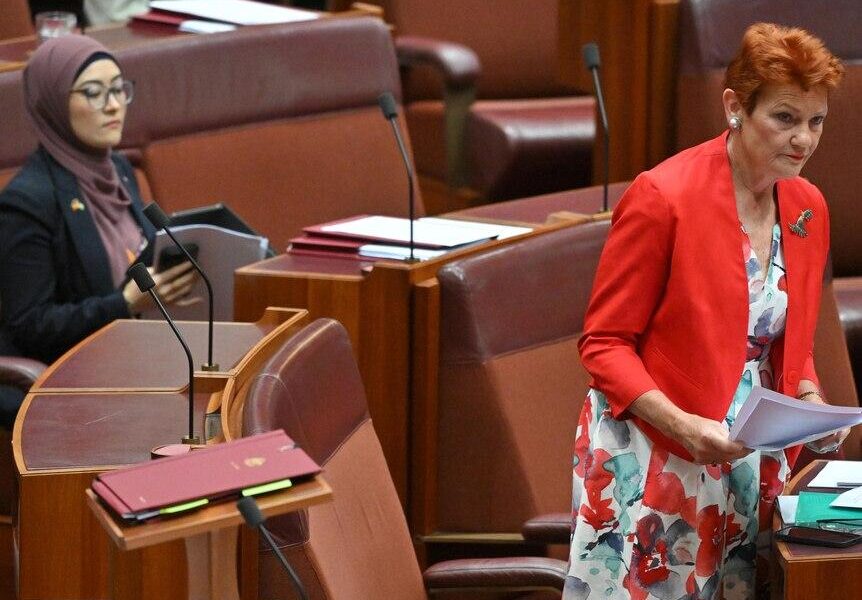

“Get Out If You Hate It So Much” — The Viral Claim That Put Pauline Hanson and Fatima Payman Back in the Spotlight
A viral social-media post attributes a blunt parliamentary rebuke to Senator Pauline Hanson during an exchange with independent Senator Fatima Payman. But behind the online rhetoric lies a more complex reality: a turbulent political rivalry that recently gave way to an unexpected parliamentary alliance.
Australian politics has once again produced one of those moments that quickly escapes the walls of Parliament and becomes a nationwide conversation.
A viral post circulating online claims that Senator Pauline Hanson delivered the blunt line, “Get out if you hate it so much,” during a tense Senate exchange involving independent Senator Fatima Payman. The wording has generated strong reactions across social media, with supporters interpreting it as a forceful statement about national loyalty and critics viewing it as an escalation of partisan friction.
However, there is an important distinction between the viral version of the story and what can be independently verified.
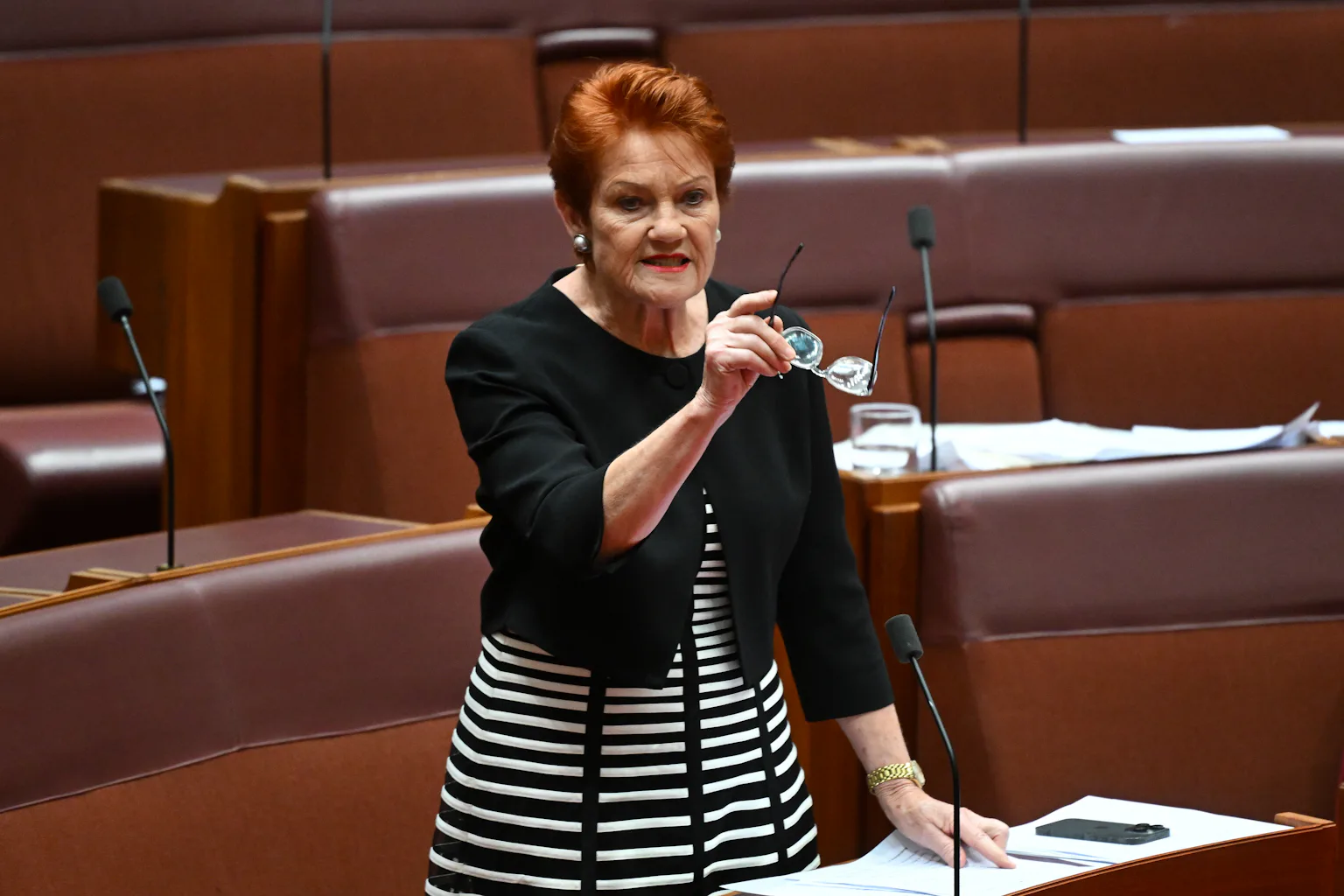
No reliable parliamentary transcript or major Australian news report confirms that exact sentence as a recent Hanson remark to Payman. Consequently, the quotation should be treated as an unverified claim rather than established fact.
Yet the reason the story resonates with many Australians is simple: Hanson and Payman have already shared some of the most confrontational exchanges seen in federal Parliament in recent years.
A History of Legislative Clash and Confrontation
The political relationship between Hanson and Payman has been notably turbulent since 2024.
The friction intensified when Hanson questioned whether Payman was eligible to sit in Parliament, raising concerns surrounding her Afghan citizenship and Section 44 of the Australian Constitution. The dispute quickly escalated into one of the most dramatic Senate clashes of that parliamentary term.
Payman responded angrily, accusing Hanson of making racist and personal attacks. The confrontation grew so heated that independent senator Lidia Thorpe left the chamber after throwing documents in Hanson’s direction, prompting the Senate President to warn that physically threatening behavior would not be tolerated.
While Hanson maintained that Payman’s citizenship status warranted formal parliamentary scrutiny, Payman countered that the Australian Labor Party had already thoroughly examined the issue before endorsing her candidacy for the 2022 federal election. Hanson’s subsequent motion to refer Payman to a parliamentary committee was ultimately defeated by Labor and the Greens.
That documented history ensures that any interaction between the two senators immediately draws intense public scrutiny.
From Senate Rivals to Unlikely Parliamentary Allies
Despite their history of sharp disagreements, Hanson and Payman recently appeared side-by-side alongside independent MP Dai Le to campaign for a shared goal: comprehensive reform of parliamentary staffing arrangements.
The crossbench politicians argued that minor-party and independent parliamentarians lack the baseline staffing resources allocated to major parties. This disparity directly affects a politician’s capacity to research complex legislation, communicate with constituents, and fulfill core duties.
The political pairing was striking. Hanson leads the nationalist One Nation party, while Payman sits on the crossbench after resigning from Labor. Their ideological divides on migration, identity, and foreign policy are deep and well-documented. Yet on the issue of institutional resources, they presented a united front.
Payman asserted that elected representatives must be capable of putting ideological differences aside when pursuing a common administrative cause. Hanson similarly emphasized that the campaign centered purely on structural equity rather than past disputes.
The Staffing Disparity Debate
The battle over parliamentary resources touches on a fundamental question of how effectively independent and minor-party politicians can operate within Westminster systems.
Recent modeling indicated significant imbalances in resource distribution, with minor-party offices operating on significantly lower staffing ratios compared to major parties, and some crossbenchers receiving minimal or no personal staff allocation. The trio called for greater transparency and an independent framework for determining staffing allocations across federal parliament.

While the federal government has faced persistent pressure from the crossbench over the current system, the development highlights how quickly political adversaries can find common ground on institutional mechanics.
Why Pauline Hanson and Fatima Payman Remain Focal Points
The enduring public interest in both politicians stems from their distinct trajectories in Australian public life.
Pauline Hanson has spent decades as a prominent and polarizing figure, campaigning aggressively on immigration, national identity, and multiculturalism. Her interventions regularly challenge mainstream political consensus. In 2025, she faced a Senate censure and suspension after wearing a burqa during a protest over full-face coverings, sparking heated national debates over freedom of expression and parliamentary standards.
Fatima Payman, meanwhile, charted a unique path by transitioning from a Labor senator to an independent following sharp disagreements with the government’s foreign policy positions. Her frequent clashes with Hanson reflect two entirely different political constituencies colliding within the federal legislature.
Separating Fact From Viral Fiction
For news consumers navigating politically charged online content, the safest approach is to separate documented events from unverified claims.
Hanson and Payman possess a recorded history of bitter parliamentary clashes, contrasted by a documented instance of pragmatic cooperation on parliamentary resources. However, the exact “Get Out If You Hate It So Much” quotation lacks verification through official parliamentary records or credible journalistic reports.
As online narratives continue to amplify brief, sensationalized snippets, the broader reality remains compelling enough: two prominent Australian politicians, once fiercely opposed across the Senate floor, continue to shape the national debate through both intense confrontation and unexpected cooperation.
How do you think independent and minor-party politicians should be resourced to compete fairly with major political parties in Parliament?