
The Five Minds of Melbourne: What the 1901 Flag Contest Really Revealed About Australia’s Unfinished Identity
The Great Exhibition of a New Continent
On the afternoon of September 3, 1901, the spring air inside Melbourne’s cavernous Royal Exhibition Building carried the sharp scent of damp wool, printer’s ink, and industrial varnish. Beneath the grand timber arches of the Great Hall—which months earlier had hosted the opening of the first Commonwealth Parliament—more than 32,000 designs were pinned, strung, and mounted across miles of wooden partitions.
It remains one of the largest public participatory design competitions ever mounted in the Western world.
The Commonwealth of Australia had drawn its first breath on New Year’s Day, 1901, when six self-governing British colonies—New South Wales, Victoria, Queensland, South Australia, Western Australia, and Tasmania—federated into a single sovereign dominion. Yet the new nation lacked an emblem. In April 1901, Prime Minister Edmund Barton’s government, coordinating with the Melbourne journal The Review of Reviews, launched a worldwide competition offering a combined prize pool of £200—equivalent to several years’ wages for an ordinary working laborer.
The postal service was swamped with 32,823 entries. Submissions arrived from outback sheep stations, London clerk desks, goldfield shanties, and colonial shipping offices. Some sketches featured kangaroos charging across green silk; others proposed intricate combinations of boomerangs, wattle sprays, British heraldic lions, and the Southern Cross.
When the seven-man judging panel concluded its review, they reached an unexpected impasse. Rather than crowning a solitary visionary, the judges discovered that five separate entrants, working in total isolation across thousands of miles of ocean and continent, had independently submitted nearly identical conceptual sketches.
The £200 purse was divided equally into £40 purses, and five names were permanently written into the Commonwealth gazetteers:
┌────────────────────────────────────────────────────────────────────────┐
│               THE FIVE JOINT DESIGNERS OF THE 1901 FLAG                │
├───────────────────────┬──────────────────┬─────────────────────────────┤
│ Name                  │ Age / Origin     │ Vocation / Background       │
├───────────────────────┼──────────────────┼─────────────────────────────┤
│ Ivor Evans            │ 14 | Melbourne   │ Schoolboy (son of flagmaker)│
│ Leslie John Hawkins   │ 18 | Sydney      │ Optician's apprentice       │
│ Egbert John Nuttall   │ 35 | Melbourne   │ Practicing architect        │
│ Annie Dorrington      │ 35 | Perth       │ Botanical painter & artist  │
│ William Stevens       │ 35 | Auckland    │ Merchant marine 1st officer │
└───────────────────────┴──────────────────┴─────────────────────────────┘
The winners reflected an unexpected cross-section of early Edwardian society:
-
Ivor Evans, a 14-year-old student at Melbourne Grammar School, whose father ran an established commercial flag-making enterprise in the city.
-
Leslie John Hawkins, an 18-year-old optician’s apprentice from suburban Leichhardt in Sydney.
-
Egbert John Nuttall, an established architect from the Melbourne enclave of Prahran.
-
Annie Dorrington, a 35-year-old botanical illustrator and oil painter living in Perth, who achieved victory at a historical juncture when women were almost entirely locked out of Commonwealth public administration.
-
William Stevens, a first officer serving aboard the Union Steam Ship Company of New Zealand, operating out of Auckland—a vivid reminder that New Zealand had been actively courted to join the Australian federation and remained explicitly named in the preamble of the Commonwealth Constitution.
At 2:30 p.m. that afternoon, Countess Hopetoun, wife of the Governor-General, pulled a ceremonial halyard above the dome of the Exhibition Building. A giant blue ensign, measuring 36 feet by 18 feet, unfurled in the wind, greeted by a 21-gun artillery salute from the Royal Australian Artillery and a choir singing the newly commissioned federal anthem.
Anatomy of an Evolving Emblem
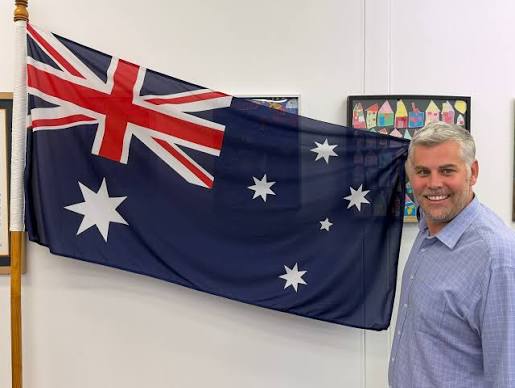
The standard raised on that September afternoon was fundamentally recognizable, but it was not identical to the flag that flies from Parliament House today. It was anchored by three primary visual pillars, each bearing distinct constitutional and historical mandates:
-
The Union Jack: Situated in the upper hoist (canton), occupying one-quarter of the flag’s visual field, reflecting Australia’s direct constitutional origins as a self-governing dominion of the British Empire.
-
The Commonwealth Star (Federation Star): Positioned immediately below the Union Jack. In the original 1901 design, this large white star featured six points, representing the six founding colonial states that formed the Commonwealth.
-
The Southern Cross (Crux): Occupying the fly on a dark blue field. In the 1901 rendering, the constellation mirrored the night sky with literal astronomical fidelity: the stars—Alpha, Beta, Gamma, Delta, and Epsilon Crucis—featured varying numbers of points (ranging from nine to five points) to represent their differing magnitudes of visual brightness.
┌────────────────────────────────────────────────────────────────────────┐
│               THE EVOLUTION: 1901 TO THE FLAGS ACT 1953                │
├───────────────────────┬──────────────────┬─────────────────────────────┤
│ Feature               │ 1901 Original    │ Standardized Modern Flag    │
├───────────────────────┼──────────────────┼─────────────────────────────┤
│ Commonwealth Star     │ 6 points (States)│ 7 points (+ Territories)    │
│ Alpha / Beta Crucis   │ 9 points each    │ 7 points each               │
│ Gamma Crucis          │ 8 points         │ 7 points                    │
│ Delta Crucis          │ 7 points         │ 7 points                    │
│ Epsilon Crucis        │ 5 points         │ 5 points (unchanged)        │
│ Legal Foundation      │ Gazette Notice   │ Flags Act 1953 (Statutory)  │
│ Primary Civil Use     │ Red Ensign       │ Blue Ensign                 │
└───────────────────────┴──────────────────┴─────────────────────────────┘
The design underwent two critical institutional transformations.
First, in 1903, King Edward VII granted imperial approval to the design, initiating a cleanup of the Southern Cross. The constellation’s primary stars were simplified to an identical, uniform seven-pointed template for ease of industrial manufacturing, leaving only the faintest star, Epsilon, with five points.
Second, in 1908, the Commonwealth acquired the territory of Papua. To recognize this external territory, as well as the anticipated establishment of a federal capital territory, the government added a seventh point to the Commonwealth Star.
Crucially, for the first half of the twentieth century, the blue flag was strictly a state and military banner; Australian citizens on land almost universally flew the Australian Red Ensign. It was not until Prime Minister Robert Menzies drafted and passed the Flags Act 1953 that the Blue Ensign officially superseded the Red to become the sovereign, statutory National Flag of the Australian people.
2. Professional Analysis & Personal Perspective
My Professional Perspective
I have spent thirty years reporting on the ideological battlegrounds of the Anglo-Pacific world. I have stood under the Union Jack in Belfast, the Stars and Stripes in post-9/11 Washington, and the Southern Cross from the docks of Darwin to the suburbs of Sydney. If there is one lesson three decades of political anthropology teaches you, it is this: national symbols do not emerge from divine inspiration or aesthetic innocence. They are bureaucratic compromises frozen in thread.
When the modern Australian press retells the story of the 1901 flag competition, it is invariably served up as a cozy piece of heritage confectionery. We are invited to marvel at the democratic charm of it all: a fourteen-year-old schoolboy, a woman artist from Perth, an apprentice, an architect, and a Kiwi mariner, all spontaneously dreaming up the same patriotic sketch like an Edwardian fairy tale.
It is a comforting, sentimental myth. But it systematically obscures the calculated political machinery that engineered the outcome.
To understand why the Australian flag looks the way it does—and why it remains the most contested piece of cloth in the Southern Hemisphere—we must examine the deep structural reality of 1901 that polite anniversary features deliberately overlook.
THE REALITY CHASM: THE POPULAR MYTH VS. THE HISTORICAL MACHINE

         THE CIVIC MYTH                        THE STRATEGIC REALITY
┌───────────────────────────────┐       ┌───────────────────────────────┐
│ • Blank-canvas democracy      │       │ • Heavily rigged parameters   │
│ • Spontaneous public consensus│  VS.  │ • Colonial Office imperatives │
│ • Pure aesthetic convergence  │       │ • Mandatory imperial canton   │
│ • Celebrated national unity   │       │ • Exclusion of Indigenous text│
└───────────────────────────────┘       └───────────────────────────────┘
1. The Pre-Cooked Canvas: The Illusion of Blank-Slate Democracy
The competition was marketed as an open, blank-slate invitation to imagine a nation. In reality, the contest was strictly fenced by imperial geopolitical necessity.
By 1901, the British Empire’s Admiralty had enforced rigid maritime vexillology for more than three decades under the Colonial Naval Defence Act 1865. Every colonial dependency, dominion, and naval territory was structurally required to base its maritime identification on the British Blue or Red Ensign: the Union Jack in the canton, with the badge of the colony pinned to the fly.
Furthermore, the competition’s judging panel was dominated not by painters or visionaries, but by British naval officers, colonial heraldists, and political imperialists. The instructions were unmistakable: any design that failed to give visual primacy to the mother country had zero chance of selection.
The fact that five separate entrants submitted the same design was not a supernatural cosmic alignment; it was an exercise in compliance.
Every entrant with basic literacy understood the formula:
-
Keep the Union Jack in the corner to appease the Crown and the Admiralty.
-
Drop the Southern Cross into the fly because it had been the accepted regional shorthand since the 1851 Anti-Transportation League and the 1854 Eureka Stockade.
-
Stick a star underneath to represent the federal colonial union.
The judges did not discover five creative geniuses. They discovered five capable applicants who correctly solved an ideological equation predetermined by Whitehall.
                 THE ADMIRALTY'S VEXILLOLOGICAL ALGORITHM

    ┌────────────────────────────────────────────────────────┐
    │       MANDATORY IMPERIAL CANTON (COLONIAL ACT 1865)    │
    │  • Union Jack must occupy the upper hoist quarter      │
    │  • Sovereign allegiance non-negotiable to Whitehall    │
    └───────────────────────────┬────────────────────────────┘
                                │
                                ▼
    ┌────────────────────────────────────────────────────────┐
    │          REGIONAL ASTRONOMICAL IDENTIFIER (FLY)        │
    │  • Southern Cross constellation (historic shorthand)   │
    │  • Signals geographic hemisphere to global shipping    │
    └───────────────────────────┬────────────────────────────┘
                                │
                                ▼
    ┌────────────────────────────────────────────────────────┐
    │            CONSTITUTIONAL COMPOSITE (BOTTOM)           │
    │  • Commonwealth Star: 6 points for the 6 colonies      │
    │  • Structural federalism translated into geometry      │
    └────────────────────────────────────────────────────────┘
2. The Great Erasure: The Void Beneath the Stars
What makes the 1901 competition so poignant—and so searingly controversial in contemporary Australia—is not what was painted on those 32,000 sheets of paper, but what was systematically erased.
The Commonwealth of Australia was founded on the legal fiction of terra nullius—the doctrine that this continent was unowned, uninhabited in the sovereign sense, prior to the arrival of the First Fleet. The competition was held in the shadow of the inaugural Commonwealth Parliament, whose very first legislative priority was the passage of the Immigration Restriction Act 1901, the cornerstone of the White Australia policy.
In all 32,823 entries, and across the deliberation records of the judging committee, there is no institutional trace of the oldest continuous living cultures on earth. The Indigenous peoples whose ancestors had charted the Southern Cross for 65,000 years—who saw in those exact same stars the celestial footprint of the Wedge-tailed Eagle (Bunjil) or the celestial emu (Gugurmin)—were wholly excluded from the symbolic birth of the Commonwealth.
The flag was engineered specifically to project an unyielding, homogenous outpost of the Anglo-Saxon diaspora in the South Pacific. When modern Australians view the flag, its crisis of legitimacy does not stem from its colors or geometry, but from the deliberate historical amnesia woven into its fiber.
3. The Unanswered Questions
As the 125-year milestone is marked across the nation, several operational and political questions remain unanswered by our civic institutions:
-
Why did the civilian population reject the Blue Ensign for fifty years? Modern flag defenders often speak as if the current national standard has been waved by citizens continuously since 1901. In reality, ordinary Australians overwhelmingly chose the Red Ensign until Robert Menzies used parliamentary force to restrict the red standard to maritime shipping in 1953. Why has that half-century of popular civilian preference for the red banner been excised from the modern national narrative?
-
Why does the New Zealand connection remain an institutional footnote? William Stevens’s status as a winning co-designer is an awkward reminder of the great forgotten path of Federation: New Zealand was an active participant in the constitutional drafting conventions of the 1890s. Australia’s flag was literally co-designed by a mariner living in Auckland. What does it say about our regional historical literacy that this foundational trans-Tasman connection has been reduced to a trivia answer?
-
What is the true cost of dual-symbolism? Australia today exists in a permanent dual-flag reality. At every major sporting event, civic ceremony, school assembly, and ministerial press conference, the Australian National Flag stands flanked by the Australian Aboriginal Flag and the Torres Strait Islander Flag. Can an unresolved nation indefinitely project two fundamentally competing narratives of origin without eventually reconciling the stone and the cloth?
The standard hoisted above the Royal Exhibition Building on that spring afternoon 125 years ago was a testament to its era. It captured a fledgling dominion attempting to reconcile its British cradle with its Pacific coordinate, negotiating its colonial debts while looking out into an uncertain twentieth century.
The five ordinary individuals whose hands sketched that geometry deserve their place in the national record. Ivor Evans, Leslie Hawkins, Egbert Nuttall, Annie Dorrington, and William Stevens did not seek to engineer a centuries-long identity war; they answered a call to imagine their world using the only visual language they were permitted to speak.
Yet the measure of a nation’s maturity is its ability to outgrow the childhood portraits of its founding.
A flag is not a sacred artifact handed down from heaven; it is a human document. It is a canvas on which a people project their shared values, their collective grief, and their aspirations for the future. When that canvas is held captive by an insistence on imperial deference, it ceases to be an emblem of unity and becomes a historical fence line dividing citizen from citizen.
As the anniversary winds ripple through the Southern Cross today, the question facing twenty-first-century Australia is no longer who drew the lines in 1901:
Can a mature, confident democracy continue to look toward its future through a window framed by the empire of its past?