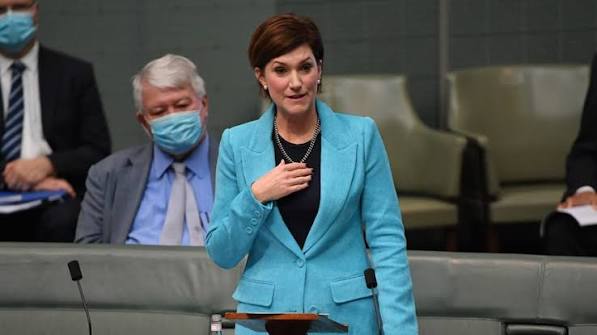

Former MP Nicolle Flint Calls for Prime Minister Anthony Albanese to Resign Over Bondi Attack Response
Former Liberal MP Nicolle Flint has demanded the resignation of Prime Minister Anthony Albanese, arguing that the government failed to demonstrate adequate leadership following the December 2025 Bondi Beach antisemitic terrorist attack.
The political fallout from the Bondi Beach terrorist attack continues to reverberate through Canberra, with former Liberal MP Nicolle Flint launching a direct call for Prime Minister Anthony Albanese to step down.

Speaking during a television interview on Sky News, Flint argued that the Prime Minister had failed to show the level of leadership required in the wake of the national tragedy. Her demand has intensified a broader, highly polarized debate over political accountability, national security, and the rising tide of antisemitism in Australia.
While government defenders point to subsequent policy overhauls, royal commission investigations, and strengthened counter-terrorism measures, critics argue that questions regarding pre-attack warning signs and ministerial responsibility remain unanswered.
The Tragedy That Shook the Nation
The Bondi Beach attack on December 14, 2025, remains one of the darkest moments in recent Australian history. Fifteen people were killed and dozens more were injured when gunmen targeted a Hanukkah gathering in what Australian authorities formally classified as an antisemitic terrorist atrocity.
The massacre instantly thrust national security, social cohesion, and firearms regulations to the forefront of the political agenda.
In response, the Albanese government convened a National Cabinet meeting the following day. Officials pledged to implement stricter measures against hate speech and terrorism while initiating comprehensive reforms to Australia’s legislative and regulatory frameworks.
Yet, for political figures like Flint, the central question extends beyond the immediate emergency response. Critics have repeatedly demanded answers regarding whether law enforcement and intelligence agencies had access to adequate warning signs prior to the bloodshed.
Flint’s Demand and the Broader Accountability Debate
Flint’s demand that Albanese “must go” represents one of the most severe personal attacks on the Prime Minister’s leadership since the tragedy occurred.

Her intervention encapsulates a central fault line in contemporary Australian politics: when a major security failure happens, where does ultimate responsibility lie?
Opposition voices maintain that political leaders must bear accountability for the broader environment surrounding extremism and security preparedness. Government supporters, conversely, argue that operational security is managed by independent intelligence agencies and police forces, making political scapegoating unhelpful during a national crisis.
Amid these clashing perspectives, the Albanese administration announced a formal Royal Commission on Antisemitism and Social Cohesion in January 2026. Tasked with examining the specific circumstances surrounding the Bondi attack, the commission was also given a mandate to evaluate law enforcement, border controls, immigration management, and intelligence-sharing capabilities.
What the Royal Commission Interim Report Found
A crucial turning point in the political debate arrived in April 2026 with the release of the Royal Commission’s interim report.
Led by Commissioner Virginia Bell, the interim findings indicated that existing legal and regulatory frameworks had not fundamentally prevented security agencies from responding to the threat, noting that no immediate legislative action was required on that specific front. At the same time, the commissioner issued 14 targeted recommendations aimed at upgrading Australia’s counter-terrorism capabilities.
Legal experts note that while political figures remain free to voice opinions and demand resignations, such assertions should be carefully distinguished from formal findings established by independent judicial inquiries.
Firearms Reform and Policy Changes Move Forward
Away from political crossfire, the federal government has pressed ahead with substantial legislative adjustments.

In August 2026, the National Cabinet agreed to a heavily revised National Firearms Agreement. The updated framework introduces stricter licensing prerequisites, tighter controls on 3D-printed weapons, and enhanced intelligence-sharing mechanisms across state and federal jurisdictions. Additionally, a national gun buyback scheme was advanced as part of Canberra’s ongoing security response.
These policy shifts have generated their own political friction. While proponents argue the reforms are vital to plugging legislative gaps exposed by the Bondi massacre, skeptics question whether tighter firearms controls fully address the underlying drivers of targeted extremism.
What Happens Next?
The political battle over the Bondi attack is far from resolved.
While political figures like Flint continue to press the issue of leadership accountability, the official judicial process moves toward its conclusion. The federal government has requested that Commissioner Bell deliver the final report of the Royal Commission before December 14, 2026.
As Canberra awaits that final document, the overarching question remains: will the formal findings bridge the deep political divide, or will they simply ignite an even larger debate over Australia’s national security?
Do you think political leaders should be held directly accountable for security failures, or should scrutiny remain focused exclusively on law enforcement agencies?