The Invisible Border: How Breakfast Television, High Court Rulings, and the Ghosts of the Caliphate Collided in Australia. u1

The Invisible Border: How Breakfast Television, High Court Rulings, and the Ghosts of the Caliphate Collided in Australia
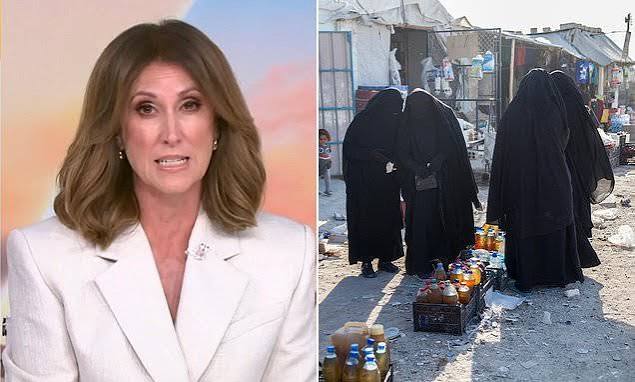
CANBERRA — Under the glare of television studio lights in Sydney’s Martin Place, the ritual of Australian morning television unfolded with its customary cadence. Commuters brewed coffee, traffic crawled across the Harbour Bridge, and on the set of the Seven Network’s flagship program Sunrise, anchor Natalie Barr leaned forward to press federal ministers on a dilemma that has haunted Western democracies for the better part of a decade.
The subject was not inflation, petrol excise, or regional rail funding. It was the unresolved human and legal wreckage of the self-declared Islamic State of Iraq and Syria (ISIS): the fate of Australian citizens held in the dust-choked prison camps of northeastern Syria and Iraqi detention centers, and the profound question of what happens when those citizens seek to return home.
In a succession of tense, forensic broadcasts featuring senior Cabinet figures—including Health Minister Mark Butler and Home Affairs Minister Tony Burke—alongside Deputy Opposition Leader Jane Hume, Barr confronted the federal government’s official stance. The ministers had repeated the Commonwealth’s established talking points: Australia would not mount state-funded repatriation flights to extract citizens who voluntarily abandoned their homeland to join a genocidal death cult. Yet, in the same breath, the government acknowledged that under domestic and international law, Australian citizens possessing valid identity and travel documentation could not be permanently banished from their country of birth.
“Yeah, but for weeks you’ve also said we can’t stop them,” Barr pointed out during one exchange. “By Australian law, we have to issue them with passports. We had to do the DNA. That was law… Mark, these are apparently ISIS fighters. If they’ve been involved in beheadings, will we let them back in? So we have to let them back?”
Within hours, that pointed, legitimate line of journalistic questioning was extracted, stripped of its legal and procedural nuance, and thrust into the high-velocity furnace of the digital attention economy. Sensationalized banners and social media accounts transformed a discussion about statutory constraints into an incendiary political slogan: “The Australian Government Is Protecting Terrorists.”
The Anatomy of a Political Firestorm
The phrase ricocheted across community message boards, talkback radio frequencies, and populist political circles. While federal officials strongly rejected the claim that the Commonwealth was offering shelter or quarter to violent extremists, the virality of the accusation revealed the scale of public anxiety and mistrust surrounding national security management.
The controversy did not materialize out of thin air. It gathered force against a backdrop of complex and legally fraught return operations:
-
The Damascus Airport Incident: Reports emerged indicating that four Australian women, widely characterized as “ISIS brides,” along with nine children, were intercepted at Damascus International Airport after being denied boarding. Syrian authorities claimed the passengers were halted because Canberra had refused to receive them, while Australian ministers insisted they were not coordinating with the Syrian regime and had simply refused to provide diplomatic travel assistance.
-
The Return of Repatriated Women: In separate developments, Australian Federal Police (AFP) counterterrorism squads met returning female citizens at Sydney and Melbourne airports, immediately executing arrest warrants and lodging severe criminal charges relating to foreign incursions, membership in terrorist entities, and alleged slavery offenses committed in Syria.
-
The Prospect of Returning Fighters: Security assessments began circulating through parliamentary committees warning that thirteen Australian men detained in Iraqi facilities could potentially seek repatriation or release, forcing Canberra to prepare for the return of trained combatants.
-
The Legislative Push: One Nation leader Pauline Hanson escalated the pressure by writing directly to Coalition leadership, demanding emergency bipartisan legislation to stretch counterterrorism powers—including citizenship stripping, preventive detention, and Temporary Exclusion Orders—to the absolute outer perimeter of the Australian Constitution.
The Anthony Albanese Labor government found itself trapped between two opposing forces. On one side stood a skeptical public and an aggressive parliamentary opposition demanding an ironclad guarantee that no individual associated with ISIS would ever walk a suburban street again. On the other stood the Australian Constitution, the High Court of Australia, and the fundamental tenets of common-law citizenship.
Federal ministers maintained that intelligence agencies like the Australian Security Intelligence Organisation (ASIO) and the AFP possess world-class surveillance frameworks capable of managing risks through Control Orders, electronic monitoring, and strict reporting mandates. Yet, as critics repeatedly emphasized, round-the-clock surveillance is an extraordinarily expensive, resource-draining enterprise that can never promise absolute immunity against radicalized intent.
2. Professional Analysis & Personal Perspective
My Professional Perspective
I have spent three decades reporting from the world’s conflict zones, intelligence hubs, and courtrooms—from the smoking perimeter of Ground Zero in New York to the desert checkpoints outside Mosul, and into the marble halls of the High Court in Canberra. Over those thirty years, I have learned a foundational rule of investigative reporting: whenever an emotional slogan like “the government is protecting terrorists” dominates the conversation, it is almost always deployed to obscure an institutional crisis that neither side of politics knows how to resolve.
The public is reacting to what feels like a visceral betrayal of national sovereignty. How could an Australian passport holder board a flight to Raqqa, live inside the brutal, slave-trading caliphate of Abu Bakr al-Baghdadi, and then—years after that nightmare collapsed—demand that the Australian taxpayer fund their monitoring, legal representation, and healthcare?
It sounds monstrous. It sounds like bureaucratic cowardice.
Yet behind the breathless headlines and the viral outrage lies a much deeper, darker reality that mainstream coverage consistently fails to explain to the public: Canberra is not protecting terrorists. Canberra is wrestling with the devastating collapse of its own legal shortcuts, while praying the Australian electorate doesn’t realize how limited the government’s executive powers actually are.
What Important Details Have People Overlooked?
To understand why ministers fumble their words when pressed by television interviewers like Natalie Barr, one must examine the legal battlefield that the average citizen never sees.
The public debate routinely treats citizenship as a gold-plated membership card that politicians can simply revoke at a press conference. For years, successive federal governments told voters exactly that. Beginning in 2015, the Coalition government—with bipartisan Labor support—passed aggressive amendments to the Australian Citizenship Act 2007, granting the Minister for Home Affairs the unilateral power to strip dual nationals of their Australian citizenship if they engaged in terrorism-related conduct overseas.
It was presented as an invincible shield. It assured suburban voters that extremists would simply be scrubbed from the national roll and abandoned to the sands of the Middle East.
What the public has largely overlooked is that the High Court of Australia systematically dismantled that entire framework.
In landmark decisions such as Alexander v Minister for Home Affairs (2022) and Benbrika v Minister for Home Affairs (2023), the highest court in the land ruled that the executive government does not possess the constitutional authority to unilaterally strip a citizen of their citizenship as a form of punishment. Under Chapter III of the Australian Constitution, the power to punish criminal conduct belongs exclusively to the judiciary—not to a politician sitting at a ministerial desk.
Furthermore, under the Passports Act 2005 and bedrock international treaties dating back to the 1961 Convention on the Reduction of Statelessness, a sovereign state cannot render a human being stateless. If a returnee possesses only Australian citizenship, Australia is their sole sovereign home.
When Natalie Barr asks, “So we have to let them back?” and a Cabinet minister pauses, that pause is not hesitation born of sympathy for ISIS. It is the cold, humiliating recognition of constitutional reality. A government can use Temporary Exclusion Orders (TEOs) to delay a returnee’s arrival for up to two years to allow intelligence agencies to assemble evidence and prepare arrest warrants, but it cannot legally build an invisible wall around the continent and lock its own citizens out forever.
The Forgotten Ground: The Syrian Kurdish Reality
There is another, even more significant dimension of this story that has been almost entirely scrubbed from the Western political narrative: the voices of those holding these prisoners.
For nearly a decade, the burden of warehousing Western jihadists and their families has been dumped on the Syrian Democratic Forces (SDF) and the Autonomous Administration of North and East Syria. These Kurdish-led fighters were the West’s most effective ground allies in the physical destruction of the caliphate. They sacrificed more than 11,000 of their own sons and daughters to liberate cities like Raqqa and Kobani.
Today, those same Kurdish forces are forced to divert scarce soldiers and resources to guard tens of thousands of foreign women and children inside squalid, open-air detention camps like al-Hawl and al-Roj.
I have spent time reviewing field reports from these camps. They are humanitarian catastrophes and security tinderboxes. Al-Hawl is not a conventional prison; it is a sprawling, tented city where hardcore ISIS ideologues continue to run clandestine sharia courts, carry out vigilante executions, and indoctrinate a generation of children growing up in the dirt.
For years, the Kurdish administration has begged Australia, Britain, France, and Canada to take back their citizens. Their message to Western capitals has been blunt: We are not your permanent off-the-books penal colony. We do not have the resources, the legal courts, or the prisons to hold your citizens while your politicians hold focus groups.
When Australian politicians brag that they will “offer no assistance” to help these families leave Syrian camps, they frame it as toughness. In truth, it is the height of international irresponsibility. It is an attempt to outsource our national security risk to an impoverished, war-torn militia in northern Syria that faces constant military bombardment from Turkey and insurgent attacks from ISIS sleeper cells.
If those camps collapse—if an earthquake, a major Turkish military offensive, or an armed prison break fractures the perimeter—these detainees do not disappear into the ether. They melt into the global underground.
From an intelligence perspective, leaving an Australian extremist unmonitored in an ungoverned war zone is infinitely more dangerous than bringing them through Kingsford Smith Airport in handcuffs, placing them into maximum-security remand, or fitting them with a GPS tracking bracelet under an AFP Control Order.
[ UNCONTROLLED RISK ]                               [ MANAGED RISK ]
Indefinite Detention in Syria                      Supervised Return to Australia
        │                                                  │
        ▼                                                  ▼
* Camp collapse / Prison break                     * Biometric processing at border
* Re-absorption into ISIS networks                 * Immediate AFP arrest & charge
* Untracked global transit                         * Judicial trial in open court
* Children fully radicalized                       * Control Orders & electronic tagging
Why Does This Story Matter?
This debate matters because it exposes the fundamental fragility of the social contract in modern liberal democracies.
Democracy rests on a mutual covenant: the state demands obedience to the law and allegiance to the nation, and in return, it provides security and guarantees fundamental rights. When a group of citizens openly rejects that covenant—when they celebrate the slaughter of Australian citizens, burn their passports on social media, and swear fealty to an apocalyptic theocracy—they shatter the moral foundation of that contract.
It is entirely natural that the public revolts at the idea of these individuals returning. The public views citizenship as a moral status. The law, however, views citizenship as a legal status.
This divergence creates a fertile breeding ground for populist exploitation. When mainstream political leaders refuse to level with the public about the limits of their legal authority, they create a vacuum. That vacuum is immediately filled by inflammatory headlines and bad-faith commentary declaring that the government is “protecting terrorists.”
The deeper danger is that this dynamic erodes public trust in the institutions designed to keep the country safe. If Australians are led to believe that their intelligence services, federal police, and judicial systems are working on behalf of extremists rather than citizens, the very legitimacy of the justice system begins to crumble from within.
What Questions Remain Unanswered?
As this story continues to dominate news bulletins, the following investigative questions demand answers from Canberra:
-
The Intelligence Ceiling: How many individual returnees can the Australian Federal Police and state counterterrorism commands realistically monitor simultaneously? A full-time, 24-hour physical surveillance team on a single high-risk target requires between 20 and 30 dedicated personnel, rotating across three shifts. If dozens of returnees arrive over the next two years, does the Commonwealth have the manpower to sustain that vigilance without pulling detectives away from active domestic terror plots?
-
The Evidentiary Gap: Under Australian law, prosecuting an individual for offenses committed inside a foreign war zone requires admissible, verifiable evidence that can withstand the scrutiny of an Australian jury. How much evidence collected by US special forces, Syrian militias, or intelligence intercepts is actually usable in an open courtroom without burning classified tradecraft? If a returning fighter cannot be convicted due to evidentiary rules, what legal mechanism protects the community once temporary Control Orders expire?
-
The Innocence of the Children: More than two-thirds of the Australians remaining in Syrian camps are children under the age of twelve. The vast majority were born in the caliphate; they had no agency in their parents’ catastrophic choices, yet they have spent their developmental years surrounded by disease, malnutrition, and extremist violence. What specific, funded deradicalization and mental health infrastructure exists to reintegrate these children into Australian schools, or are we simply setting them up to become a multi-generational security crisis thirty years from now?
Beyond the fiery exchanges on breakfast television, this is not a reality show dispute. It is an agonizing test of our legal maturity.
The confrontation sparked by Natalie Barr’s questioning on Sunrise was never truly about a government attempting to protect criminals. It was the visible shudder of an advanced Western democracy running headfirst into the limits of its own legal and moral architecture.
It is easy to govern when the choices are between good and evil. It is agonizingly difficult to govern when the choices are between two profound liabilities: either repatriating citizens who despised the nation and testing the resilience of our counterterrorism surveillance, or abandoning those citizens in a foreign war zone, betraying our Kurdish allies, violating our own constitutional traditions, and risking an unmonitored resurgence of the very terror we claim to fight.
The public anger is real, understandable, and deeply justified. The families who lost loved ones to ISIS atrocities deserve nothing less than total accountability. But an honest nation must recognize that strength is not measured by theatrical declarations of permanent exile that can never survive a High Court challenge. True national strength is measured by the ability of our legal system to bring citizens to account under the rule of law, to jail those who broke our statutes, to rehabilitate the innocent children caught in the crossfire, and to shoulder our own sovereign burdens rather than dumping them on the victims of the Middle East.
As the cameras click off and the outrage cycle turns to another target, we are left to ponder a question that cuts to the very core of our democratic resilience:
If a democracy can only defend its security by abandoning its own constitutional principles and casting out its own citizens, are we truly defeating the ideology of the terrorists—or are we allowing them to dismantle the very foundations of our free society?