When Trunks Tangle, Hearts Remember: A Moment of Innocence Among Baby Elephants.


In the vast rhythm of the wild, there are moments so small, so fleeting, that they could easily be missed. No thunder. No danger. No struggle for survival. Just life, unfolding quietly the way it was always meant to.
One such moment happened on an ordinary day beneath the African sun.
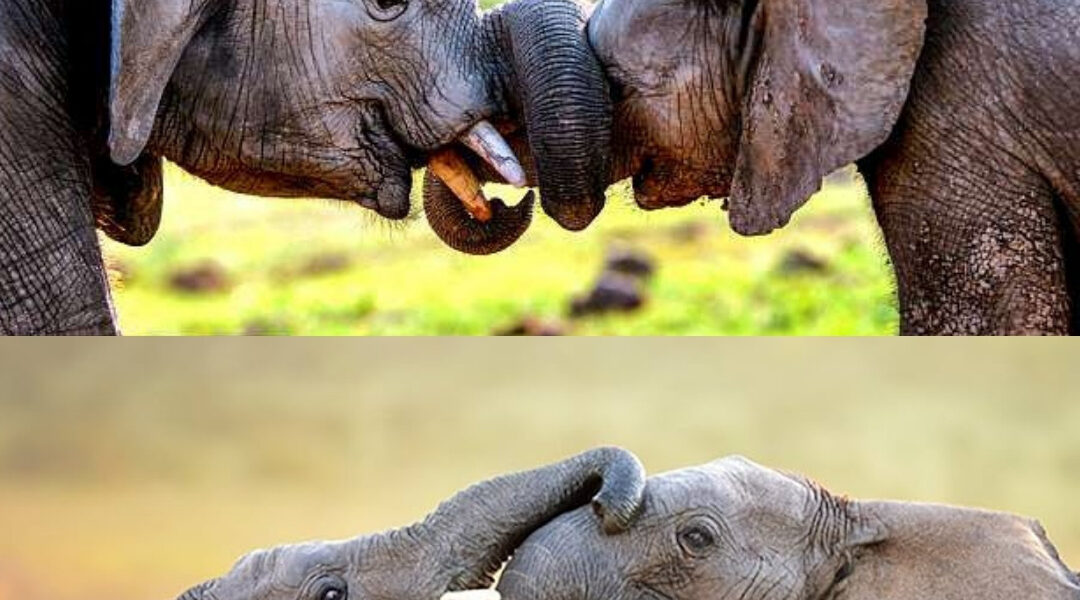
Two baby elephants stood close together, their legs still a little unsteady, their bodies round with youth. They were learning the world the way all children do — through play. Through curiosity. Through touch.
And then their trunks tangled.
At first, it looked like a mistake. One trunk looped around the other, then twisted again, as if neither quite understood where their own ended and the other began. They pushed gently, pulled clumsily, stepping sideways, wobbling, trying to free themselves.
Instead, they laughed — in the way elephants do.
Low rumbles. Soft snorts. A playful energy that needed no translation.
They weren’t fighting. They were practicing. Learning how to control the most important part of their bodies — the trunk that would one day help them drink, eat, communicate, comfort, and survive.
But for now, it was just play.

This tender scene was captured by photographer Anne Laing, who has spent decades behind the lens, yet still finds herself humbled by moments like this. She has photographed world cups, Olympic stadiums filled with tens of thousands of cheering fans, and history-making events that last only seconds.
And yet, it was two baby elephants — tangled up in their own innocence — that stopped her heart.
For those who know elephants, the scene carries deeper meaning.
A baby elephant is not born knowing how to use its trunk. For the first months of life, it flops uselessly, dragging on the ground, swinging unpredictably. Calves trip over it. They accidentally step on it. They wrap it around branches, siblings, even their own legs.
It takes time.
It takes patience.
It takes play.
Through these playful “fights,” calves learn coordination. They learn boundaries. They learn how to engage without harm. They imitate adults — pushing, testing strength, discovering balance.
What looks adorable to us is essential to them.
And what makes the image even more powerful is what stands just out of frame.
Their mothers.

Elephant calves are never truly alone. Around them are watchful eyes, experienced matriarchs, mothers who remember droughts, migrations, and losses. While the babies play, adults stand guard — trunks occasionally reaching out to stroke a calf’s back, reassure them, remind them they are safe.
In one of the photographs, a mother gently touches her baby with her trunk — a gesture filled with affection and reassurance. The trunk, so often seen as a tool, becomes something else entirely: a hand, a hug, a heartbeat made visible.
Elephants use their trunks to grieve.
To comfort.
To celebrate.
To remember.
And here, they use them to love.
In a world that so often shows us elephants through tragedy — poaching, habitat loss, broken families — this moment feels like a quiet rebellion against despair.
No chains.
No fear.
No loss.

Just childhood.
Water plays a role too. In nearby moments, the calves splash, drink, spray each other with delighted clumsiness. Adult elephants may drink up to 150 liters of water a day and travel miles to find it, but calves learn first by imitation and play.
They spray too much.
They miss their mouths.
They soak themselves more than they drink.
And it doesn’t matter.
Because learning is not meant to be perfect.
It’s meant to be joyful.
For Anne Laing, days spent watching elephants are lessons in slowing down. She often says the key is not rushing — driving slowly, listening carefully, noticing the snap of branches or the shift of movement in dense vegetation.
Elephants don’t announce themselves.
They reveal themselves to those willing to wait.
That patience is rewarded with moments like this — a tangle of trunks, a pause in the great urgency of survival, a reminder that even in the wild, there is room for laughter.
Room for clumsiness.
Room for growth.
Room for innocence.
And perhaps that is why these images resonate so deeply.
Because they remind us of something we often forget.
That before strength, there is softness.
Before wisdom, there is play.
Before responsibility, there is joy.
These calves will grow.
Their trunks will become powerful, precise, capable of uprooting trees and lifting immense weight.
They will remember paths across land.
They will carry knowledge forward.
But once, they were just babies.
Tangled.
Uncertain.
Laughing.
And the world was kind enough — just for a moment — to let someone capture it.
In that image lives a promise:
That as long as elephants are allowed to be elephants,
There will always be hope,
Curled gently around itself,
Like two little trunks learning how to belong.