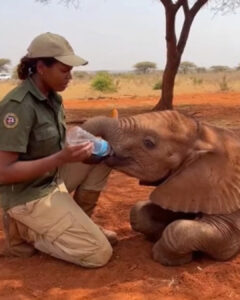
The ground burned beneath Lila’s knees as she knelt in the red Kenyan dust, the heat of the day still trapped in the earth even as the sun slid lower. An acacia tree cast a thin, merciful strip of shade, barely enough to matter. Beneath it stood the smallest elephant she had ever seen alone.
The calf swayed weakly on unsteady legs, his trunk hanging like it didn’t quite belong to him yet. Mud clung to his skin in cracked layers, evidence of puddles that had dried too fast, of water searched for and never found. His breaths came shallow and uneven, ribs shifting too quickly beneath his tight gray hide.
He should have been pressed against his mother’s leg.
He should have been surrounded by the low rumbles of a herd that never truly leaves its young.
Instead, there was silence.
Drought had stripped the land raw. Rivers had retreated into memory. Grass had turned brittle and sharp. Somewhere out there, the herd had moved on, chasing survival the only way they knew how. Whether the calf had fallen behind, collapsed, or simply been lost in the confusion, no one could say.
All that mattered was that he was here.
And alone.
Lila moved slowly, deliberately, the way years of training and instinct demanded. Any sudden movement could push him into panic, and panic could kill him faster than thirst ever would. She stopped a few feet away and lowered herself fully to the ground, making herself smaller, less threatening.
“It’s alright,” she said softly, her voice low and steady. “It’s alright, little one.”
The calf’s ears twitched. His eyes—dark, enormous, rimmed with exhaustion—shifted toward her. There was no fear in them anymore. Fear required energy. What remained was confusion, and something close to surrender.
Lila reached for her water bottle, hands careful not to let it glint too sharply in the sun. She unscrewed the cap slowly, the sound loud in the hush of the savanna. She waited. Let him hear it. Let him process.
“Easy,” she whispered. “We’ve got you now.”
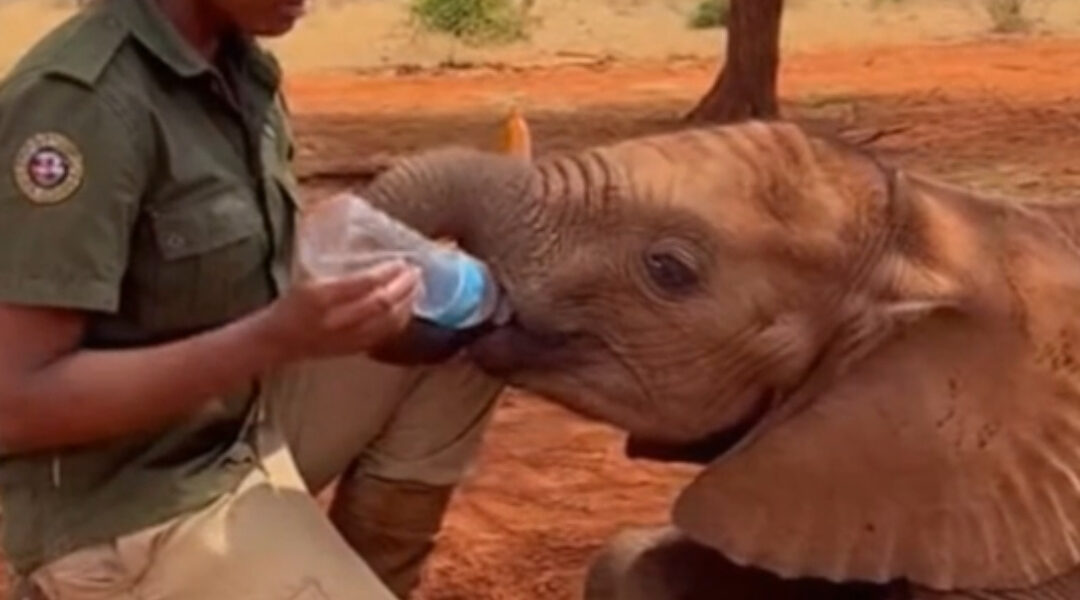
She tipped the bottle just enough for water to bead at the opening. The calf lifted his trunk toward it, the movement awkward and shaky, like a child learning to use unfamiliar limbs. His trunk wavered, missed, then brushed the bottle clumsily.
Lila didn’t pull away.
She held steady.
“That’s it,” she murmured. “You’re doing good.”
The calf managed to curl the tip of his trunk around the bottle and sucked, weak at first, then a little stronger. Water dribbled down his chin and splashed onto the dust, darkening it instantly. Lila felt her chest tighten as she watched the ground drink what he couldn’t.
“Slow,” she whispered. “Drink slow.”
His breaths stuttered, then eased just slightly. A faint sigh escaped him, so soft she felt it more than heard it. His trunk loosened, then tightened again, instinct fighting exhaustion.
Lila reached out with her free hand and laid it gently against his flank. His skin was hot. Too hot. She stroked him slowly, the way she’d learned calmed calves better than restraint ever could.
“I know,” she said quietly. “I know.”
Tears slid down her face, carving clean lines through the dust stuck to her skin. She didn’t wipe them away. The calf leaned—just barely—into her touch, his weight shifting as if he’d finally decided the ground wasn’t going to swallow him.
Somewhere behind her, a radio crackled.
“Lila,” her partner’s voice came through, distant but urgent. “Truck’s on the way. Ten minutes.”
“Copy,” she said softly, never taking her eyes off the calf. “He’s drinking.”
“Good,” the voice replied. “Stay with him.”
She had no intention of moving.
The bottle grew lighter in her hand as the water level dropped. The calf drank in short, careful pulls now, less frantic. His eyes half-closed, lashes clumped with dust. He looked impossibly young in that moment—too young for a world this harsh.
“You’re safe,” Lila whispered. “No one’s leaving you.”
The bottle finally ran empty with a hollow sound that made her heart sink. She lowered it slowly, keeping her hand where it was on his flank. The calf’s trunk searched for the water again, confused, then dropped weakly.
“Shh,” she murmured. “That’s all for now.”
He leaned closer, pressing his small head toward her chest, not with force, just enough to feel something solid. Lila adjusted her position, bracing him, letting his warmth bleed into her own.
The red earth around them was quiet. No wind. No birds. Just breathing.
She could feel his chest rise and fall beneath her palm, still too fast, but steadier than before. She matched her breathing to his without realizing it, slowing herself so he could follow.
In.
Out.
In.
Out.
“You’re doing great,” she whispered. “Just stay with me.”
Her mind flickered through everything that could go wrong. Dehydration. Shock. Internal injury. The long road ahead if he survived this first hour. Orphaned calves needed constant care, round-the-clock feeding, emotional support that could never fully replace a herd.
She pushed the thoughts away.
Not now.
Right now, this was enough.
The calf shifted again, his trunk lifting weakly and brushing her arm, as if checking that she was still there. Lila smiled through tears.
“I’m not going anywhere,” she said. “Promise.”
The sound of the truck reached them at last—a low rumble across the land, growing closer. Dust rose on the horizon. The calf’s ears flicked at the noise, uncertainty rippling through his small body.
“It’s okay,” Lila said quickly, firm but gentle. “That’s help.”
She kept her hand on him, grounding him, as the vehicle approached and stopped a careful distance away. Doors opened quietly. Boots touched the earth softly. No one rushed in.
They knew better.
Lila stayed exactly where she was, one hand still warm against the calf’s side, the empty bottle forgotten in the dirt beside her. She whispered to him as the team prepared supplies, as a shadow passed over them, as the first drops of IV fluid were readied.
“You made it,” she said. “You held on.”
The calf sighed again, deeper this time, his head lowering until it rested against her shoulder. His eyes closed fully now—not in collapse, but in something closer to trust.
In the vast hush of the savanna, with drought pressing in from every direction, one small life had been found before it disappeared completely.
The bottle was empty.
But Lila’s arms were not.
And for now, that was enough.