
It was meant to be a night of warmth.

A night shaped by familiar traditions—food laid out carefully, voices overlapping in conversation, the quiet comfort that comes from knowing everyone you love is under one roof. Thanksgiving has always carried that promise: a pause from the world, a reminder of what truly matters.
For the Fleury family, that promise was shattered by fire.
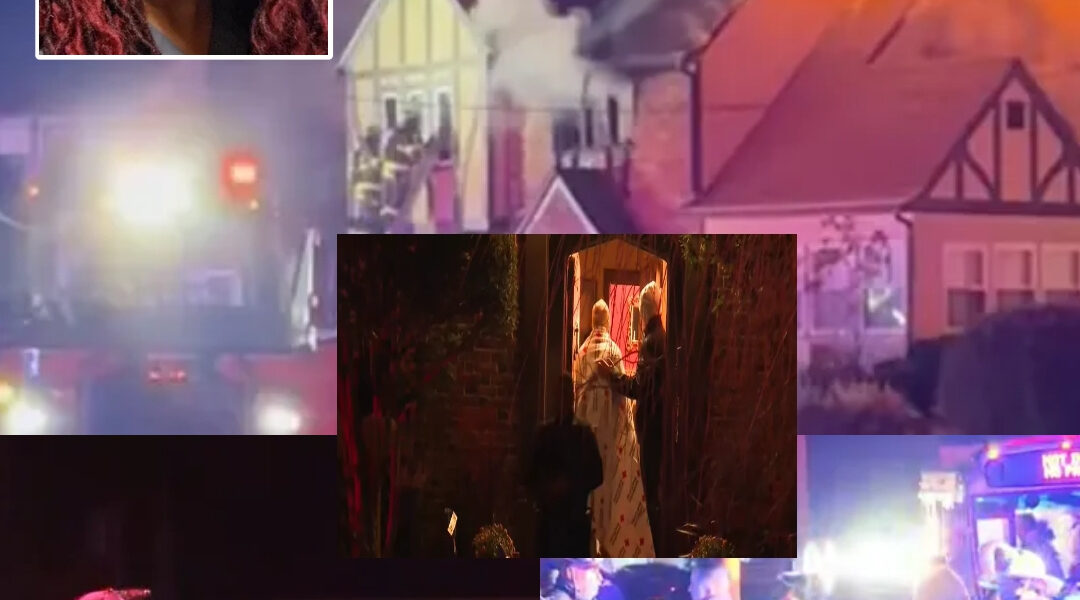
The flames came fast.

One moment, the house held laughter and movement. The next, it filled with smoke so thick it stole breath and blurred vision, heat rising with terrifying speed. Neighbors would later say the fire seemed to explode outward, swallowing the home before anyone could fully understand what was happening.
Inside, chaos took hold.
But so did courage.
Frantzia Fleury was forty-nine years old, the eldest daughter, the steady one. A former Marine, she had learned long ago how to stay calm when everything around her fell apart. Even after her service, she continued to build her life around helping others, working as a radiologic technologist, easing fear in patients who arrived anxious and vulnerable.

On that Thanksgiving night, those instincts returned without hesitation.
Her sister, Pojanee Fleury, forty-two, moved with a different energy—creative, expressive, alive with purpose. She was a writer, a publisher, a community builder. She had founded Brown Eyez Magazine to amplify voices often pushed to the margins, believing deeply in the power of storytelling and representation. Where Frantzia grounded people, Pojanee lifted them.
They were different, but inseparable.
And when the fire trapped their disabled father inside the home, neither sister paused to consider their own safety.
They went to him.

Smoke burned their lungs. Flames licked the walls. The air itself felt hostile. But together, they reached their father, supporting him on either side, guiding him step by step toward the exit. He could not move quickly. His body could not keep pace with the danger closing in.
So they became his strength.
Witnesses later described seeing the sisters emerge from the burning house, their silhouettes flickering against the firelight, their father between them. They spoke to him, reassured him, shielded him from falling debris and choking smoke.
They got him out.

Not only him.
Six other people escaped because Frantzia and Pojanee refused to leave anyone behind. Seven lives were saved by two women who chose love over fear, action over instinctive self-preservation.
For a brief moment, it seemed like they might all survive.
But fire is merciless.
At some point—whether they turned back to check for others or were overtaken by the smoke—the sisters were caught. Heat intensified. Structures weakened. Flames surged with a force no human body could withstand.
When firefighters finally reached them, the battle had already been lost.
At 6:45 p.m., Frantzia and Pojanee Fleury were pronounced dead.
The news rippled outward in disbelief.

Friends struggled to comprehend how two women so full of life could be gone in an instant. Neighbors gathered outside the charred remains of the home, staring at the ruins as if time might rewind if they looked long enough.
“They were the nicest people,” one neighbor said quietly. “Always smiling. Always kind. This doesn’t make sense.”
Another remembered growing up with them—being babysat by one of the sisters, feeling safe in their presence even as a child. “They’ve always been good people,” he said. “Always.”
But tragedy does not ask who deserves it.
As the community mourned, the family faced an unbearable truth: their father was alive because his daughters were not.
He lay in a hospital bed recovering from smoke inhalation, weak and disoriented, asking for his girls. Doctors and nurses exchanged heavy looks. Family members struggled with an impossible question—how do you tell a man that both of his daughters died saving him?
“How do you tell him they’re gone,” a cousin wrote, “when they gave their lives so he could stay?”

There was no right answer.
Pojanee’s colleagues from community organizations released statements honoring her as a selfless leader, someone who poured her energy into lifting others. Artists, writers, and activists shared stories of how she had encouraged them when they felt unseen.
Frantzia’s coworkers remembered her quiet strength—the Marine veteran who never boasted, the technologist who held patients’ hands when they were scared, the woman who never missed Thanksgiving with her father.
Just days before the fire, she had shared an old photo with him online, smiling proudly, captioned simply: “Daddy’s girl.”
No one knew it would be her last post.

A vigil followed days later. Candles flickered in the cold air. Strangers stood beside family members, united by grief. A pastor spoke of courage—not the kind found in headlines, but the kind that shows up in living rooms, in moments where love demands everything.
“The greatest love,” he said softly, “is to lay down one’s life for another.”
Two children—each now without a mother—were held close by relatives, their small hands gripping tightly as if afraid the world might take more if they let go.
Thanksgiving will never be the same for the Fleury family.
It will no longer be just a holiday of gratitude, but a reminder of what was lost—and what was given. A reminder of two sisters who ran toward danger instead of away from it, who chose family over survival.

Their story is not only one of tragedy.
It is a testament.
Heroism does not always wear uniforms or seek recognition. Sometimes it lives in daughters who refuse to abandon their father, in sisters who stand shoulder to shoulder when the world is burning.

The fire took Frantzia and Pojanee Fleury from this world.
But it did not take their courage.
It did not take their love.
And it did not take the lives they saved.

On that Thanksgiving night, two sisters became heroes—not because they wanted to be remembered, but because love left them no other choice.
And that legacy will endure, long after the flames are gone.