
The biting January wind howled through the loading dock and concrete canyons of downtown, carrying the cruel cold of the late night into the Canyon Plaza Mall. Hank Miller, the overnight custodian for the sprawling center, was finishing up the final public restroom before the main doors were sealed. His back was perpetually hunched, his receding hair a crown of white, and his face, weathered by sixty-plus years of hard work, held the quiet solitude of a man who lived alone.
He was scrubbing a sink, the harsh sound of running water and cleaning chemicals masking everything else, but then, a thin, high-pitched cry pierced through the noise. It was sharp, weak, and utterly out of place.
“E… e…”
Hank froze, his sponge halfway to the counter. He strained to listen. It wasn’t the sound of a stray cat, nor the distant wail of a siren. It was the raw, desperate sound of a newborn baby, fragile and terrified. A heavy, unsettling feeling settled in his chest.
He moved slowly, following the sound toward the large accessible stall at the back. The blue sanitation bin usually tucked against the wall was slightly ajar. When Hank carefully pushed it aside, the sight that met his eyes made his old heart seize up with shock and sorrow.
A small bundle, loosely wrapped in a pale yellow, threadbare towel, lay huddled on the cold, grey tiled floor. Inside was an infant, still bright red, its face contorted in a silent scream, wailing against the cruel cold that bit into its tiny limbs.
“Oh, Jesus,” Hank whispered, his voice catching in his throat, a mix of horror and sudden, fierce protection.
All the exhaustion from his graveyard shift evaporated. The basic, primal instinct to protect the helpless surged forward. He dropped to his knees, his rough, steady hands gently lifting the baby. He checked quickly: the umbilical cord was still there, crudely cut. This child was barely an hour old.
Hank looked around frantically, but the room was empty, sterile. No note, no sign of the mother, only the flimsy towel. Tears pricked his eyes. “How could anyone… leave you here, sweet thing? In this cold?”
He couldn’t bring himself to stand, fearing any sudden movement. He sat back on the floor, leaning against the cold cinder-block wall, his aching legs stretched out. In that moment, Hank wasn’t just a janitor; he was an unexpected guardian, the only thing standing between this small life and the bitter cold.
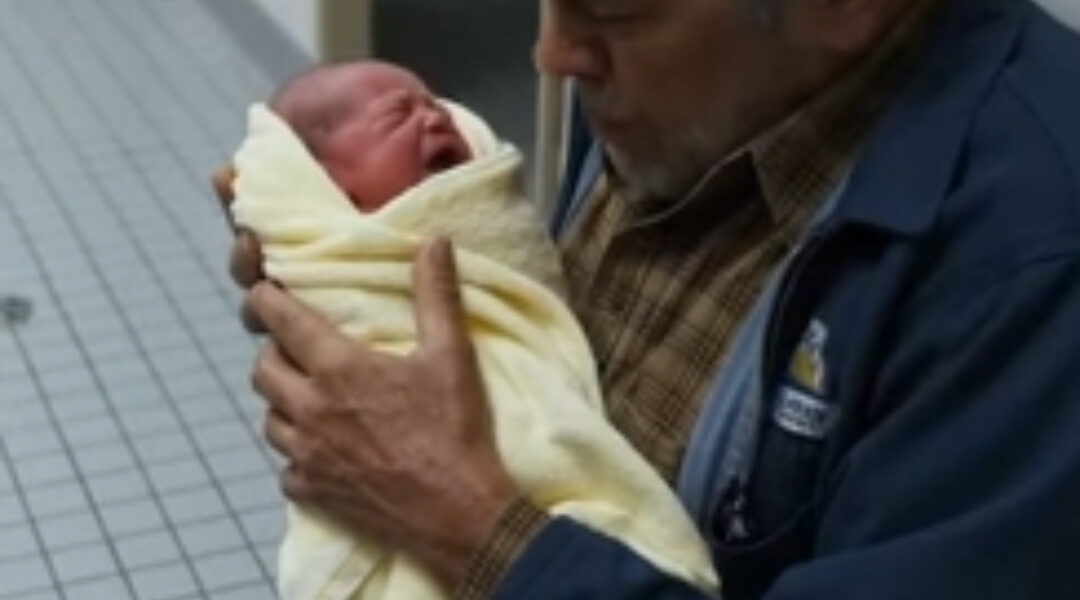
He pulled his heavy work parka tighter around the towel, cocooning the baby, and pressed the child against his chest, sharing the warmth of his own body. He began to speak, his voice a low, gravelly rumble:
“It’s okay, little one, it’s okay. Grandpa’s here. I got you now.” (This is the moment from the video.)
The baby continued to cry—a sharp, penetrating sound that cut him deep.
“Shh… shh… I know you’re cold. I know you’re scared. Shh. We’re safe. I’ve got you. You belong with me now…”
Hank gently rocked the baby, his eyes fixed on the tiny, distressed face. The fragility of the infant’s skin was jarring against the calloused toughness of his hands. He felt the intense, shivering life force in his arms—an innocent soul that deserved warmth, safety, and a mother’s embrace.
Hank closed his eyes. He thought of his own children, grown and distant, and the many years he had lived in quiet isolation since his wife passed away. He had spent his retirement years feeling invisible, like a fixture in the mall he cleaned.
But now, this life—this sacred burden thrust upon him by fate—had shattered his solitude. The need of this tiny being was a sudden, electric shock, reigniting a purpose he thought he had lost.
“You are safe,” he whispered again, a vow more than a comfort. “I won’t let go.”
He stayed there, allowing the cold to seep into his clothes, focusing only on transferring his own warmth to the child. Slowly, miraculously, the wailing subsided. The baby became quiet, its huge, dark eyes staring up at the flickering ceiling lights. It had found its anchor; it had found warmth and security.
Hank knew he had to call it in. The baby needed proper medical care, and he knew the protocol. He fumbled for his worn flip phone, his hands shaking slightly as he dialed 911.
When the paramedics and police arrived, they found the unusual scene: an old, grizzled man in a blue janitor’s uniform, sitting on the cold floor, holding a tightly bundled infant. His gaze was fierce, protective, and filled with a profound, sudden love.
Hank didn’t release the baby until a kind paramedic carefully lifted it into a transport bassinet. He leaned down, whispering into the tiny ear, a promise only they would share: “Be strong for me, little one. I’m going to find you.” He mentally named the child “Hope.”
Before the ambulance lights faded into the city night, a young officer thanked Hank, telling him he was a hero. Hank just shook his head. To him, he was the one who had been rescued from the cold isolation of his own life.
From that night forward, Hank was changed. He still cleaned the mall, but his life had a new focus. He carefully kept the pale yellow towel—a precious reminder. Every week, he used his limited savings to buy necessities and visited “Hope” at the county children’s services center, watching her through the glass.
Hank knew he couldn’t adopt her, but he knew his place in her life: he was the warmth in the dark, the first safe harbor. His story, starting in a lonely restroom stall, became a quiet testament to the unexpected power of love and the human spirit.
“You’re safe now. I have you,” he had promised. And in that promise, he found salvation for them both.