

There are places in this world where nature stops whispering…
and begins to speak in monuments.
One of those places lies off the coast of Iceland, on the windswept volcanic island of Heimaey — a place built from fire, carved by storms, and shaped by time so ancient it feels almost holy.
For years, locals have spoken of a creature that stands at the edge of the Atlantic.
Not a whale.
Not a seal.
But something far larger… something that seems almost alive.
A stone elephant.

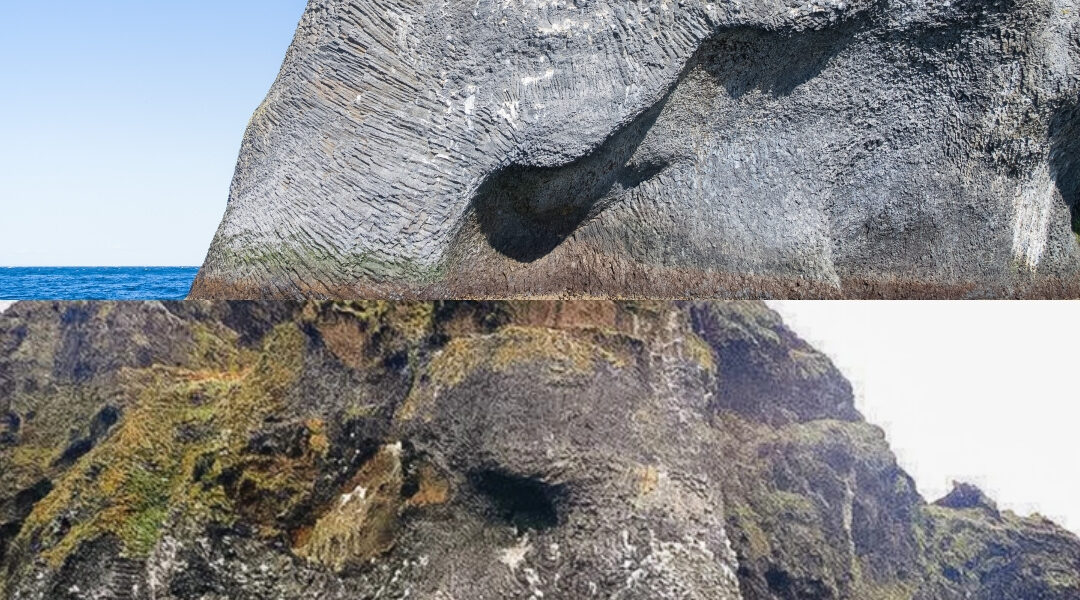
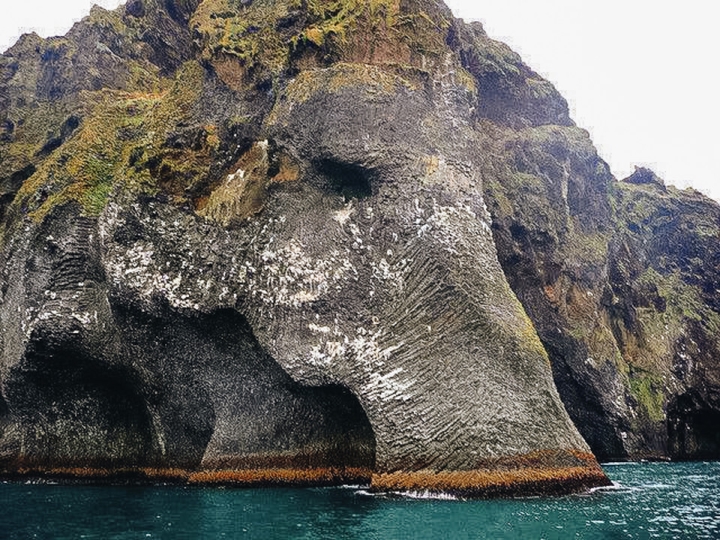
Not carved by human hands, not arranged or sculpted or forced into being — but patiently shaped by the earth itself. Towering over the waves, its great “trunk” appears to dip into the cold northern water as if drinking from the sea after a long and weary journey.
And when you finally see it, really see it, something in your chest stirs — because it doesn’t feel like imagination. It feels like discovery.
What makes this illusion so astonishing isn’t just the outline.
It’s the details.
The cliff is formed entirely of basalt, a rock born from rivers of lava that cooled so quickly they cracked into deep folds and creases. Those wrinkles — carved by fire, sculpted by the ocean — resemble the tough, aged skin of an elephant. The kind you might see wandering across African plains, except here it is frozen in stone beneath northern skies.
Then there are the shadows.
There is one particular indentation that looks uncannily like a watching eye, set deep beneath the curve of what resembles an enormous floppy ear. From the right angle, the resemblance is so perfect, so hauntingly precise, that even the most skeptical visitor stops, blinks, and whispers:
“It really does look like an elephant.”
And in that instant, the world feels a little more magical.
People travel to Heimaey from everywhere — not for shops or cities or noise, but for this silent guardian of the sea. Photographers climb cliffs to capture its shape. Travelers stand with their breath held, waiting for the light to change, hoping to catch the exact moment when the illusion sharpens into astonishing clarity.
Some say the rock looks peaceful.
Some say it looks ancient.
Others claim it looks thirsty — bent forward as if taking the first drink after a long migration across the world.
But everyone agrees on one thing:
It is unforgettable.

What makes it even more incredible is how delicate the illusion is. You can’t see the “elephant” from every direction. You have to stand in just the right place — at the right distance, at the right angle, when the sea is calm enough to cast a clean reflection and the sky is bright enough to show every fold of stone.
Just one step left or right, and it becomes a cliff again.
One step back, and the magic disappears.
Maybe that’s why it feels so special.
It’s as if nature is letting you in on a secret — but only for a moment, only if you’re paying attention. Only if you still believe in wonder.
And when the waves crash at its feet, spraying white foam around the stone trunk, it’s hard not to imagine the ancient creature lifting its head once more… watching the horizon… listening to the world it has guarded for thousands of years.
This “stone elephant” is a reminder of something we often forget:
Nature is an artist far greater than any of us.
And sometimes, in the quietest corners of the earth, she reveals her masterpieces.