
Most people never see what happens in the subway after midnight. The crowds vanish, the laughter fades, the trains rumble past like distant thunder, and the platforms become long, echoing tunnels of flickering lights and shadows. But for Elias Santiago, age sixty-three, this was his world — a world he had patrolled for two decades with steady boots and tired eyes.

He had seen everything the underground could throw at him: drunks asleep on benches, fights that broke out over nothing, lost tourists wandering in confusion, menacing figures lurking where they shouldn’t. But nothing — not in twenty years — prepared him for what he saw that night.
It was exactly 2:00 AM.
He had just completed his routine sweep of the west platform and was making his way toward the turnstiles when he heard something… off. Not a sound, but a feeling. The kind that makes the hairs on the back of your neck stand straight, the kind that old instincts learn to trust.
Elias rounded the corner.
And then he froze.
Standing near the very edge of the yellow line — dangerously close to the tracks where the third rail pulsed with silent, lethal voltage — was a child.
A little girl.
Barefoot.
Shivering.
Dressed in thin, dirty pink pajamas.
Her blonde hair was tousled. Her eyes were wide with fear and exhaustion. She couldn’t have been older than eight.
Elias’s heart slammed against his ribs so hard he thought it might crack. He’d seen adults stumble onto the tracks. He’d seen what electricity does. One slip. One panic. One wrong step in that moment… and she would be gone.
He didn’t shout. Didn’t run. Didn’t do what instinct screamed at him to do.
He did the opposite.
He softened.
He lowered his shoulders, loosened his face, and breathed slowly — making himself look like a grandfather walking toward a frightened kitten, not a uniformed guard approaching a potential emergency.
“Hey there,” he said softly, even though his pulse was racing. “That looks like a cold place to stand.”
His voice echoed gently in the empty station.
The little girl turned toward him.
And in that single moment, Elias saw the whole story written across her face: anger that burned earlier in the night, fear that followed, regret settling in like an icy wind. He didn’t know it yet, but hours earlier she’d run away after a heated argument at home — slamming the door, convinced the world was too small, too unfair, too loud.
But the dark city, the cold tunnels, the loneliness — it all swallowed her pride. She didn’t want to be brave anymore. She wanted to go home.
Her lips trembled. Her tiny body shook.
Elias took one careful step. Then another.
“It’s alright, sweetie,” he murmured. “You’re not in trouble. You’re just cold. Let’s get you warmed up.”
That broke her.
The brave front crumbled. Her chin wobbled. Tears spilled. And instead of running away — instead of panicking and bolting toward danger — she ran straight to him.
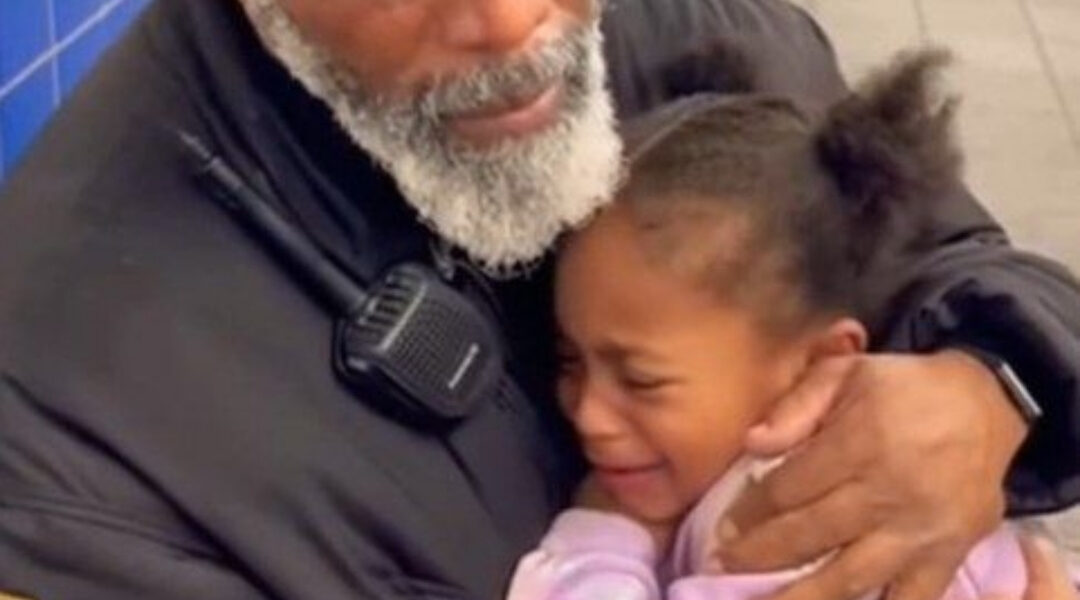
She collided with his chest, sobbing into his heavy coat, her small hands gripping the fabric as if he were the only solid thing in the universe.
Elias, a man who had seen enough sorrow for ten lifetimes, felt his throat tighten. He wrapped his arms around her gently, keeping his movements slow, steady, safe.
“There we go,” he whispered, rocking her lightly. “I got you. I got you.”
He guided her away from the platform edge, toward a bench against the tiled wall. He sat down, keeping her tucked into his coat so the warmth trapped inside his uniform could reach her cold skin. Her whole frame shook — not just from cold, but from fear, shame, regret, relief.
She cried into him until her sobs softened into hiccups.
“I… I shouldn’t have left,” she whispered.
He rubbed gentle circles on her back. “We all make mistakes, sweetheart. Even grown-ups. Especially grown-ups.”
She sniffled. “Mom’s gonna be so mad…”
“No,” Elias said softly. “She’s gonna be scared. She’s gonna be worried. And when she sees you, she’s gonna hold you so tight you can’t breathe. That’s not anger. That’s love.”
The little girl tucked her face deeper into his coat, absorbing every ounce of safety she could find.
Elias pulled out his radio and called it in, his voice steady even as he continued holding her.
“This is Unit 18. I’ve got a minor, female, approximately eight years old. Lost child. Needs medical and parental contact. I’ll stay with her.”
He didn’t let go of her. Not even when officers arrived at the top of the stairs. Not even when they walked over.
She clung tighter.
“It’s okay,” he told her, his voice warm as a blanket. “They’re good people. They’re here to help just like me.”
Behind the approaching officers came a sound Elias had expected — a sound every parent would recognize instantly.
A scream.
A mother’s scream.
Raw. Breaking. Terrified.
“Lily!”
The girl lifted her head, tears blurring her sight.
“Mom?”
Her mother rushed down the steps so fast she nearly slipped. She reached them in seconds, dropping to her knees, scooping her daughter into her arms with a sob that shook her entire body.
“My baby — my baby, where did you go? I thought — I thought—” She couldn’t finish.
The girl cried too, apologizing over and over.
Elias watched quietly, his heart full, his chest tight.
After a moment, the mother looked up at him. Her eyes brimmed with gratitude, desperation, and pure relief.
“Thank you,” she whispered. “Thank you for saving her.”
Elias shook his head, humility softening his wrinkles. “She came to me,” he said. “I just made sure she got to you.”
The mother began crying again, holding her daughter as if letting go would shatter the world.
Elias stood, nodded to the officers, and stepped back into the shadows of the platform — returning to the place where he belonged, where he had spent twenty years protecting strangers who didn’t even know his name.
But tonight… tonight he had saved a life.
Tonight he had been the soft voice in a terrifying world.
Tonight he had been home, just long enough for a frightened little girl to find her way back to her mother.
And as he resumed his patrol, the last thing he heard was the little girl’s voice calling out softly:
“Thank you, mister…”
Elias smiled.
“You’re welcome, kiddo.”
And the trains kept running.
And the tunnels hummed.
And somewhere above ground, a mother held her child a little tighter than before.