
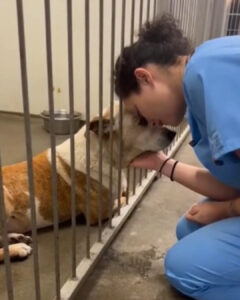
The shelter dog wouldn’t lift his head.
He lay pressed against the cold concrete at the back of the kennel, ribs rising sharply with each breath, body folded inward as if trying to disappear. His eyes stared at the wall, unfocused, not watching—just waiting. Waiting for the next noise. The next disappointment. The next reason to flinch.
The volunteers had tried everything.
Treats slid gently across the floor and stopped untouched. Toys were placed near the gate, squeaked once, then quietly removed. Voices softened, hands stayed low, patience stretched thin. Some dogs warmed quickly. Others took days.
This one had been here weeks.
The notes on the clipboard were brief and tired: Shuts down. No eye contact. Does not engage.
Then Lena came in.
She arrived after a night shift at the hospital, hair pulled back, shoulders heavy, scrubs still faintly smelling of antiseptic and stale coffee. She hadn’t planned to stop by the shelter. She rarely did after work—she was usually too exhausted. But that morning, she couldn’t go straight home. The quiet of her apartment felt heavier than the noise of the world.
So she came here instead.
She paused in front of the kennel and didn’t say anything at first. She just looked. Not at the clipboard. At him.
The dog didn’t react.
Lena lowered herself to the floor outside the gate, knees bending slowly, joints aching. The concrete was cold even through her scrubs, but she didn’t shift away. She didn’t reach for the latch. She didn’t make the soft, coaxing noises people often made when they wanted something back.
“I’m not gonna touch you,” she said quietly. Her voice was calm, almost flat—not rehearsed kindness, just honesty. “I’ll just sit.”
She leaned her back against the wall and let her hands rest loosely in her lap.
Minutes passed.
The shelter smelled like bleach and damp fur. Somewhere down the row, another dog barked, sharp and restless. A metal bowl clanged. Footsteps echoed and faded. Time moved, but nothing else did.
Lena exhaled slowly.
“Rough day,” she murmured, not expecting a response. “Mine too.”
The dog’s ear twitched.
It was small. Barely noticeable. But Lena saw it.
She didn’t smile. She didn’t move closer. She simply stayed.
She slid one hand forward, fingers threading slowly through the bars, stopping well short of where the dog lay. There was still space between them. Important space.
“That’s as close as I go,” she said softly.
The dog didn’t lift his head. But his breathing changed. It slowed, just slightly, like a body reconsidering its defenses.
Another minute passed.
Then, with an effort that seemed to cost him everything, the dog shifted. His claws scraped faintly against the concrete as he dragged himself forward an inch. Then he froze, muscles tight, braced for the mistake he was sure he had made.
Nothing happened.
Lena didn’t move.
Another inch.
His head lifted just enough to rest against the metal bars. His nose pressed through the opening, tentative, trembling. The air between them felt suddenly fragile, as if a single wrong breath could shatter it.
Lena sucked in a breath she hadn’t realized she was holding.
“Hey,” she whispered. “Yeah… I know.”
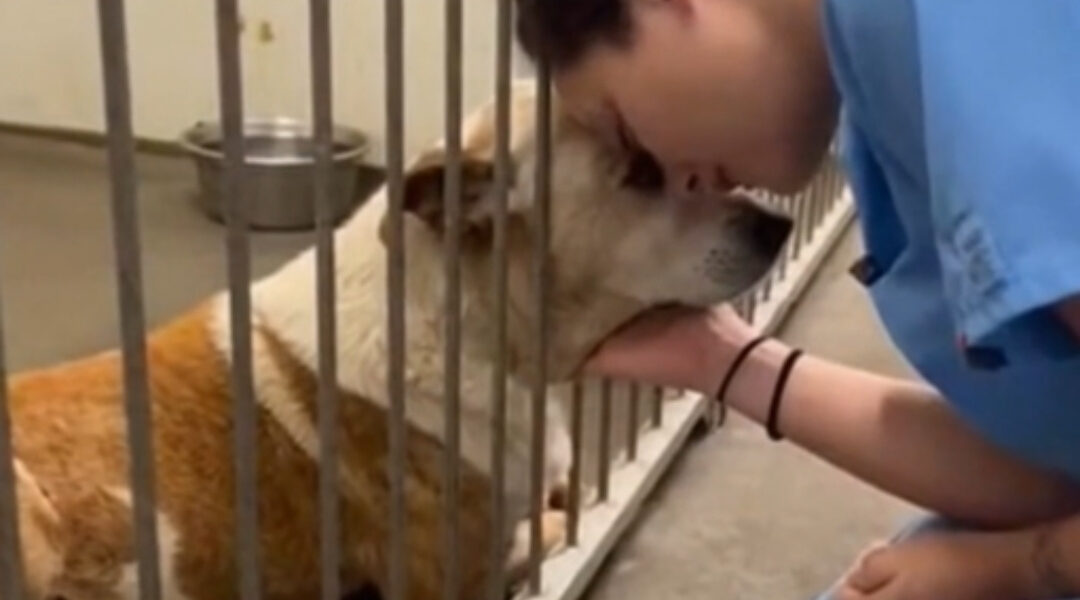
She leaned forward until her forehead rested gently against his through the bars. She didn’t touch him with her hands. Not yet. Just skin to skin, breath to breath.
The dog closed his eyes.
It wasn’t dramatic. No tail wag. No sudden transformation. Just a quiet surrender to the moment, as if his body had decided—finally—that this was safe enough.
Lena stayed exactly where she was.
At the hospital, she spent her nights surrounded by alarms and urgency, by people who needed fixing, saving, stabilizing. She was trained to act quickly, decisively. To intervene.
Here, she did none of that.
She just stayed.
When the attendant came down the aisle later, clipboard tucked under one arm, he slowed when he saw them. Lena hadn’t noticed the time passing. Her legs had gone numb. Her back ached. But she didn’t move.
One hand now rested lightly on the dog’s neck, fingers barely curved, as if touching too firmly might undo everything. The dog leaned into it, just a fraction. Enough.
The attendant cleared his throat softly.
Lena didn’t look up.
“Is he okay?” the man asked.
She nodded, eyes still closed. “Yeah,” she said quietly. “He’s okay.”
The attendant smiled, understanding more than he said, and walked away.
Lena stayed a little longer.
When she finally stood, she did it slowly, carefully, as if leaving a sleeping child. The dog watched her this time. His eyes followed her steps. When she reached the end of the aisle, she turned back.
“I’ll come back,” she said. Not a promise. A statement.
The dog didn’t move.
But he lifted his head.
That afternoon, Lena went home and slept. When she woke up, the image of the kennel floor and the quiet weight of a dog’s trust stayed with her. The next day, she came back. And the next.
The dog didn’t change overnight. He still startled at loud sounds. Still flinched at sudden movements. Still took his time.
But he waited for her.
A week later, she signed the papers with hands that trembled only a little.
The dog walked out of the shelter slowly, cautiously, like someone stepping into a life they weren’t sure they deserved yet.
Lena matched his pace.
She had learned something in that kennel—something the hospital never taught her.
That healing doesn’t always come from doing more.
Sometimes, it comes from sitting down, staying still, and letting trust find its way to you—at its own speed.