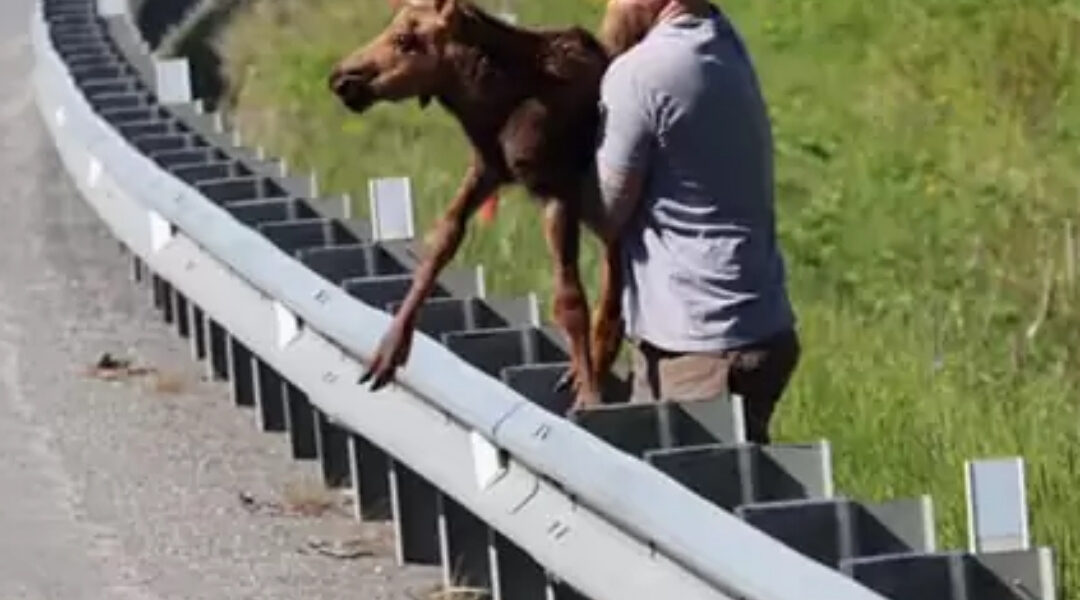

On a quiet Sunday morning in Clam Gulch, Alaska, the world slowed to a halt for reasons far more urgent than traffic. Cars stretched in both directions, engines idling, drivers craning their necks — all watching a life-or-death struggle unfold beside the highway.
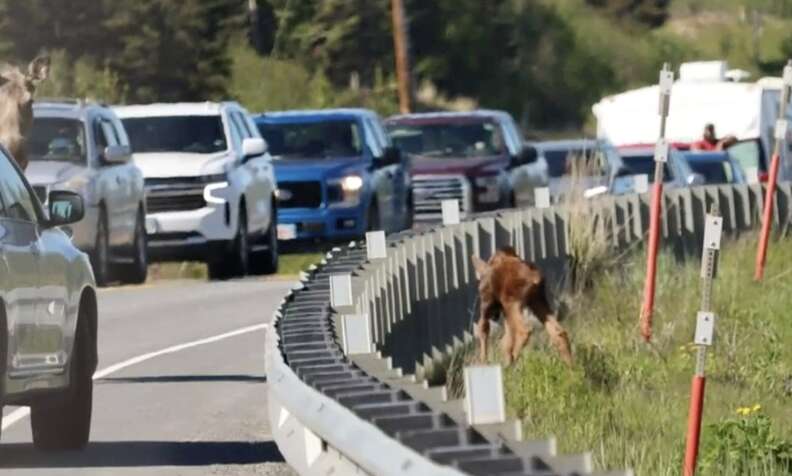
A mother moose stood anxiously at the roadside, pacing, her muscles tight with fear. Beside her, a tiny calf — all legs and wobbling determination — tried desperately to follow her across the highway. But the guardrail was too high, too sharp, too unforgiving for a newborn who’d barely learned to stand.
Each time he tried to scale it, his little legs shook. Each time he failed, his mother circled back, bringing him again toward the center of the guardrail — the section with no cars — even though it kept him moving in the wrong direction. She didn’t understand the danger. She only understood her baby needed her.
Inside the line of waiting cars, two strangers watched the same heartbreaking scene from opposite lanes.
One was Andrea Bock, frozen behind the wheel, whispering prayers the calf wouldn’t collapse from exhaustion.
The other was Joe Tate, returning from a fishing trip with his friends, watching the calf weaken each minute.
The little one was trembling now. He stumbled. He paused. His sides rose and fell faster with each desperate breath.
“He looked so tired,” Andrea said later. “He practically walked into anyone who’d help him.”
Every passing second widened the gap between mother and calf — and widened the danger.
A panicking moose is unpredictable.
A separated calf is vulnerable.
A stressed mother can charge, stomp, or attack.
Everyone knew interfering with wildlife was dangerous.
But everyone also knew that if nothing changed, this calf wouldn’t survive.
And then, finally — quietly, without fanfare — Joe Tate opened his truck door and stepped into the cold morning air.
He didn’t run.
He didn’t shout.
He simply walked with purpose, eyes fixed on the calf, heart pounding, hoping the plan he and his friends had created would work.
Unknown to Andrea or anyone else watching from the southbound side:
Joe’s friends had pulled their trailer forward, positioning it between the mother moose and her baby — blocking her view, just long enough to keep her calm.
Joe waited.
Watched.
Listened for the beat of hooves from the other side.
And then he acted.
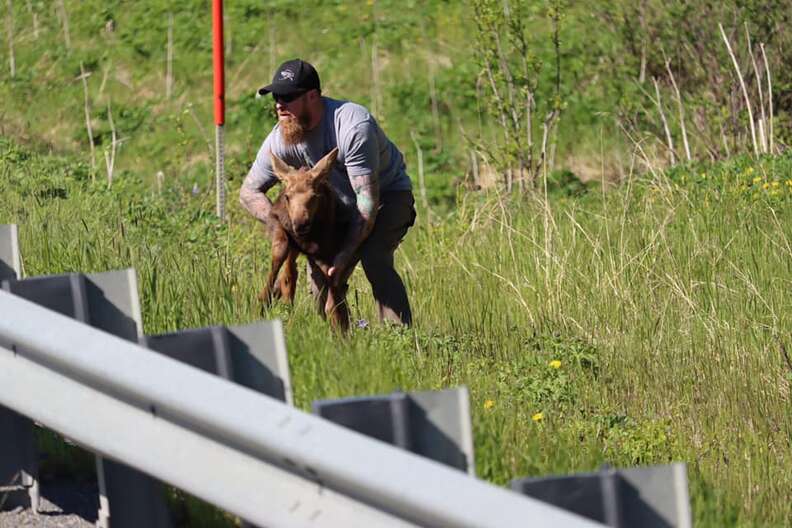
With the mother temporarily out of sight, he reached the calf, who — exhausted, frightened, trusting — almost stepped into his arms.
Andrea held her breath.
Other drivers gasped.
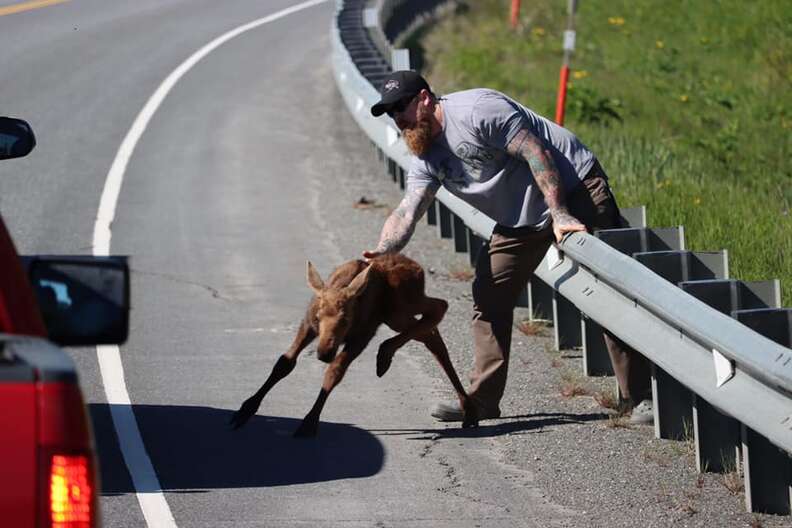
Someone whispered, “Oh God… please let this work.”
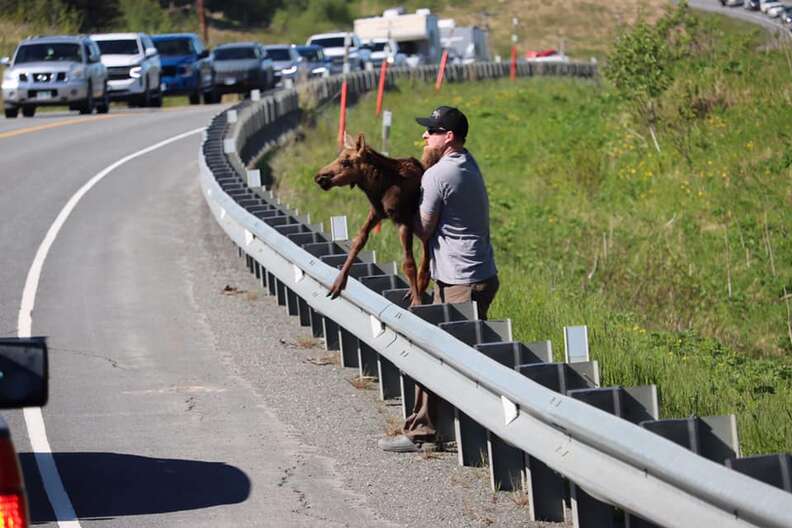
Joe lifted the calf gently — mindful of its fragile legs, mindful of the life he now carried — and in one swift, careful motion, placed him over the guardrail on the side where his mother waited.
No fanfare.
No applause.
Just one man doing what needed to be done.
The calf stood, dazed for a moment, as if trying to understand he was finally free.
Then — a soft grunt.
A pause.
A recognition.
His mother rushed toward him, sniffed him, nudged him, scolded him in the way only moose mothers can.
And together, the pair slipped back into the forest.
Alive.
Reunited.
Safe.
Andrea exhaled for what felt like the first time in half an hour.
“It was pretty cool,” she said later. “Brave, too.”
Joe, humble as always, shrugged off the attention:
“It could have gone bad,” he admitted. “But it didn’t. And it was worth the risk.”
And maybe that’s what heroism really looks like:
Not dramatic.
Not loud.
Not seeking thanks or recognition.
Just a person, sitting in traffic on an ordinary day, seeing a small life fighting for a chance — and deciding to help.
Because sometimes the world stands still for a moment,
and a tired little calf learns that even among steel guardrails and roaring cars,
kindness still finds a way to cross the road.