
In the early light of a Kenyan morning, the land moved the way it always had — slow, patient, ancient. Dust drifted lazily beneath towering acacia trees. A distant rumble of elephant footsteps rolled across the plains like a heartbeat.
And then something extraordinary happened.
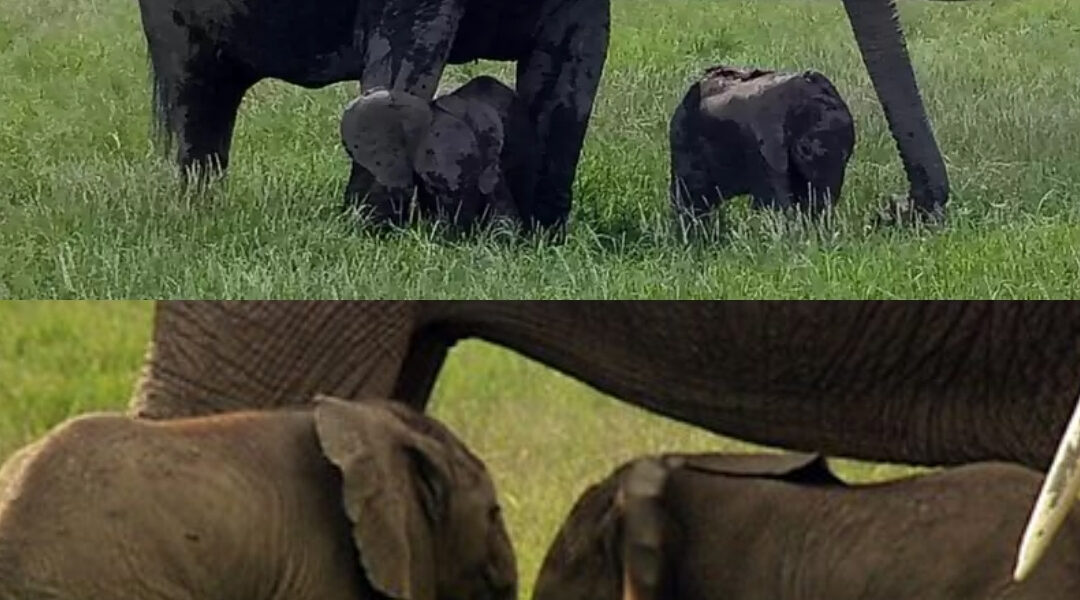
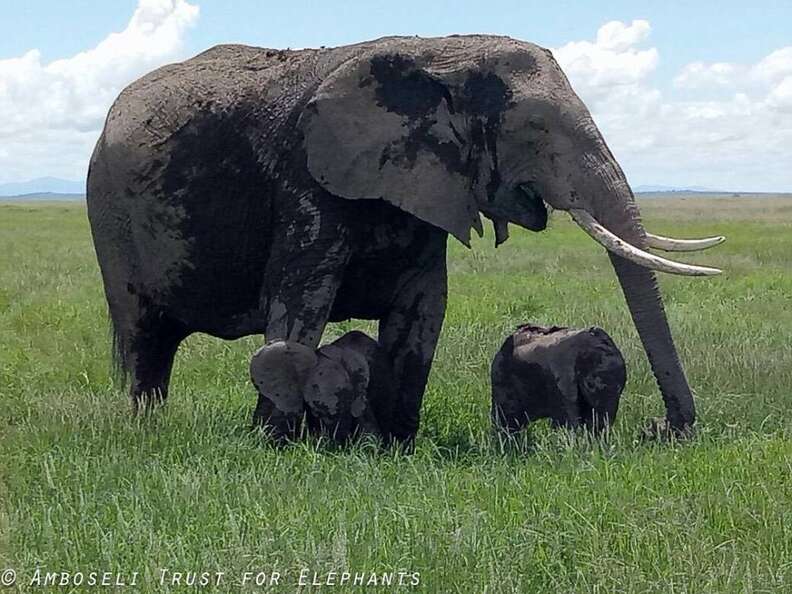
Paru, a 38-year-old elephant matriarch, stood surrounded by her family as labor ended and life arrived — not once, but twice.
Twins.
In the wild, elephant twins are almost unheard of. The odds are less than one percent. Even when it happens, survival is rare. Elephant mothers produce only enough milk for one calf, and the strain of caring for two newborns often proves too much for even the strongest females.
But Paru did not stand alone.
She belonged to a family of nearly forty elephants — mothers, aunts, cousins, elders — all bound by memory, protection, and an unspoken understanding passed down through generations. The moment the first calf touched the ground, the family closed in. When the second followed, something shifted.
This was no longer just a birth.
It was a test.
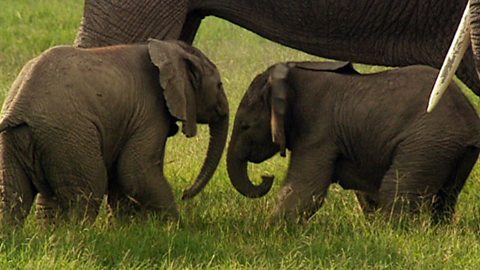
The calves — one male, one female — were impossibly small beneath the towering legs that surrounded them. Their movements were uncoordinated, their legs uncertain, their trunks flailing as they tried to understand gravity, balance, and breath all at once.
Paru lowered her head and rumbled softly — a sound meant only for them.
Her family answered.
Elephants are known for their intelligence, but what matters most in moments like this is their devotion. Every adult female stepped into a role without instruction. One nudged a calf upright. Another stood watch, scanning the horizon. Older sisters positioned themselves strategically, forming a living barrier against danger.

Among them was the twins’ big sister — still young herself, but already attentive, already protective. She stayed close, mirroring Paru’s movements, learning what it meant to help raise life rather than simply follow it.
For days, the family moved slowly.
Very slowly.
Every step was measured so the calves could keep up. When one stumbled, someone was always there. When Paru paused to nurse, the herd formed a tight circle, shielding the newborns from sun, predators, and disruption.
Rangers watching from a distance could hardly believe what they were seeing.
Amboseli National Park is home to nearly 1,600 elephants, yet the last recorded case of wild elephant twins there had been more than four decades earlier. This wasn’t just rare — it was historic.
But history doesn’t guarantee survival.
The first weeks were the most dangerous.
The calves needed milk constantly. Paru’s body was under enormous strain. At times, one calf would nurse while the other waited, shifting impatiently, unaware of how fragile the balance truly was. That’s when the family intervened most.
Aunties distracted the waiting calf.
Sisters guided wandering steps.
Elders slowed the herd’s pace even further.
No one rushed Paru.
No one left her behind.
Kenneth Ole Nashu, a senior park warden, later described it as something deeply moving to witness. “This is a unique scenario,” he said. “We are proud — and we are watching closely to make sure the babies are healthy.”
But the watching was careful, respectful.
Amboseli exists within a local community, and its elephants survive not just because of fences or rules, but because of people — rangers who patrol tirelessly, who protect families like Paru’s from poachers, who understand that conservation is not about control, but guardianship.
Weeks passed.
Then months.
Against all odds, both calves survived.
At two months old, they were still small, still vulnerable, but thriving. They stayed close to Paru’s sides, moving in unsteady synchrony, often bumping into each other like they were still learning how to share space — and life.
Sometimes they slept pressed against Paru’s legs, one on each side, their breathing rising and falling in quiet rhythm. Other times, they wandered just far enough to test independence, only to return at the first sign of uncertainty.
Paru watched everything.
She was older than most mothers when she gave birth, her body carrying the wisdom of decades — droughts endured, predators avoided, calves raised. That experience mattered now more than ever.
Elephant families depend on memory. They remember where water lasts longest. Where danger hides. Where safety waits. And Paru’s family had decades of memory working in favor of these two fragile lives.
Still, nothing about this was guaranteed.
Every day was a quiet negotiation with fate.
And every day, the family chose patience over speed, protection over distance, unity over convenience.
That is what saved the twins.
Not luck.
Not spectacle.
Family.
In the wild, survival is often portrayed as strength alone — the fastest, the biggest, the most aggressive. But elephants have always known something different.
Survival is collective.
It is slowing down for the smallest.
Standing guard when someone else is weak.
Sharing what little you have because life depends on it.
As the twins grew stronger, their steps steadier, their trunks more controlled, the herd slowly resumed its natural rhythm. But something remained changed.
There were now two new heartbeats in the family.
Two lives everyone felt responsible for.
Two reminders that even in a world shaped by loss, something miraculous can still take root.
For the rangers who watched, for the conservationists who study elephant behavior, for the communities who protect this land, the twins became a symbol — not just of rarity, but of possibility.
In a time when elephants face relentless threats from habitat loss and poaching, Paru’s twins stood as proof that when protection works, when families remain intact, when elders are allowed to lead and teach, life finds a way.
And perhaps that is the quiet miracle worth remembering most.
Not just that twins were born.
But that they were welcomed.
Protected.
Raised together.
Still walking.
Still learning.
Still alive.