

Arthur had worked these fields for forty years, long enough for the land to etch itself into his skin. He was a man shaped by weather, by seasons, by hard truths. He didn’t waste words, didn’t linger on feelings, and he certainly didn’t expect anything unusual from a simple morning harvest.
But nature has a way of interrupting even the most seasoned men.
He was halfway through his first pass, the steady rumble of the 10-ton tractor drowning out everything except his own thoughts about rain forecasts and late crops. Then — beneath the engine’s growl — he heard something that shouldn’t have been there.
A cry.
Thin, soft, almost swallowed by the wind.
He froze. Slammed the brakes. The machine jerked to a stop.
Arthur climbed down, his boots crunching over broken stalks. He listened again. There — faint, trembling, scared.
He walked toward the sound, parting the stubble with his hands.
And there she was.
A newborn fawn.
No bigger than a housecat.
Curled into herself, shivering violently.
She was so still he thought she might already be gone — until her tiny chest rose, then fell, in the shallowest breath he’d ever seen.
Her eyes were dull, unfocused. Her legs tucked tight beneath her body. Her fur cold and damp. Alone. Abandoned or orphaned — maybe spooked mother, maybe worse — the reasons didn’t matter now.
Arthur knew the rules.
Every farmer does.
You don’t interfere with wildlife. You let nature do what nature does.
But he wasn’t looking at nature anymore.
He was looking at a dying baby.
And that changed everything.
He sighed — long, low, rough — a sound halfway between frustration and heartbreak. Then he reached down, scooped the fragile creature into his arms, and tucked her against the warmth of his chest inside his overalls.
“Alright, little one,” he muttered. “Let’s get you warm.”
Back at the farmhouse, his wife looked at him like he’d brought home the sky.
They laid the fawn by the wood stove, wrapped her in soft towels, rubbed her tiny limbs until some warmth returned to her. Arthur held her head steady while his wife dribbled warm milk into her mouth. At first, the fawn didn’t swallow. Her breathing rattled. Her eyelids fluttered.
Then — slowly — she drank.
Just a sip.
Then another.
Arthur felt something unspool in his chest — something he thought the years had hardened.
Hours passed, the harvest long forgotten. And as the sun began to dip, he carried the fawn back outside. She was still weak, but awake now, her tiny ears twitching, her legs stretching in clumsy new attempts at standing.
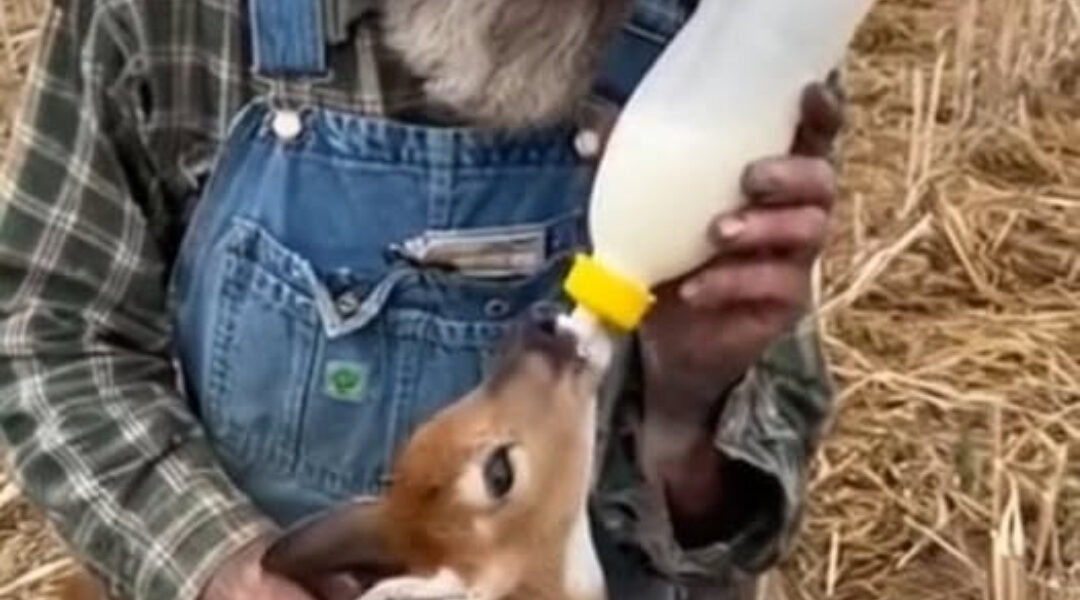
Arthur sat in the field, lowering himself onto the dirt. He held a bottle steady in his big, weather-beaten hands. Hands that had hauled lumber, fixed engines, pulled calves, buried dogs — hands that weren’t used to gentleness.
But today, they held a life.
The fawn leaned into him, sucking greedily, strength returning drop by drop. She blinked up at him with wide, dark eyes as if trying to understand who this giant was — this man who smelled like hay and diesel and safety.
Arthur stroked her head with one rough thumb.
“Easy, sweetheart,” he murmured. “Help’s coming soon.”
He’d already called the wildlife rescue. They’d arrive later that evening. They’d take her someplace safe, someplace with professionals who knew how to raise her strong and wild again.
But for this brief, unexpected afternoon — between the broken stalks, the fading sunlight, and the forgotten harvest —
Arthur was her entire world.
Her warmth.
Her shelter.
Her chance.
And maybe, he realized, she’d given something back to him too — a reminder that even the hardest lives still have room for gentleness, and that some stops in the field aren’t interruptions.
They’re moments that change you.