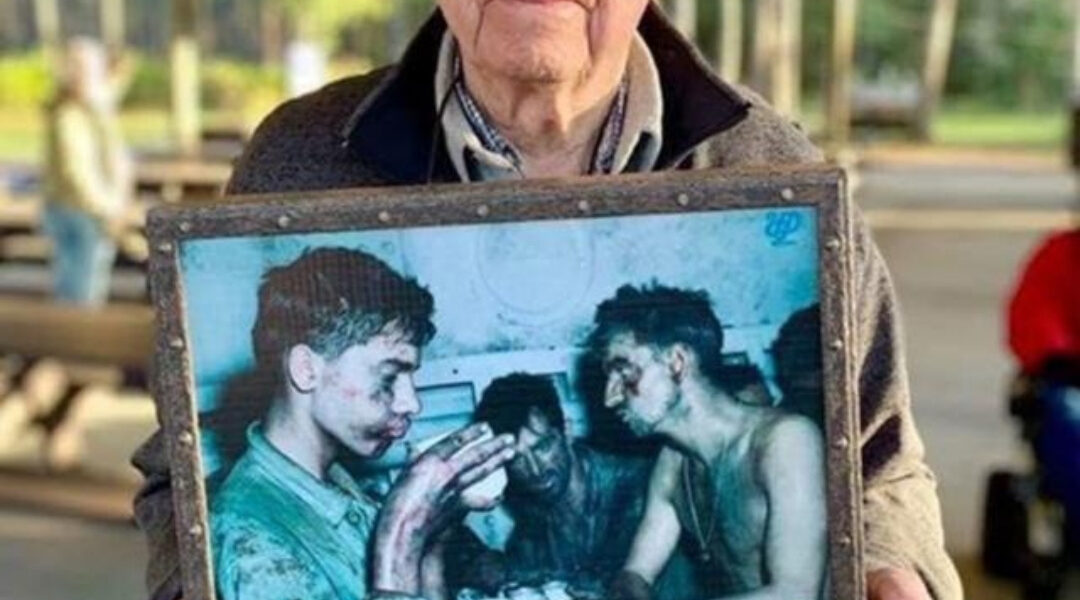


Ninety-eight years old — and still holding the photograph that captured the moment he realized he was alive.
In the faded 1944 picture, Marine Private First Class Faris “Bob” Tuohy sits on the left, clutching a cup of hot coffee aboard the USS Arthur Middleton. His face is drained, shaken, and unmistakably human — a rare wartime image the censors allowed because it showed what combat really did to young men.
The photo was taken just after he survived the two-day battle for Engebi, part of the brutal fighting across the Eniwetok Atoll. His regiment — the independent 22nd Marines — killed more than 700 enemy defenders. Only nineteen surrendered. The rest died fighting.
Faris was just 19 or 20 years old in that moment, exhausted and hollow-eyed, drinking coffee like it was the only thing keeping him tethered to the world.
Beside him sits Private First Class Stephen Garboski, only a few years older. Stephen would never make it home. Weeks later, on Guam, he became one of more than a thousand Marines of the 1st Provisional Marine Brigade who were killed in action.
The man in the center — Faris believes — was later killed on Okinawa.
Three young men in a single photo.
Only one lived long enough to hold it again.
Faris says he later survived another unimaginable moment: he was hit in a friendly-fire strike when USAAF aircraft mistakenly attacked Marine positions. Even then, he lived. Many around him did not.
And now, nearly eight decades later, he still holds that photograph… not as a reminder of war, but as a reminder of survival. A reminder of the friends he left behind. A reminder of the boys who never grew old.
This April, Faris Tuohy celebrated his 98th birthday.
A life lived.
A war survived.
A picture that carries every ghost of 1944.