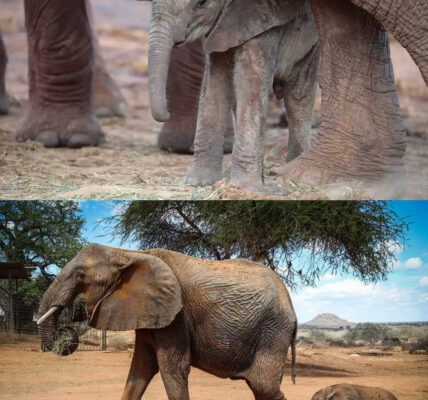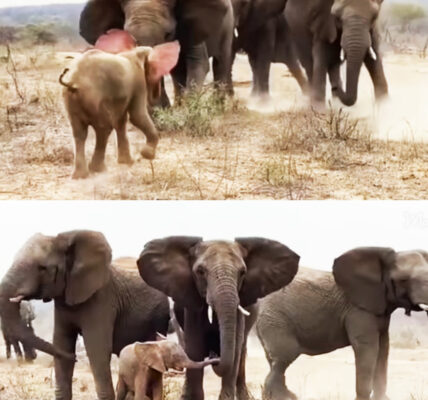

In the sweeping grasslands of Addo Elephant National Park, there are moments so gentle, so unexpectedly sweet, that they seem to stop the entire world. This was one of them — a moment held together not by danger or drama, but by something far softer: the determined joy of a baby elephant named Stompie.

Stompie was barely a year old, still round with youth, still clumsy on his feet, and still discovering his place in the quiet language of elephant life. His name, “Stompie,” meaning “Stumpy” in Afrikaans, had been affectionately given by rangers who watched him wobble through the world with endless enthusiasm and absolutely no sense of personal space.
He was small, but his spirit filled the savanna.
On this particular morning, the older elephants were busy — grazing, dusting themselves, tending to the slow rituals of the day. But Stompie, as always, was searching for adventure. His eyes scanned the field until they landed on the teenage bull who often tolerated him. Older, calmer, and eternally patient, the young bull had become Stompie’s favorite target for mischief.
And so the dance began.
Stompie approached quietly at first, his little feet padding softly through the grass. Then, with the kind of confidence only a child could muster, he pressed his trunk firmly against his companion’s side — not a push, not a demand, but a question:
Will you play with me?

The older elephant flicked his ear, pretending not to notice. But Stompie wasn’t giving up. He nudged again, this time with more enthusiasm. Then came the trumpeting — high-pitched and excited, as if he were announcing to the whole world that the game was about to begin whether the older bull approved or not.
Still no reaction.
So Stompie tried the most reliable tactic of all: he charged.
A tiny elephant charging is a sight both hilarious and adorable, full of wobbling momentum and fierce determination. He dashed forward, head lowered, and bumped directly into the teenager’s leg with a thump that startled only himself.
The older elephant looked down at him, torn between annoyance and affection.
And then — in a moment that felt like the sun itself softened — he gave in.

With a slow, patient sigh, the older elephant lowered himself to the ground, stretching out across the grass as if to say, Alright, little one… let’s play.
What followed was thirty minutes of pure, unfiltered joy.
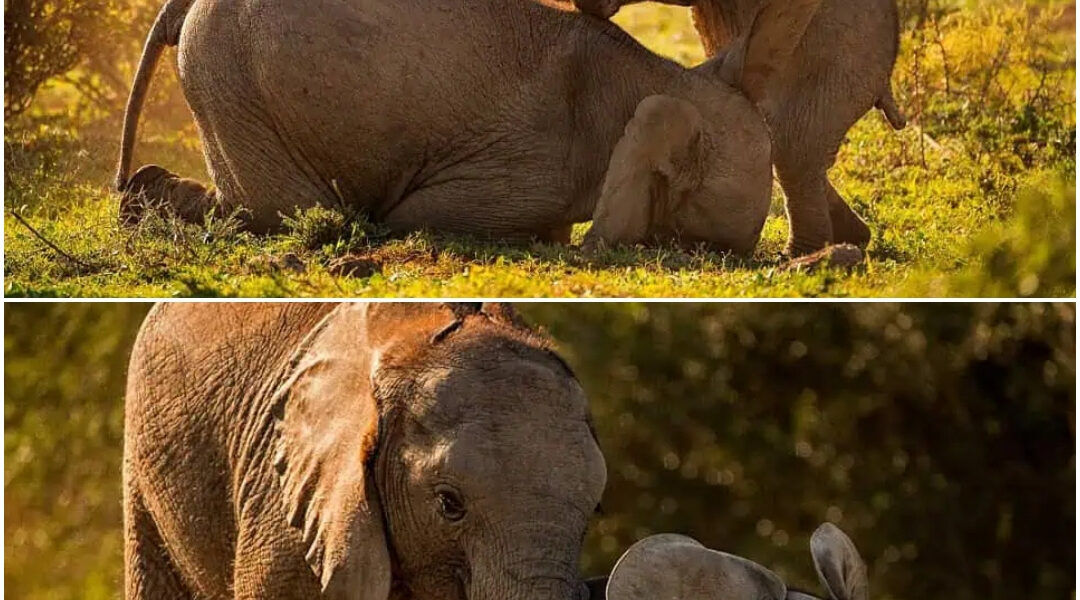
Stompie squealed and scrambled over him, climbing onto his head, sliding down his back, tumbling over his legs. The older bull tolerated every moment, even lifting his trunk occasionally to nudge Stompie upright when the little calf toppled sideways in a fit of excitement.

To watch them was to witness love — not the dramatic kind, but the quiet kind that lives in trust, comfort, and connection.
Wildlife photographer Jeni Williams, who had been checking waterhole levels that morning, stopped in her tracks as she watched the scene unfold. Her camera clicked softly, but the elephants seemed unaware — wrapped entirely in the private world only play can create.
She would later say that the expressions on their faces were the most surprising of all. Elephants don’t smile the way humans do, but there was something unmistakably joyful about the subtle lift in their cheeks, the softness in their eyes. Those small, knowing smirks hinted at a bond far deeper than a simple game.

At one point, the older elephant rolled fully onto his stomach, face pressed into the grass, as Stompie clambered triumphantly atop his head. The calf stood there proudly, chest puffed out, as if he had conquered a mountain — his own personal Everest.
But the moment that stayed with Jeni the most was not the play itself, but the quiet pause afterward.
When the teenager finally decided the game was over, he rose slowly, shaking dust from his back as Stompie slid off with a squeak of surprise. The older elephant stood tall again, regal and composed. Stompie gazed up at him, trunk lifted in admiration.
And then — almost in slow motion — the teenager lowered his head and gently touched his trunk to Stompie’s forehead.

A gesture of affection.
A gesture of acceptance.
A gesture that said, You matter to me.
In that soft moment, the entire landscape seemed to exhale.
For elephants, play is not just entertainment. It is teaching. It is bonding. It is emotional inheritance — a way for younger generations to learn the rules of strength, gentleness, and community. And for Stompie, this play session wasn’t simply fun. It was a lesson, a memory, a chapter in the long story of becoming an elephant.
Jeni later reflected that scenes like this are why she volunteers at the park, why she spends hours watching families at the waterholes, why wildlife photography is more than a hobby — it is a window into the profound emotional lives of creatures often misunderstood.

“Baby elephants love to play,” she said. “They climb on each other, they tumble, they test their strength. But what moved me most here was the tenderness. The older one didn’t just tolerate Stompie — he enjoyed him.”
And perhaps that is why these images touched people around the world.
Because in Stompie’s persistence, we saw childhood.
In the older elephant’s patience, we saw mentorship.
In their shared joy, we saw family.
Their interaction reminded us that affection exists far beyond human language. That love takes many forms — a nudge, a nuzzle, a shared patch of sunshine. That even in the wild, where survival is often harsh and unforgiving, there is still room for softness.
Stompie may never know that his playfulness became a global phenomenon. He may never understand that his little charge toward an older friend brought smiles to thousands of faces. But he does know this:
He is loved.
He is seen.
He is part of something bigger.
And in the vastness of the African plains, under a sky wide enough to hold every story, that is everything.