She Wouldn’t Leave the Barn: How an Old Dog Led a Farmer to a Life in the Storm.

The storm had no mercy that night.
Wind tore across the fields like something alive, rattling tin roofs and bending fence posts until they screamed. Rain fell sideways, sharp and relentless, drumming against the old barn at the edge of the property. It was the kind of night that kept animals restless and men awake, the kind that made every sound feel like a warning.
Joe was already up when he noticed her absence.
The old retriever—golden once, now faded with age—hadn’t come back inside. She usually slept near the heater on nights like this, curled close enough that Joe could hear her slow, wheezing breath. Her joints weren’t good anymore. Cold weather hurt her. She never stayed out in storms.
But her bed was empty.
Joe pulled on his jacket and stepped into the rain, calling her name into the dark. The wind swallowed his voice. The yard lights barely reached past the fence line, their glow trembling in the downpour.
Then he heard it.
Not a bark.
A whine.
Low. Insistent. Almost pleading.
It came from the barn.
Joe jogged across the mud, boots slipping, heart tightening with every step. The barn doors were shut, but light leaked through the cracks in the old wood. Inside, the smell of wet straw and earth hit him immediately.
And there she was.
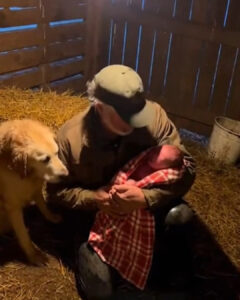
The retriever stood in the far corner, body curved protectively around something small. She didn’t move when Joe entered. She didn’t even turn her head. One paw rested on the ground like a barrier, her posture stiff with purpose.
She looked at him once.
Then back down.
Joe followed her gaze—and froze.
There, in the straw, soaked and shivering, was a newborn baby.
The child was barely visible beneath the mud and rainwater that had pooled through the barn floor. Wrapped in nothing but a thin, darkened cloth, the baby’s chest rose unevenly, breaths shallow and weak. A faint cry slipped out—more breath than sound—before fading again.
“Oh my God,” Joe whispered.
He dropped to his knees without thinking, ignoring the cold seeping through his jeans. The retriever pressed closer to the baby, nose hovering inches from the tiny face, her breath warm, steady. She whined again, softer now, as if urging him to hurry.
Joe reached out with shaking hands.
The baby was cold.
Too cold.
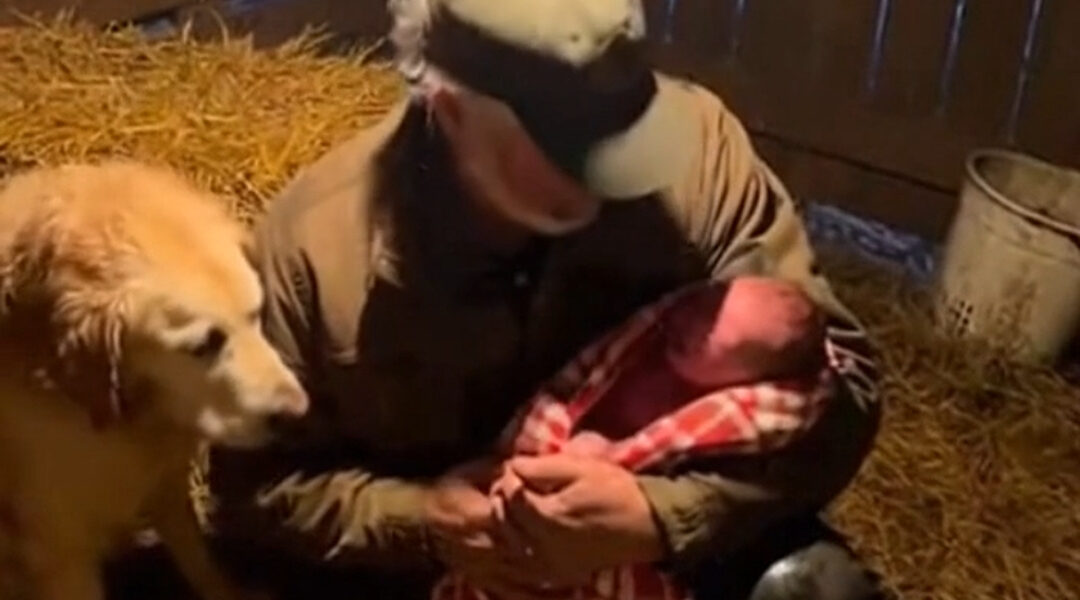
He lifted the child carefully, cradling the tiny body against his chest, feeling how impossibly light it was. The baby let out a thin cry, lips tinged blue, fingers curling weakly into the fabric of Joe’s jacket.
“I’ve got you,” Joe said, his voice breaking. “You’re okay. You’re safe now.”
He rocked slowly, instinct taking over, pressing warmth into warmth. The retriever stepped closer, resting her head against Joe’s leg, eyes never leaving the baby. Her tail thumped once against the straw—weak, but certain.
Joe wrapped his jacket tighter around the child, shielding the small face from the draft slipping through the boards. The baby cried again, a little stronger this time, chest rising more fully.
Pink began to return.
Joe exhaled for what felt like the first time since he’d stepped into the barn.
“Good girl,” he murmured, reaching down to stroke the retriever’s damp ears. “You did good. You kept them safe.”
The dog leaned into his touch, letting out a long, relieved breath. She settled beside him, body curved protectively as if the job wasn’t finished yet.
Rain hammered the roof overhead. Thunder rolled in the distance. Inside the barn, time slowed.
Joe stayed there on the straw, rocking the baby gently, whispering reassurances he wasn’t sure the child could hear—but needed to say anyway. He thought about how close this had come to ending differently. How easily the storm could have drowned out that fragile cry. How many people might have driven past the farm that night without ever knowing.
But the dog had known.
She must have smelled something wrong, heard something beneath the wind. Instead of running for warmth, she had followed instinct older than training or comfort. She had stayed. She had guarded.
Joe eventually stood, holding the baby close, careful not to jostle the small body. The retriever walked beside him, step for step, refusing to leave their side as he headed back toward the house and the phone.
Emergency lights would arrive later. Paramedics would move quickly, wrapping the baby in warm blankets, praising Joe for acting fast. They would ask questions—how long the baby had been there, whether he knew anything else.
Joe would answer what he could.
But when they asked how he found the child, he would look down at the old retriever sitting at his feet, soaked and shaking now that the adrenaline had faded.
“She showed me,” he’d say simply.
News of the rescue spread quickly through the small community. People talked about the storm, about the miracle, about the baby who survived a night that should have taken everything. Some called Joe a hero.
He shook his head at that.
Heroes don’t have paws, he’d think. Heroes don’t whine softly in the dark and refuse to move.
At home, the barn corner where the baby had been found was cleaned, fresh straw laid down. The storm passed. The fields dried. Life returned to its routines.
But the retriever slept closer to Joe after that. And sometimes, in the quiet of early morning, Joe would catch her staring toward the barn, ears tilted, as if listening for a sound only she could hear.
A sound that night had changed everything.
Because in the middle of a storm, when the world was loud and cruel and unrelenting, an old dog chose to protect something small and fragile. She chose to stay.
And because of that choice, a baby lived.
Sometimes, salvation doesn’t arrive with sirens or lights. Sometimes it comes on four tired legs, guided by instinct and loyalty, standing guard in the dark until someone finally listens.