The forest had gone quiet in a way that felt wrong.

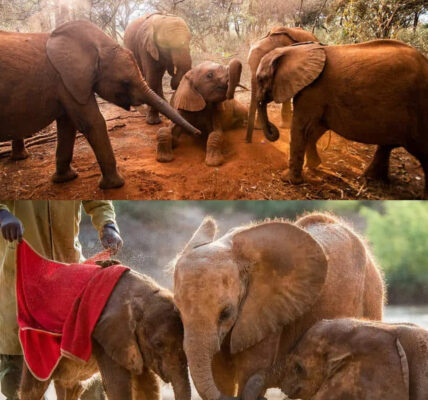
Birds kept their distance. The herd had already moved on, leaving behind only trampled grass, broken branches, and one mother elephant standing alone with her baby.
The calf did not move.
She nudged him gently at first, the way she had done since the moment he was born—soft taps with her foot, a careful curl of her trunk around his small body. This was how she woke him when it was time to stand, to feed, to follow. This was how she checked that he was still there.
But this time, he did not respond.
The calf had wandered from the herd days earlier. Whether from confusion, weakness, or simple misstep, no one knows. What is known is that by the time his mother reached him again, life had already slipped away. Three days too late. Three days that changed everything.
Still, she refused to believe it.
Elephants are not creatures of impulse. They are deliberate, thoughtful, deeply emotional beings with memories that last a lifetime. This mother knew her baby’s weight, his smell, the sound of his breathing. She knew the difference between sleep and silence.
And yet, she tried.
She pushed him again, harder now. Her trunk rose into the air as she trumpeted—a long, aching sound that tore through the trees. It was not a call to the herd.
It was a cry.

When he did not rise, she did something no one watching would ever forget.
She lifted him.
The calf’s body was small compared to hers, but still heavy—dead weight carried by grief. She draped him across her tusks and shoulders and began to walk. Step after step. Slow. Careful. Determined.
Two kilometers.
That is how far she carried him.
Through forest paths and open land, her massive body moving with a gentleness that seemed impossible under such weight. Each step said the same thing: Not yet. Not like this.
When she reached the river, she stopped.
Water had always meant life. It cooled their skin, washed away dust, eased aching joints. Perhaps—some instinct whispered—water could wake him.
She lowered the calf into the stream.

The current flowed around his small body as she nudged him again, urging him to stand, to breathe, to come back. She splashed water over him with her trunk. She positioned him carefully, the way mothers do when teaching their young how to bathe.
Her trumpets echoed again, louder now, filled with urgency and sorrow.
Those who witnessed the scene stood frozen, unable to intervene, unable to look away. This was not confusion. This was not instinct gone wrong.
This was grief in its purest form.
She stayed with him.
She nudged.
She waited.
She tried again.

Time passed, and slowly, inevitably, the truth settled in—not as understanding, but as something heavier. Something that pressed down on her body and spirit alike.
At last, she stood still.
Her trunk rested against the calf’s side, unmoving now. The cries softened, then faded into a silence that felt unbearable. She did not leave immediately. She remained there, standing over him, as if her presence alone might still matter.
Because to her, it did.
Elephants are known to mourn. They revisit the bones of their dead. They touch skulls and tusks gently, reverently. They remember.
But watching a mother try to bring her baby back—carrying him for kilometers, placing him in water, refusing to accept what had happened—revealed something even deeper.
Hope.
Not the hopeful optimism humans like to imagine, but a stubborn, aching refusal to let go of love.

When the video of this moment was shared, it spread quickly. Thousands watched. Many wept. People who had never stood near an elephant, never felt the ground tremble beneath one, suddenly recognized something painfully familiar.
A mother refusing to stop being a mother—even when there is nothing left to save.
Comments poured in from around the world. Some spoke of heartbreak. Others of recognition. Many said the same thing in different words: This is love.
Because love does not disappear when life does.
It lingers.
It tries.
It hopes long after hope makes sense.
This was not the first time such devotion had been seen. Elsewhere, another young elephant once guarded her mother’s body for hours, refusing to leave her side. Different places. Different circumstances. The same truth.
Elephants feel loss.
They understand absence.
They grieve.
And they remember.
For this mother, the world would never return to what it was. The herd would move on, because survival demands it. But the memory of her calf—his weight, his warmth, the way he once followed her so closely—would remain.
She had done everything she could.
She carried him.
She tried to revive him.
She stayed.
And in doing so, she showed the world something uncomfortable yet undeniable: that the line humans draw between animal and emotion is far thinner than we like to believe.
Because when a mother stands in a river, nudging a lifeless body, crying into the open air, refusing to accept silence where there was once breath—there is no difference at all.
Only love.
And loss.
And the quiet, devastating truth that some bonds are so strong they do not end, even when life does.