
The drought had already stolen the land’s softness.
By 2022, the earth in parts of Kenya had cracked open like old scars, rivers shrinking into memories of themselves, watering holes vanishing one by one. For wildlife, survival had become a daily search — for shade, for food, for water that no longer came easily.
That was how the mother elephant found herself walking farther than usual.
She was fully grown, heavy with years and experience, her body bearing the quiet wisdom of migration routes passed down through generations. Beside her trotted her calf — just five months old, still dependent on her milk, still learning how to place his feet in a world that was already unforgiving.
He stayed close. Always close.
To him, she was safety. Warmth. Life itself.
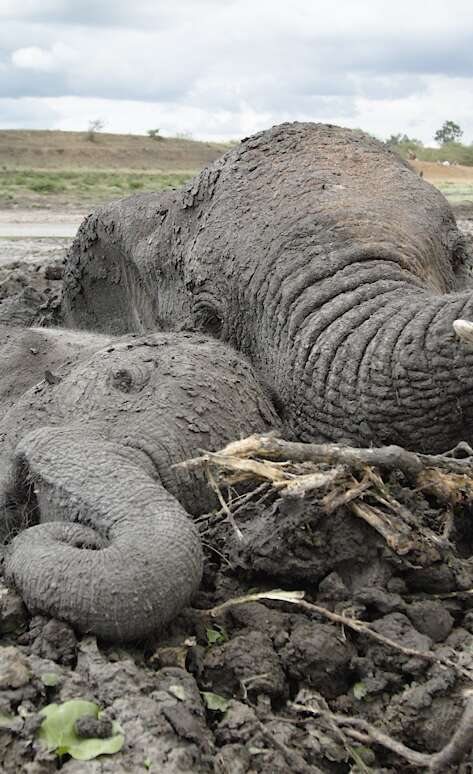
When they reached what looked like water, it must have felt like a small miracle. From a distance, the surface shimmered, dark and inviting — a promise after days of thirst. But drought plays cruel tricks. What the elephants believed to be a watering hole was, in truth, a vast stretch of dense, sucking mud — a hidden trap waiting for weight and movement.
The mother stepped first.
Her massive foot slipped.
In an instant, everything changed.
As she tried to regain her balance, the mud gave way beneath her. The heavier she struggled, the deeper she sank. Each attempt to stand only pulled her farther down, the thick sludge clinging to her legs like wet cement.
Sean Michael, director of communications at Sheldrick Wildlife Trust, would later explain it simply: she had no traction. No way to stand.
The calf panicked.
Young, inexperienced, and terrified by his mother’s distress, he stumbled forward — and slipped into the mud beside her.
Now there were two.
For two days, under a merciless sun, the pair fought the earth itself. The mud tightened its grip, drawing them deeper with every movement. The mother’s strength faded hour by hour. Dehydration set in. Her legs churned uselessly, exhaustion weighing heavier than her own massive body.
There was nothing she could do.
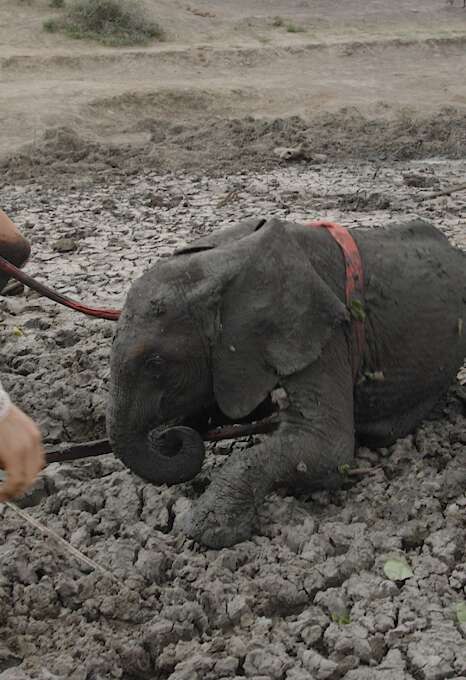
Except protect her baby.
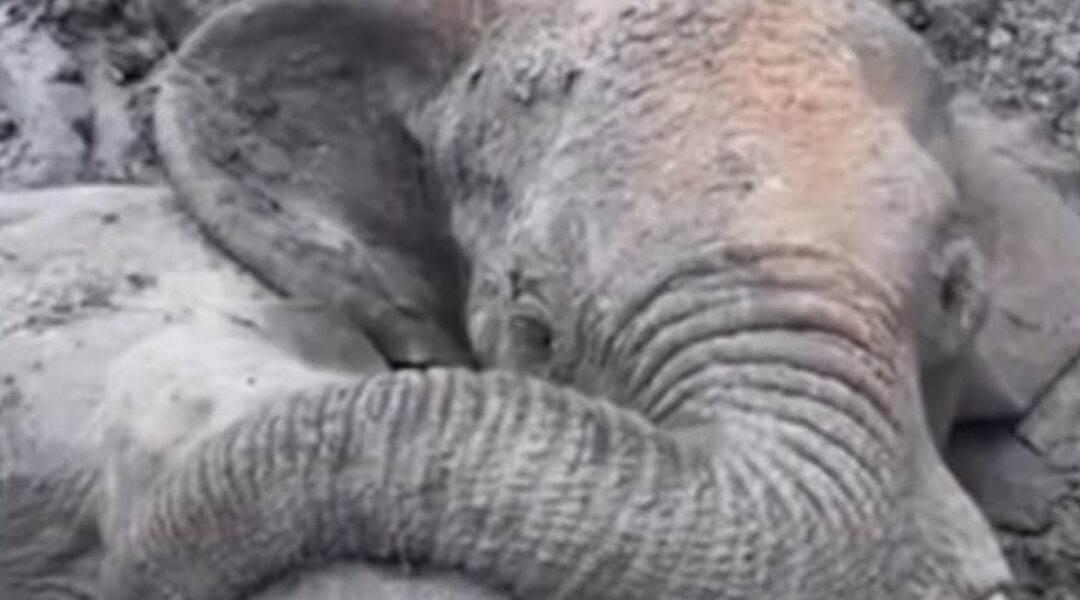
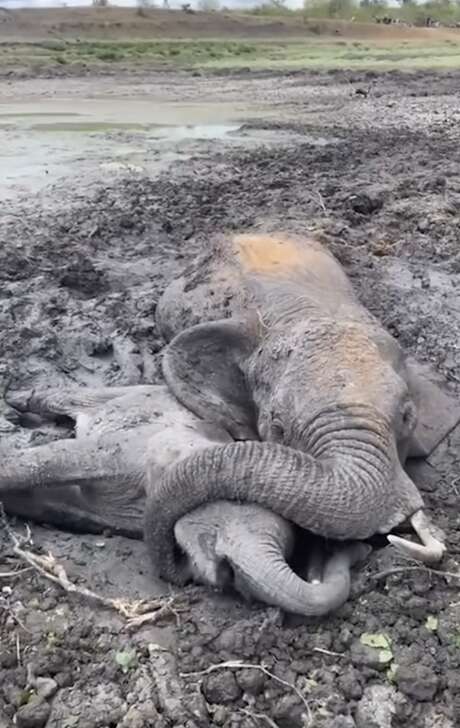
She pressed her trunk against him, holding him close, shielding him from sinking further. When the heat burned and the flies gathered, when thirst clawed at her body, she stayed wrapped around him — an unspoken promise that even if she could not save herself, she would not abandon him.
This was motherhood stripped bare.
No escape.
No certainty.
Only love.
Word of the trapped elephants reached the Kenya Wildlife Service and Wildlife Works, who immediately contacted Sheldrick Wildlife Trust (SWT). The area was heartbreakingly familiar. Just days earlier, SWT had rescued two other elephants from the same dangerous stretch of land — a deadly illusion created by drought.
When the rescue team arrived, the situation was dire.
The calf desperately needed milk. The mother was severely dehydrated, her legs churning weakly, no longer even fighting — just moving out of instinct. The team administered fluids to the mother, trying to give her body enough strength to endure what would come next.
Then they began digging toward the calf.
The mother reacted instantly.
“She was going crazy because she was so protective of her baby,” Michael said later. While elephants often understand when humans are there to help, this mother did not see rescuers — she saw a threat.
She feared losing the one thing she had left.
She draped her trunk over her calf’s body and refused to move. Every attempt to reach him was met with fierce resistance. Even trapped, even exhausted, she would not allow anyone near her baby.
The rescuers understood.
To save both lives, they made a difficult decision: the mother would need to be safely anesthetized.
When the sedative took effect, the team worked quickly. They freed the calf from the mud, lifting him out at last. But the moment he was placed on solid ground, the calf realized something was wrong.
His mother wasn’t moving.
He cried out.
Over and over, he ran back toward her, wailing, his small body trembling with fear. He did not understand anesthesia. He only knew his mother was still trapped — and he would not leave her.
“Elephants are hugely family-oriented creatures,” Michael explained. “Mothers and babies are extremely loyal and attached to each other.”
So the veterinarians made another hard choice.
They anesthetized the calf as well — gently, carefully — so the team could focus on the mother without the baby running back into danger.
Freeing her was no small task.
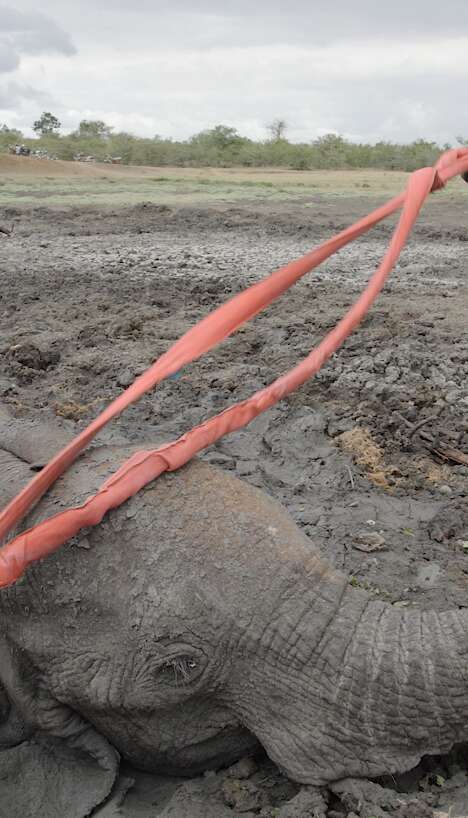
The mud had claimed her body completely. Rescuers dug tirelessly, shovels sinking, arms aching. Three vehicles were brought in — a tractor and two Land Cruisers — their engines straining as ropes were secured around her massive frame.
Slowly. Carefully.
The mud resisted.
And then, inch by inch, she began to move.
After hours of coordinated effort, the mother elephant was finally pulled free.
The rescue took an entire day.
When the anesthesia wore off and the calf was revived, the first thing he did was wobble toward his mother. Unsteady but determined, he nudged her with his trunk, urging her to wake up, to stand, to follow.
When she stirred, he didn’t wait.
He turned and began to lead.
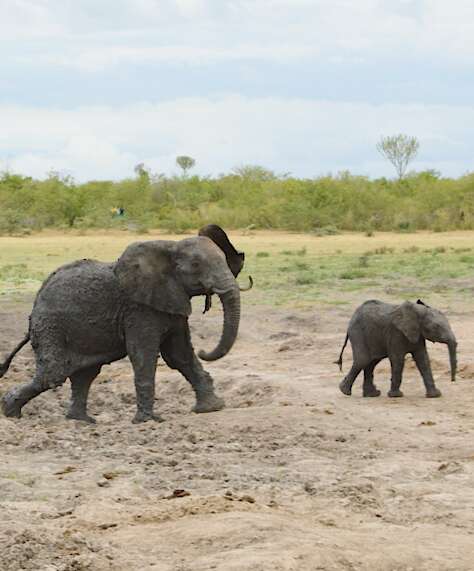
Together, still coated in drying mud, the pair walked away from the pit that nearly claimed them. This time, the calf went first, carefully testing the ground, showing his mother the path forward — a quiet reversal of roles that brought rescuers to tears.
They watched as the elephants disappeared back into the wilderness, small clumps of mud falling from their backs with each step.
Both survived.
No broken bones. No lasting injuries. Just exhaustion, thirst — and life.
But the story did not end there.
Moved by what they had witnessed, Sheldrick Wildlife Trust worked with the local chief and county government to address the danger permanently. The treacherous mud was reshaped and secured, transformed into a dam that could still serve the community — without becoming a death trap for elephants.
Because rescue should not only save lives.
It should prevent suffering from repeating itself.
In a year defined by drought and loss, this mother and calf reminded the world of something ancient and powerful: that love does not loosen its grip, even when the earth itself tries to pull you under.
She could not stand.
She could not flee.
But she held on.
And because of that — because of her refusal to let go, and the people who refused to look away — two lives walked free again.
Together.