

Mrs. Johnson taught eighth grade at a school most people only talked about in statistics. Low income. Underfunded. “Difficult kids.” She had heard all the labels. Still, every morning, she stood in her classroom believing something simple: behavior always tells a story.
She noticed David early in the year.
He was angry in a way that went deeper than teenage attitude. He snapped at teachers. He fell asleep during lessons. When other students laughed at him, he lashed out with his fists. And they laughed often—because his clothes were dirty, because he smelled bad, because it was easy to pick on the kid who already looked defeated.
Most teachers saw a problem.
Mrs. Johnson saw a warning sign.
One afternoon, David was sent to the principal’s office for stealing. A girl had caught him taking a stick of deodorant from her backpack. The rule was clear: theft meant suspension.
Mrs. Johnson walked straight to the office.
“Don’t suspend him,” she said quietly. “Send him to me.”
When David entered her classroom later that day, he was braced for impact. His jaw was tight. His fists were clenched. He stood near the door, already preparing for another lecture, another punishment, another confirmation that adults only saw him as trouble.
Mrs. Johnson locked the door.
Without raising her voice, she crossed the room and opened a large metal cabinet in the corner. The hinges creaked as the door swung wide.
David stared.
Inside were rows of supplies—not textbooks or papers, but toothpaste, toothbrushes, soap, shampoo, deodorant, clean socks. There were granola bars, crackers, small bottles of water. Everything neatly organized. Everything intentional.
“I keep this for students who are having a hard time,” she said gently. “I know things are tough at home. I know the water got turned off at your apartment. I heard your mom talking to the office.”
The fight drained out of David’s body.
His shoulders dropped. His breathing changed. And then the tears came—quiet at first, then uncontrollable. Years of shame poured out in seconds.
“You’re not a thief,” Mrs. Johnson told him. “You just want to be clean. That’s dignity, David. Not a crime.”
She handed him a paper bag.
“Take what you need,” she said. “And if you want, come back every Friday and refill it. No one else has to know.”
David filled the bag with shaking hands. Deodorant. Soap. Food. Not once did she rush him. Not once did she make him feel small.
“Thank you,” he whispered.
David didn’t turn into an A-student overnight. His grades improved slowly. But something far more important changed. He stopped fighting. He stayed awake in class. He came to school clean. And for the first time, he walked the halls with his head up instead of his eyes on the floor.
Someone had finally treated him like he mattered.
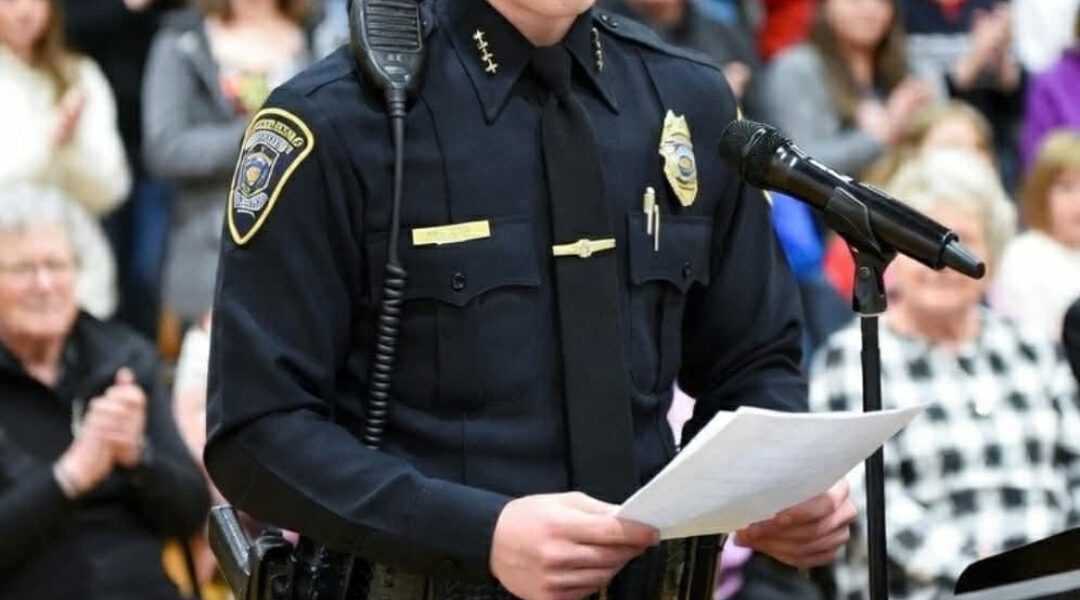
Ten years later, Mrs. Johnson stood in a crowded room at her retirement party. There were speeches, flowers, laughter. Then a tall, confident young man in a police uniform walked in.
She didn’t recognize him at first.
Until he smiled.
It was David.
He stepped up to the podium, cleared his throat, and looked straight at her.
“Mrs. Johnson didn’t just teach me history,” he said. “She taught me I was worth being taken care of. She gave me soap—but what she really gave me was self-respect. I’m a police officer today because she showed me that authority doesn’t have to mean cruelty. It can mean compassion.”
The room was silent.
Mrs. Johnson wiped her eyes.
Sometimes, changing a life doesn’t take discipline or punishment. Sometimes it takes a locked door, a cabinet full of kindness, and one adult who chooses to see the child behind the behavior.