
The clock on the wall read 4:30 a.m. The laundromat should have been empty at this hour, drowned in darkness and the silence of moments when the world was still asleep. That was exactly why Rosa loved this time—the steady hum of washing machines like a lullaby, the faint scent of detergent drifting through the air, and the rare peace that the bustling daytime world never allowed her to enjoy.
Rosa had worked at this laundromat for fifteen years. Fifteen years of sleepless nights, hands calloused from water and chemicals, eyes red from exhaustion. But she never complained. Every coin she earned was a small brick building toward a future for her granddaughter studying at a university in a distant city.
Tonight, she was wiping the last bits of lint from the final dryer when her eyes caught something near the vending machine. Something moved.
At first, Rosa thought it was just a pile of clothes someone had forgotten. But then it shifted, and a small, exhausted sob echoed through the silent space.
Her heart stopped.
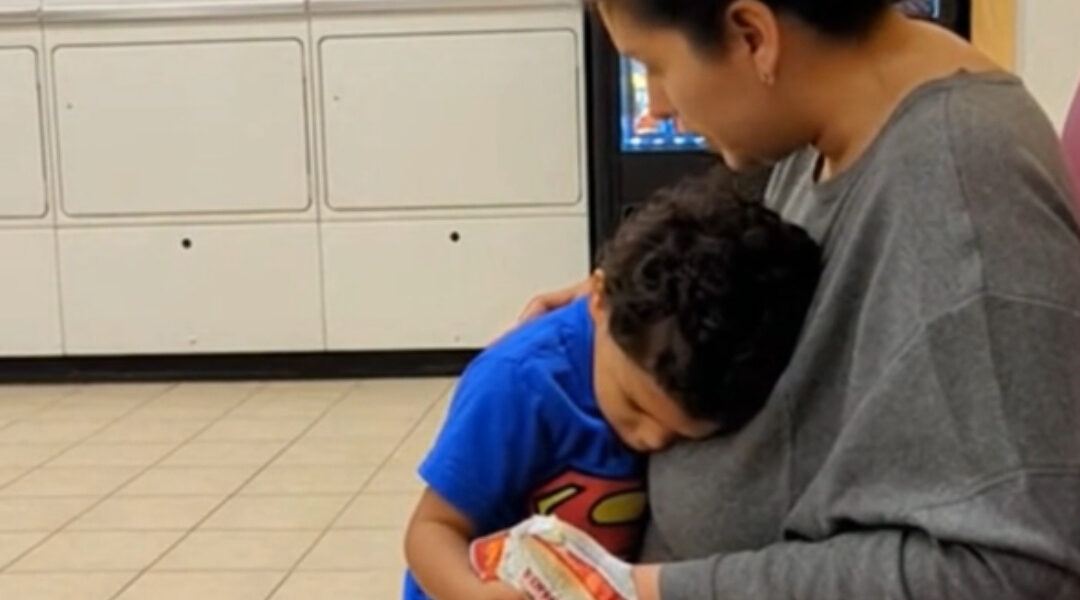
A little boy, maybe five years old, was curled up on a hard plastic chair. Bare feet tucked under his small frame, a wrinkled superhero T-shirt clinging to his body. Messy black hair, cheeks flushed from crying, and his eyes—those eyes held a fear no child should ever have to carry.
“Hey, mi amor,” Rosa whispered, kneeling a few feet away. Her voice was soft as a breeze, afraid of frightening him further. “Where’s your mamá?”
The boy rubbed his eyes, blinking against the cold fluorescent lights. “Mom… Mom said she’d be right back,” he stammered, his voice hoarse from crying too much. “She went to get money. I waited. The dryers stopped spinning.”
“How long ago?”
The boy shrugged, his lower lip trembling. “There were… there were cartoons on. Now it’s… the news.”
Rosa glanced up at the small TV in the corner. Morning anchors were talking about the weather, traffic, the ordinary things of a new day. Hours had passed.
She moved slower now, as if approaching a wounded baby bird. She understood—she understood what it felt like to be abandoned. Fifty years ago, she had been a child just like this one, huddled at a bus stop, waiting for a mother who never came back.
“Are you hungry?” she asked gently.
The boy nodded, silent. His large round eyes watched her with caution mixed with hope.
Rosa reached into her pocket and pulled out her last coin—the one she had saved to buy tomorrow morning’s coffee. She slipped it into the vending machine, her calloused fingers pressing each button with certainty. A granola bar dropped with a soft “thunk.”
“You can sit here with me,” Rosa said, her voice warm like the winter days when she used to hold her granddaughter close. “We’re going to call some kind people, people who help find mamás for little ones. Okay?”
The boy hesitated. His eyes looked at Rosa, then at the glass door, then back at Rosa. Perhaps he was wondering if he could trust this strange woman. Perhaps he was hoping that door would open and his mother would walk through.
Then he slid off the chair.
Tiny bare feet padded across the cold tile floor. Step by step, he moved toward Rosa. And when that small body pressed against her side, Rosa felt it—the boy was trying, trying with everything he had not to fall apart.
He was trembling. Not from cold, but from fear. From loneliness. From not understanding why his mother hadn’t come back.
Rosa wrapped her arms around him, gentle as if holding a fragile dream. She felt the small heart beating rapidly against her, felt the tears soaking through her uniform.
“I’m not going anywhere,” Rosa murmured into his soft hair, her voice catching. “I’m here. I’ve got you.”
Outside the glass windows, the sky was shifting from black to gray. A new day was about to begin. The first cars had started moving along the streets. The city was waking up.
But inside this small laundromat, time seemed to stand still. There was only the hum of washing machines, the gentle scent of detergent, and two people—one old, one young—leaning on each other through the long night.
Rosa knew she would have to call the authorities. She knew there would be questions, procedures, complications ahead. But right now, the only thing that mattered was that the boy in her arms had stopped shaking.
He had found a harbor, even if only temporary.
And Rosa—the cleaning woman with calloused hands and a heart full of scars—had rediscovered something she thought she had lost long ago: the belief that in this world, sometimes, a warm embrace can save a soul.
“What’s your name?” she asked softly.
“Miguel,” the boy whispered.
“Miguel,” Rosa repeated, as if carving that name into her heart. “That’s a beautiful name. I’m Rosa. And I promise you—everything is going to be okay.”
The boy looked up at her, his eyes still red but less afraid now. He said nothing, only nodded and squeezed her hand tighter.
Outside, the sun was rising.
Sometimes, angels don’t have wings. They wear cleaning uniforms and work the night shift at laundromats.