
For seventeen days, the forest held its breath.
Hidden deep within a remote stretch of land, an elephant lay still—too still for an animal whose life depends on movement. His name was Moti, and at thirty-five years old, he was balanced on the edge between survival and surrender.
Each passing sunrise marked another day closer to death.
And yet, somehow, he held on.
The Fall No One Saw in Time
No one knows exactly when Moti’s suffering began.
What was clear, when rescuers finally reached him, was that this was not a fresh injury. His front leg had been broken for a long time—long enough for infection to take hold, long enough for pain to become routine, long enough for his body to slowly give way beneath him.
At some point, Moti collapsed.
An elephant weighs several tons. When an animal of that size is unable to stand, the danger multiplies quickly. Prolonged immobility causes something called hypostatic pressure—the crushing weight of the body pressing against internal organs. Blood flow is restricted. Muscles deteriorate. The heart and kidneys begin to fail.
For elephants, lying down too long is often a death sentence.
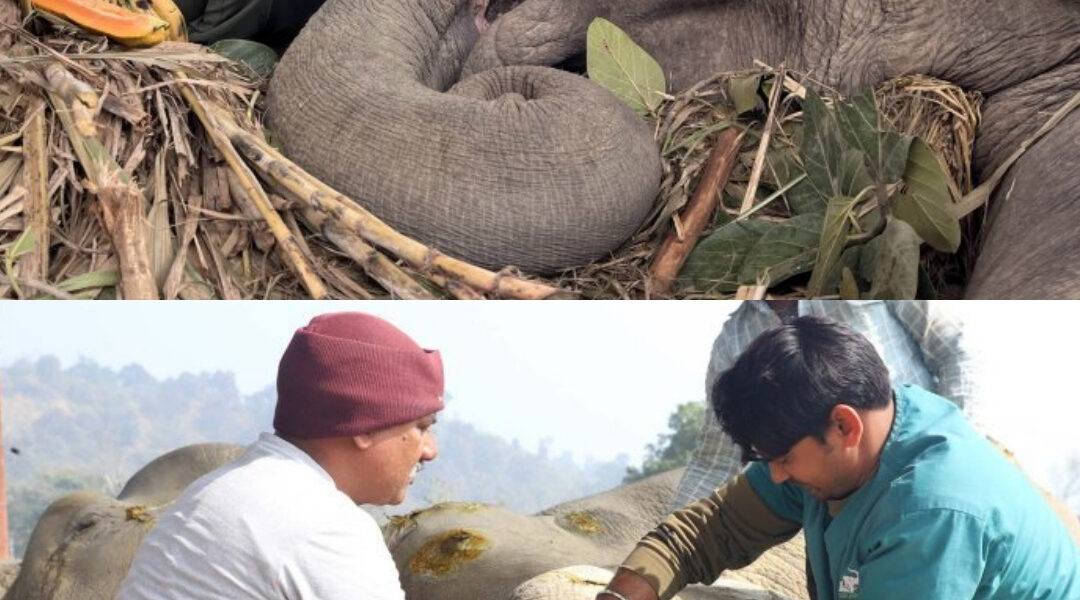
By the time help arrived, Moti had been unable to stand for seventeen days.
Seventeen days of pain.
Seventeen days of pressure.
Seventeen days of waiting—without knowing if anyone would come.
A Body Giving Up—But Not a Spirit
Rescuers from the conservation charity Wildlife SOS were the first to fully understand the gravity of the situation.
Moti’s foot pad and toenails were severely infected. His leg fracture had gone untreated. His body showed signs of extreme exhaustion. And yet, when people approached him, something unexpected happened.
He did not panic.
He did not lash out.
He did not surrender.
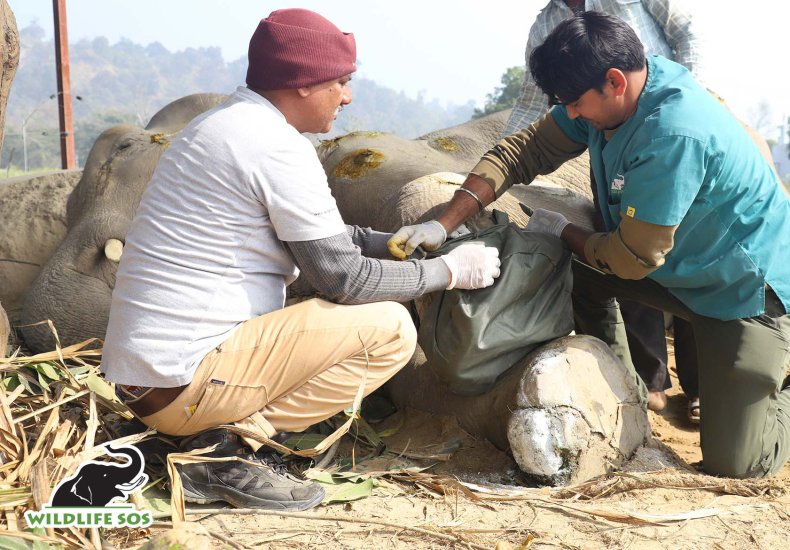
He watched.
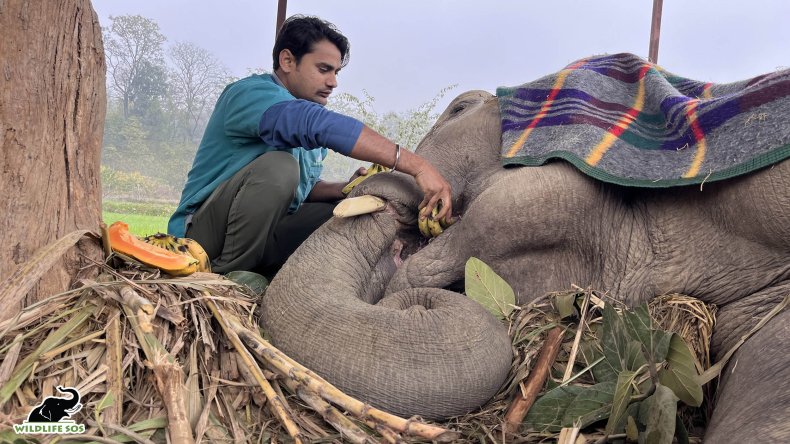
Elephants are intelligent beyond words, capable of recognizing intent. As veterinarians and caregivers moved carefully around him—treating wounds, cleaning infections, offering water and food—Moti remained alert.
Weak.
In pain.
But present.
It was as if he knew this moment mattered.
The Race Against Time
There was one terrifying truth everyone involved understood: if Moti did not stand soon, he would die.
No amount of medicine could reverse the effects of hypostatic pressure indefinitely. His organs were already under strain. His body was losing the battle.
The solution was as risky as it was necessary.
Moti had to be lifted.
Not nudged.
Not encouraged.
Lifted.
But lifting an elephant is not something done lightly—or safely—without immense planning. One wrong move could worsen his injuries or cause catastrophic failure.
Recognizing the urgency, the Indian Army was called in.
What followed was a rare collaboration between wildlife conservationists, veterinarians, forest officials, and military engineers—all united by one goal:
Keep Moti alive.
Seventeen Days End in One Moment
The day of the lift arrived quietly.
Ropes were carefully positioned. Support systems were secured. Veterinarians monitored every breath, every sign of stress. Pain management was administered. The forest itself seemed to fall silent.
Then—slowly—Moti began to rise.
Cameras captured the moment, but no video can fully express what it meant.
As his massive body was lifted upright for the first time in over two weeks, gravity shifted. Blood began flowing properly again. His organs were given a chance to recover.
He stood.
Not confidently.
Not easily.
But enough.
Enough to save his life.
For those watching, many of whom had spent days preparing for the possibility of losing him, it was overwhelming. Seventeen days of waiting had come down to a few fragile minutes suspended between hope and heartbreak.
And hope won.
Standing Is Not the End—Only the Beginning
Moti’s rescue did not mean his suffering was over.
His front leg remained incapacitated. The fracture was severe. Transporting him to Wildlife SOS’s elephant hospital—a journey of nearly eight hours—was too dangerous in his condition, especially given the remoteness of the location.
For now, Moti remains where he is.
But he is no longer alone.
And he is no longer collapsing into death.
He is supported while standing.
He receives continuous pain relief.
He eats.
He drinks.
He responds.
These may sound like small victories.
They are not.
For an elephant who lay on the brink of organ failure, every bite of food, every swallow of water, every steady breath is a declaration of resilience.
Compassion in Action
Kartick Satyanarayan, co-founder and CEO of Wildlife SOS, later spoke of the rescue with gratitude and humility.
This was not the work of one organization.
Not the success of one team.
It was a collective act of compassion.
The Indian Army.
Veterinarians.
Forest Department officials.
Caretakers.
Conservationists.
People from vastly different roles and backgrounds came together—not for profit, not for recognition—but because a life was at stake.
Moti is not just an elephant.
He is part of India’s natural heritage.
A living reminder of the bond between humans and the wild.
Saving him was not only an act of rescue—it was a statement.
That suffering should not be ignored.
That neglect should not be normal.
That even the largest, most powerful animals can be heartbreakingly vulnerable.
What Moti Teaches Us
Moti’s story is not extraordinary because he is an elephant.
It is extraordinary because he endured.
Seventeen days without standing.
Seventeen days of pain no one treated.
Seventeen days where the easier outcome—for the world—would have been to look away.
But someone noticed.
Someone cared.
And when one group could not do it alone, many stepped in.
In a world that often measures worth by convenience, Moti was inconvenient.
Heavy.
Difficult.
Expensive.
Time-consuming.
And still—he was saved.
Still Here
Moti’s journey is far from over.
Recovery will be slow.
Uncertain.
Challenging.
But today, he stands.
Today, his heart still beats.
Today, he eats and drinks under watchful eyes.
Today, he has a chance.
And sometimes, a chance is the greatest miracle of all.
Seventeen days on the brink of death did not break him.
Instead, they revealed something profound:
That life—when met with compassion—can endure far longer than anyone expects.
And that even in the quiet corners of the forest, hope can rise… one careful lift at a time.