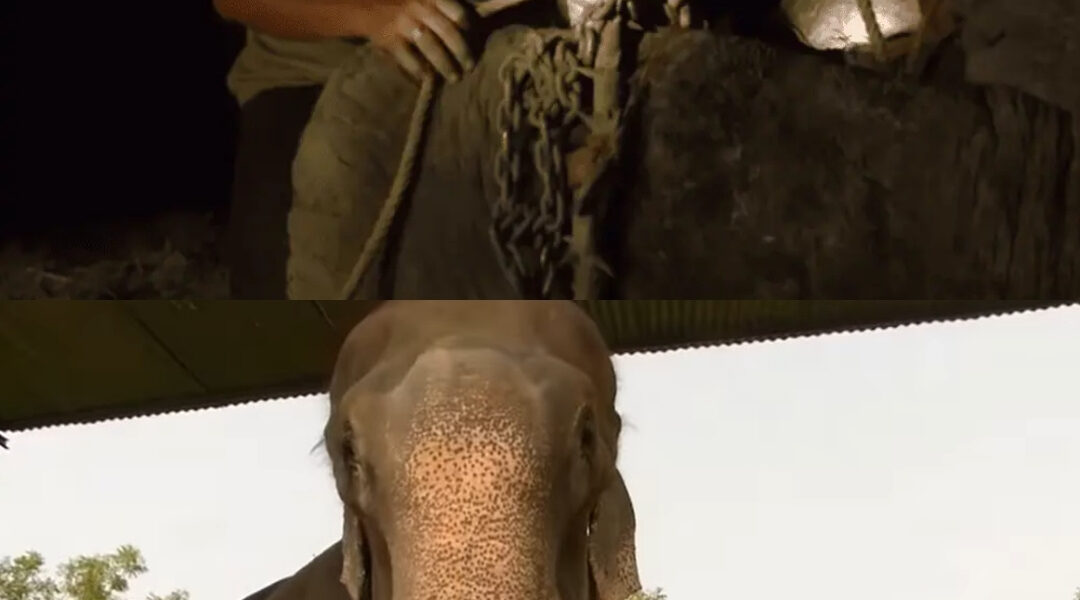

For half a century, Raju lived in chains.

Not metaphorical ones—real, jagged, rust-eaten chains that carved into his flesh, day after day, year after year. Chains that wrapped around his legs so tightly they left permanent grooves in his skin. Chains that clinked whenever he tried to take a step, reminding him that every moment of his life belonged to someone else.
No one knows exactly when his suffering truly began. Maybe it was the day he was torn from his mother, her cries echoing into the forest as he was dragged away. Maybe it was the first time a man struck him to make him “obey.” Or maybe it was all the moments in between—the hunger, the beatings, the loneliness—that slowly shaped his world into nothing but pain.
But one thing was certain:
Raju had not known a single day of freedom in 50 years.
A Lifetime of Pain
People passed him on dusty roads and never knew his story. They saw a silent elephant with sad eyes, unaware that those eyes held decades of grief. His ribs were visible beneath his wrinkled skin. His feet were infected from standing on concrete and metal. The spikes embedded in the chains cut deeper with every step, punishing him even for moving too slowly.
Sometimes, in the darkest hours of the night, Raju would gently rock back and forth—a sign seen only in elephants who have endured profound psychological trauma. He was starving, beaten, and used for profit by men who saw him not as a living being, but as property.
Fifty years is a long time to suffer.
A long time to wait for someone to care.
And yet… he waited.
The Call That Changed Everything
Thousands of miles away, in North London, a small team at Wildlife SOS received a tip about an elephant living in horrifying conditions. They had rescued elephants before, but this case was different. The photographs showed wounds so deep they looked like open craters. The chains were sharper than anything they had seen. And in his eyes… they saw something that broke them.
They saw tears.
Real tears streamed down Raju’s face the night the rescue began—tears that would later be seen by millions across the world.
Within days, Wildlife SOS assembled a rescue operation:
10 charity workers, 20 Forest Department Officers, 6 policemen, and a mission fueled by urgency, fear, and hope.
They flew to India, unsure of what awaited them. What they found was worse than they imagined.
Raju was standing alone in the dark, starving, exhausted… and terrified.
His captors tried to whisk him away before help arrived. They shouted, threatened, and even attempted to make Raju flee so rescuers couldn’t reach him. But the team held their ground. They refused to leave without him.
And that night—under a moonlit sky—Raju’s life finally changed.
The Moment the Chains Fell

The video begins quietly.
A man kneels beside Raju’s massive leg. He is not afraid—not of the elephant’s size, nor of the decades of pain written on his skin. His hands move slowly, respectfully, gently unraveling the chains wrapped around Raju’s ankles.
Metal clinks softly against the dirt.
Each layer of chain reveals a wound beneath it.
Each wound reveals a story of cruelty.
The spikes are the worst of all. Sharp, long, and curved inward, they were designed to dig into his skin every time he moved—even to punish him for breathing.
As the rescuer loosens the final knot of metal, Raju does something no one expected:
He lifts his foot.
Not to strike.
Not to flee.
But to help.
“As if he wanted to free himself,” one rescuer later said.
And then…
the final chain falls.
A sound so simple.
A sound so small.
But somehow, it echoes across half a century.
Raju doesn’t move at first.
He just stands there—bare, wounded, trembling.
Then tears begin to fall again.
Not from pain this time, but from something unfamiliar… something fragile… something he hadn’t felt in decades:
Hope.
The First Morning of Freedom
Sunrise washes over him like a blessing.
For the first time in 50 years, Raju is not being forced to walk, carry tourists, or obey commands. He is simply standing in the light, feeling warmth on his skin instead of blows.
The video shows him exploring his surroundings—hesitantly at first, then with growing curiosity. He reaches up and tears leaves from a branch, then fans himself gently with them, as if savoring the feeling.
He is learning what it means to be an elephant again.
His wounds begin to heal in the months that follow. Volunteers clean his skin daily. Veterinarians treat his infections. He gains weight. He sleeps on soft earth instead of concrete. He makes friends with other rescued elephants—elephants who understand his pain in ways words could never express.
And one day, he does something miraculous:
He plays.
A small splash of water.
A gentle trumpet call.
A spark of joy returning to a soul that had every reason to give up.
Freedom has a way of bringing life back to the broken.
A Symbol of What We Can Change
Raju’s story is not just about one elephant.
It is about every animal living in chains.
Every creature suffering in silence.
Every life waiting for someone to fight for it.
His freedom became a global message:
Cruelty exists because people allow it.
But compassion exists because people choose it.
Raju was saved because strangers cared.
Because ordinary people saw his tears and refused to look away.
His healed leg is more than a wound closing—it’s a symbol of what kindness can do.
Watch Raju’s Journey
If you cannot read the whole story,
watch the video and witness the moment the chains fall.
Then share your thoughts. Speak up. Raise your voice.
Because no elephant—no animal—should ever endure what Raju endured.
Together, we can make sure his story is never repeated.
Together, we can ensure that Raju’s tears were the last he ever shed.