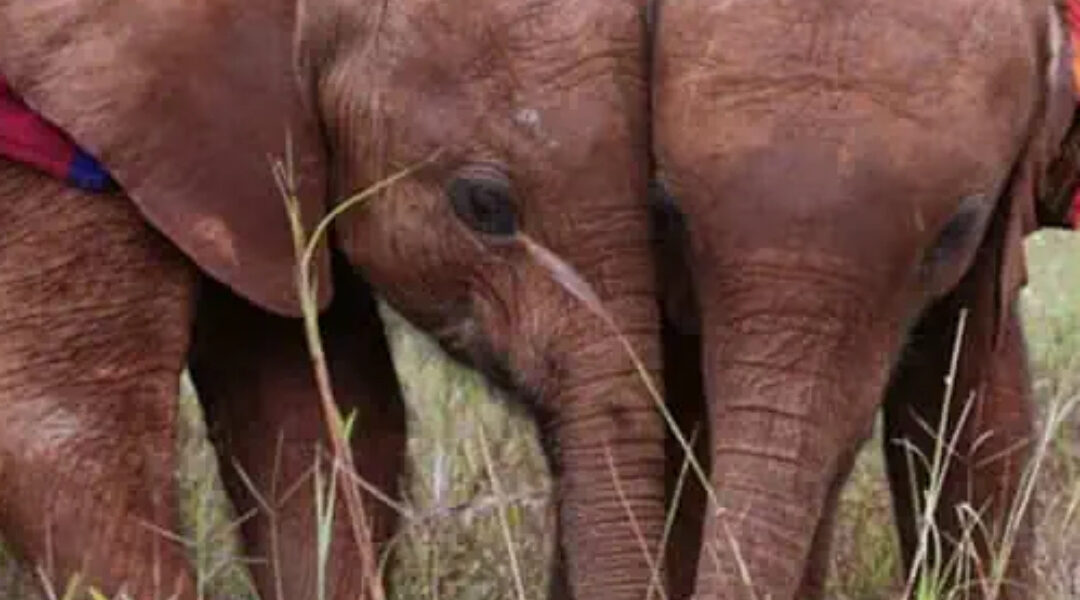

They were born into a world that promised protection, guidance, and family.

And then, almost immediately, that promise was taken away.
Ashaka and Kamok did not meet in the wild. They did not grow up side by side beneath the same matriarch’s watchful eye. They came from different places, different beginnings, different moments of heartbreak. Yet the loss they carried was the same—a mother gone, a herd vanished, and a silence no baby elephant should ever have to face alone.
Kamok’s life began with fear.
She was only a day old when she was left behind. Too weak to keep up, her tiny legs trembling beneath her, she wandered in confusion, calling out with a voice that should have been answered. Instead, there was nothing. No mother’s shadow. No comforting rumble. Just open land and the growing certainty that she had been abandoned.

Exhausted and frightened, Kamok stumbled into a human camp, her cries thin but desperate. Rangers knew immediately what they were seeing. A newborn elephant, alone, unable to survive without help. They lifted her gently, fed her with a bottle she barely understood, and stayed with her through the night—because no baby elephant should ever sleep alone.
Ashaka’s rescue came weeks later, and it was no less terrifying.
She was just three weeks old when her cries echoed from the bottom of a deep waterhole. Trapped, exhausted, and slowly weakening, she had no way out. It was her voice—raw and urgent—that alerted rangers nearby. They rushed in, lowered ropes, and pulled her to safety just in time.

Like Kamok, Ashaka had lost her mother.
Like Kamok, she was far too young to survive on her own.
Both calves were flown to the David Sheldrick Wildlife Trust nursery, where orphaned elephants are given something most of them thought they had lost forever: a second chance.
But rescue alone does not heal grief.
Baby elephants mourn. They remember. They search for what is missing.

At the nursery, surrounded by caregivers who fed them, walked with them, and slept near them at night, Ashaka and Kamok slowly began to stabilize. They learned routines. They learned trust. But something inside them still reached outward, looking for the connection only another elephant could give.
That’s when they found each other.
They were introduced quietly, without ceremony. Two small females, both from the same infant group, both still unsteady in their new world. At first, it was simple proximity—standing close, brushing shoulders, mirroring movements.

Then it became something deeper.
They began to walk together, trunks occasionally touching. When one lay down, the other followed. When one ventured forward, the other stayed close. In the mud, they rolled side by side, splashing and stumbling in playful chaos. They chased warthogs together, knocked over bushes together, and collapsed in the shade together when the day grew too hot.
They were no longer alone.

Caregivers noticed it quickly. Ashaka and Kamok were inseparable. Where one went, the other followed. If one grew anxious, the other calmed her. They rubbed their heads together in quiet reassurance, a gesture passed down through elephant generations—a way of saying, I’m here.
Rob Brandford, the UK director of the Trust, explained it simply: when elephants lose their herds, they rebuild them. The other orphans become family. Friendships form not out of convenience, but necessity—and many of these bonds last a lifetime.
For Ashaka and Kamok, that truth was unmistakable.

They were still bottle-fed with a special milk formula, still under constant watch. Rangers walked beside them daily, guiding them through the park, protecting them from danger, letting them explore without fear. When the sun scorched the ground, caregivers coated their skin in wet mud to cool them down. When night fell, someone was always there.
Still, it was clear that no amount of human care could replace what these two gave each other.
They offered companionship without conditions. Comfort without questions. Understanding without words.
Visitors to the park often stopped to watch them—two small elephants pressed close, playing like sisters, resting like family. Few could imagine the pain that had brought them there. Fewer still could look away.

The David Sheldrick Wildlife Trust was founded nearly five decades ago with a single belief: that orphaned wildlife deserves more than survival—they deserve healing. Over the years, the Trust has rescued and raised more than 150 elephants, carefully reintegrating them into the wild when they are ready. Some return to herds. Some form new ones. All carry their stories with them.
Ashaka and Kamok are still young. Their journey is far from over. One day, if all goes well, they will leave the nursery and slowly learn to live free again. But whatever the future holds, one thing is already certain.
They will not face it alone.
They lost their mothers.
They lost their herds.
But in each other, they found something unbreakable.
In a world that took so much from them so early, Ashaka and Kamok chose connection over despair. And in doing so, they remind us of something quietly powerful:
Family is not always who we are born to.
Sometimes, it’s who stays.