

The cafeteria at the VA hospital was always loud — trays clattering, nurses laughing between shifts, televisions humming with news no one really wanted to watch. But somehow, despite all that noise, Specialist Chris Hayes felt completely invisible.
He was only 22, but he felt older inside. Too old. Too tired. Too defeated.
A training accident had torn the ligaments in his knee and fractured something far deeper — his confidence, his sense of purpose, the quiet belief that he was supposed to be strong. Recovery was long, painful, and lonely. He had been sent far from home for better treatment, and the distance made everything feel heavier: the nights, the silence, the doubt that seemed to settle on his shoulders.
Every day, he ate lunch alone in the corner of the VA cafeteria.
Every day, he watched the men around him — real heroes, decorated veterans, warriors who walked with canes or rolled in wheelchairs but still carried unimaginable strength.
And every day he felt like he didn’t belong among them.
But there was one person he watched more than the others.
A 90-year-old widow with silver hair pulled neatly into a twist, pearl earrings, and a quiet grace that made strangers instinctively lower their voices when they passed her.
Her name was Dottie.
She always sat at the same table — the one by the window where the sunlight pooled like warm honey across the surface. Dottie never rushed her food. She took small bites, folded napkins with perfect corners, and kept glancing at the empty chair across from her… as though she expected someone to sit in it.
As though someone still belonged there.
For days, Chris watched her from a distance, not out of rudeness but because something about her touched a place in him he didn’t know how to name. Maybe it was the loneliness. Maybe it was the ritual. Maybe it was the strange comfort of seeing someone who looked like they, too, were trying to hold onto something the world had already taken.
One afternoon, curiosity finally got the better of him.
He asked a nurse, “What’s her story?”
The nurse followed his gaze, her expression softening.
“That’s Dottie,” she said quietly. “Her husband, Frank, was a patient here for nearly twenty years. Vietnam vet. The two of them were inseparable. He passed away last fall.”
The nurse paused, exhaling a sigh laced with affection and sorrow.
“She still eats lunch at his table every day. Same spot. Same time. Says it’s her way of ‘having lunch with Frank.’”
Chris felt something tighten in his chest — a gentle ache, the kind that comes with recognizing devotion so deep it becomes a part of someone’s daily life.
The next day, when he got his lunch tray, he didn’t walk to the corner.
He walked to her.
His hands trembled a little. He wasn’t sure why. Maybe because it felt like he was stepping into someone else’s sacred grief. Maybe because he wasn’t sure if he deserved to be at that table, a place kept warm by memories he had no right to touch.
He stood in front of her, cleared his throat, and said softly:
“Ma’am?”
She looked up, startled at first — then gentle.
“My name’s Chris,” he continued, voice shaking slightly. “And… well… I’m a long way from home. I was wondering… would you and Frank mind if I joined you for lunch today?”
For a moment, she said nothing.
Then her eyes — clouded by age, weight, and love — filled with tears.
A slow, radiant smile spread across her face.
“Oh, sweetheart,” she whispered, placing a delicate hand on the empty chair. “I think Frank would like that very much. Sit. Sit down.”
And just like that, a wounded soldier took a seat at a table for two that had been waiting for a third heart.
For the next two weeks, Chris and Dottie formed a bond that felt as natural as breathing.
She told him stories about Frank — stories filled with laughter, mischief, bravery, and the kind of love that lasts longer than lifetimes. Stories about how he wrote her letters every single day during Vietnam. Stories about how he danced with her in the kitchen until the day his legs couldn’t hold him anymore. Stories about how she still talked to him at night, hoping he heard her somehow.
Chris told her about his own parents, about the fishing trips he missed back home, about the injury that made him question his worth. And somehow, she always knew exactly what to say.
“You’ll heal,” she said one afternoon, patting his hand. “Bodies break. Hearts bend. But good men? They always stand back up.”
He didn’t know it was possible to feel mothered by someone he had just met.
But he did.
Day after day, they ate together, laughed together, held quiet moments together. People began to notice. Nurses whispered, smiling. Veterans nodded approvingly.
For that short sliver of time, the table by the window became a sanctuary — a place where grief softened, where loneliness loosened its grip, where two people from different generations stitched together something gentle and necessary.
On Chris’s last day — the day of his discharge — he nearly avoided the cafeteria altogether. Not because he didn’t want to see her, but because he didn’t know how to say goodbye.
But he went.
And when he walked in, he saw her immediately.
Dottie was dressed up a little more than usual — pearl earrings, hair freshly curled, and a tray carrying her favorite “celebration meal”: a single crab leg, buttered perfectly, the way Frank used to prepare it for anniversaries.
She smiled, wide and proud.
“Sit, Chris,” she said warmly. “Frank told me we should celebrate your recovery.”
He laughed — and then cried, without meaning to.
When it was time to go, Dottie reached for his hand with both of hers. Her skin was thin, almost translucent, but her grip was steady.
“You come back and see me, Chris,” she said softly. “You’re the first new friend I’ve made in ten years.”
He swallowed hard.
“I will,” he whispered. “I promise.”
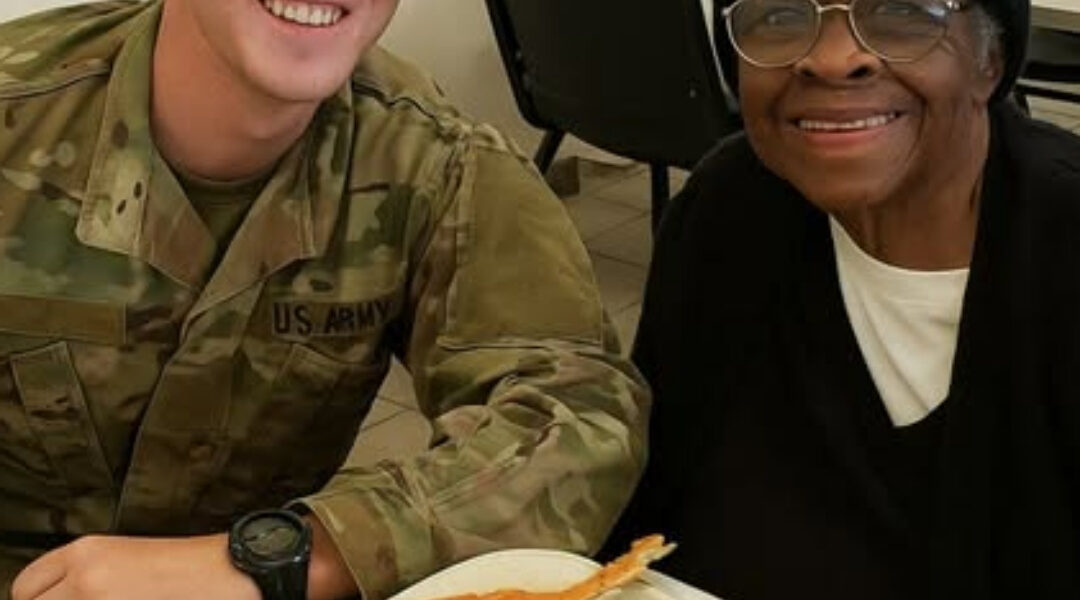
A nurse quietly snapped the photo — a soldier kneeling beside an elderly widow who refused to let love die just because her husband did.
And in that moment, the table wasn’t a place of mourning anymore.
It was a place of connection.
Healing.
Legacy.
A place where someone new finally sat down — not to replace Frank, but to honor him.
A place where loneliness finally loosened its hold on two hearts.