

Anna had always said that Copa carried the past in his eyes.
Most visitors only saw an old chimpanzee with gray hair and slow movements, a relic of the sanctuary’s rescue days. But Anna had known him for fifteen years. She knew the way his gaze lingered on open sky, like he still couldn’t quite believe it belonged to him. She knew the flinch in his shoulders at sudden noises, the way he scanned corners before he settled, as if expecting the walls to close in.
He’d spent most of his life in a tiny concrete cage at a roadside zoo. No trees. No sunlight except what filtered through rusted bars. Just people tapping glass and tossing him junk food, day after day, for decades.
By the time the zoo went bankrupt and Copa arrived at the sanctuary, he was already in his thirties. Old for a chimp in his condition. His muscles were weak, his teeth were damaged, and his trust in the world was gone.
For years, he refused to look anyone in the eye.
Until Anna.
She was a young keeper then, new to the job, all nerves and quiet determination. She didn’t rush him. Didn’t demand tricks or reactions. She just sat outside his enclosure every day, reading reports out loud, humming absentminded songs, talking to him about the most ordinary things.
“Hey old man,” she’d say. “Weather report says rain. You think they ever told you the weather where you came from?”
He would sit with his back to her at first. But his ears twitched when she spoke. Slowly, inch by inch, he started to turn his head. Then one day, he walked over to the mesh, reached a cautious hand toward her, and took the banana she offered.
That was the beginning.
Over the next fifteen years, Copa learned what it meant to step on grass. To climb platforms. To nap in the sun without someone pounding on glass to wake him. He learned that some humans brought pain.
And some humans brought combs.
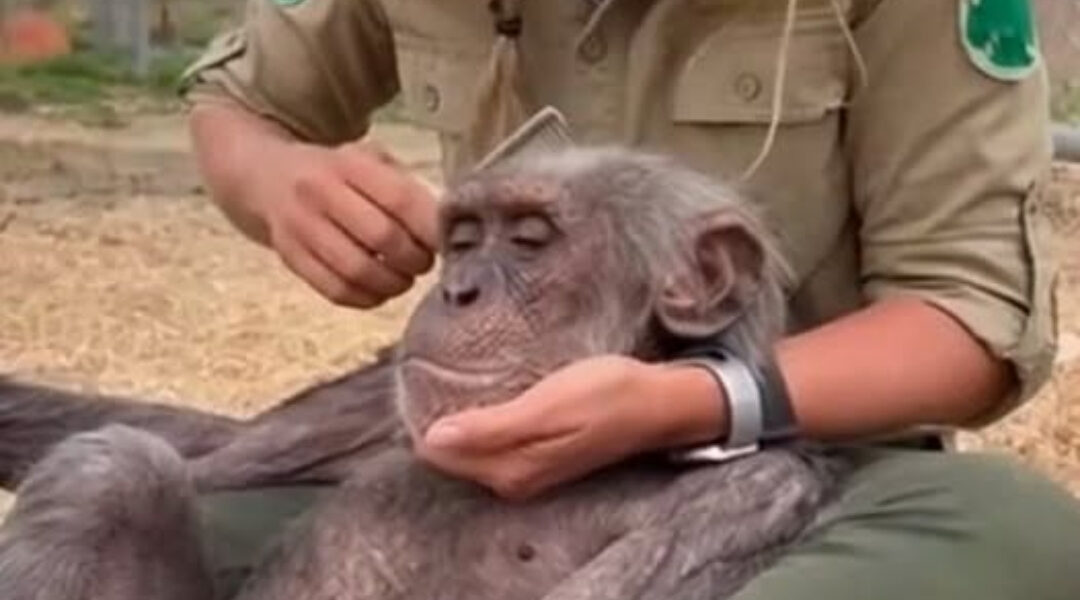
The first time Anna had combed the coarse hair on his head, Copa closed his eyes, his entire body melting with a relief she could feel through the fence. Grooming was how chimps bonded with one another, how they said, You’re safe. You’re mine. I see you.
From then on, every afternoon she could spare, Anna would sit just outside his habitat with that same soft comb. Copa would shuffle over and present his head, then his shoulders, then his arms, trusting her more with each slow stroke.
“I’ve got you, old boy,” she would whisper. “You’re okay.”
Years slipped by that way, measured not in calendars but in small, sacred routines.
Then his body began to fail him.
At first it was little things. Slower climbs. Less appetite. Stiffness on cold mornings. The vet called it “age-related decline,” gentle words for a truth Anna already sensed: Copa was getting tired.
They adjusted his diet. Gave him medications for his joints. Built more ramps so he didn’t have to jump. He’d still come for his combing sessions, still rumble softly when she scratched the spot behind his ears.
But the light behind his eyes grew softer.
In the last month, everything changed.
He started refusing food. First the vegetables, then the fruit he used to love, then even the special treats Anna brought from home. He spent long hours sitting in the far corner of the habitat, back to the world, staring at the blank wooden wall as if it were that concrete cage all over again.
“Maybe he’s in pain,” the vet suggested gently.
They increased his meds. They added supplements. They tried everything they could.
Nothing worked.
Two days ago, Copa stopped eating altogether. He wouldn’t drink. When the keepers offered his favorite juice, he closed his lips and turned away. He didn’t respond to toys, to calls, to the presence of the other chimps nearby.
He just sat.
Still.
Silent.
Done.
Anna watched from outside the habitat, fingers wrapped so tightly around the railing that her knuckles went white.
“He’s shutting down,” the vet said quietly beside her. “His body’s old. His organs are failing. We can keep him alive a little longer… but I don’t think it would be kind.”
The words hit her like a physical blow.
“What are you saying?” she forced out.
The vet took a breath. “I’m saying… it may be time to let him go. Peacefully. Before things get worse.”
Time. Let him go.
They were the right words. The compassionate words. The words she’d heard in other end-of-life meetings for other animals.
But this wasn’t just another animal.
This was Copa.
The old man who had finally learned he wasn’t trapped anymore.
The friend who had trusted her enough to close his eyes and rest while she combed his head.
She imagined him dying in a corner, alone, thinking the world had abandoned him again.
Her chest constricted.
“I need to go in,” she whispered.
“It’s not protocol,” the vet replied gently. “He’s still a powerful animal, even now. We don’t usually—”
“Look at him,” Anna interrupted, voice shaking. “He’s not going to hurt me. He’s already gone somewhere in his mind. I can’t let him do this alone.”
The vet hesitated, then nodded once.
“Five minutes,” he said. “I’ll be right here.”
Anna grabbed the old soft comb from her locker. The one that had dulled from years of use, its handle worn smooth where her thumb rested. She stepped through the double doors, heart hammering as the locks clicked behind her.
The habitat felt different from inside. Bigger, emptier, echoing with memories of all the times Copa had swung, climbed, played. Now it was just quiet straw and the sound of his uneven breathing.
“Hey, old man,” she called softly.
He didn’t turn.
Slowly, she crossed the space between them. She lowered herself onto the hay-strewn floor beside him, knees popping as she sat. Up close, he looked impossibly small — his once-strong shoulders shrunken, his belly hollow, his hair thin and patchy.
“Copa,” she whispered.
At the sound of her voice, his eyes shifted. Just a fraction. Just enough.
She slipped an arm behind his back, another under his knees, and gently guided his body into her lap.
He didn’t resist.
He let out a long, ragged sigh as his head settled against her chest, like a heavy weight finally finding a place to rest. Anna felt the heat of his body through her shirt, the faint tremor in his muscles, the slow thump of a tired heart.
Tears blurred her vision.
“I’ve got you,” she murmured, comb already in her hand. “It’s okay. I know. You’re tired.”
She began to run the comb through the sparse gray hair on his head, just like she had a thousand times before. Slow, careful strokes. The pattern his body recognized.
After a moment, his fingers relaxed. His jaw loosened. The rigid tension that had locked his shoulders for days began to melt away.
Outside the glass, staff members watched in silence. The vet, the younger keepers, the director — all of them seeing something holy in the way the old chimp settled into the arms of the one person he trusted most.
Anna leaned down, her lips close to his ear.
“You’re safe now,” she whispered. “No concrete. No cages. Just sky and grass and people who love you. You did so good, Copa. You made it all the way here. You’re not alone. Not ever again.”
His eyes fluttered shut.
She kept combing, even when her own tears fell onto his fur. She talked about the day he arrived, so angry and scared. About the first time he tasted mango. About the way he used to throw blankets over his head when it rained. She reminded him of all the small, gentle things that had made up his second life.
Minutes stretched into something softer, timeless.
At some point, the tremors in his body eased. His breathing, which had been shallow and uneven, grew slower. Steadier. Peaceful.
The vet stepped closer to the glass, watching, ready if needed.
But Anna didn’t look up.
Her world had narrowed to the weight in her lap, the rise and fall under her hands, the memories swirling between each stroke of the comb.
“Thank you for trusting me,” she whispered. “Thank you for letting me be your person. I’m right here, old man. All the way to the end.”
She didn’t know how long she sat like that.
Only that when his chest finally grew still, his face was relaxed. His body was soft in her arms. He looked, for the first time since she’d known him, completely free.
Anna pressed her forehead to his and closed her eyes.
“I promised you wouldn’t go alone,” she said, voice breaking. “And you didn’t.”
Outside, the sanctuary carried on — birds calling, other chimps chattering, staff moving quietly through their routines. Life continued, as it always does.
But inside that enclosure, on that patch of straw, a 45-year-old chimpanzee who had once been nothing more than an exhibit had died as something else entirely:
A friend.
A soul held gently.
A life that mattered.
And a keeper, with a worn-out comb and a breaking heart, had kept her promise.