

Mark had learned to live with the echo of prison doors.
Fifteen years of concrete, steel, and regret had trained him to accept the things he could not change — the meals, the routine, the fights, the loneliness. But no matter how numb a man becomes, some ache never fades.
His mother was one of them.
Her letters had been steady at first, full of hope, full of forgiveness he didn’t feel he deserved. Handwritten pages that smelled faintly of her lavender soap. She always ended them the same way:
“Come home when you can. I’ll be here.”
But time is a thief.
Letters became shorter. Then fewer. Then months passed without one. When he finally asked a guard to call home, the answer came in a shaking voice:
“She’s sick, Mark. The cancer’s back.”
From that moment, the days lost their shape. Meals turned to sawdust. Nights stretched longer, heavier. Every time the phone rang, he braced himself for the call no son ever wants.
Last week, it came.
His mother, eighty years old, was in hospice. The cancer had spread faster than anyone expected. She didn’t have much time.
Mark dropped to his knees in his cell. His bunkmate said nothing — some pain didn’t need words. That night, Mark prayed for the first time in years.
He begged.
Not for her recovery.
Not for miracles.
Just for one chance to see her.
To say goodbye.
To make something right before she left him behind forever.
The request for a compassionate visit was filed immediately. But hospice rules were strict, and her immune system was nearly gone.
Contact visits were forbidden.
The best they could offer was a no-touch visit behind the thick, cold visitation glass — the same kind used for disciplinary restrictions.
When Mark heard the decision, he nodded, even as sorrow hollowed him out.
He would take anything.
Even glass
Even distance
Even the cruelty of being close enough to see her breath fog the window but never feel the warmth of her hand.
He would take it.
Because it was the last thing he would ever get.
They brought him into the no-contact room at noon. He sat at the steel stool, staring at the fingerprint-smudged divider he’d hated for years.
Today he was grateful for it.
Today it was mercy.
His hands trembled against his thighs. He kept wiping them on his jumpsuit, desperate to stay composed.
When the door on the other side of the glass opened, he inhaled sharply.
A nurse wheeled her in.
And Mark’s world split in two.
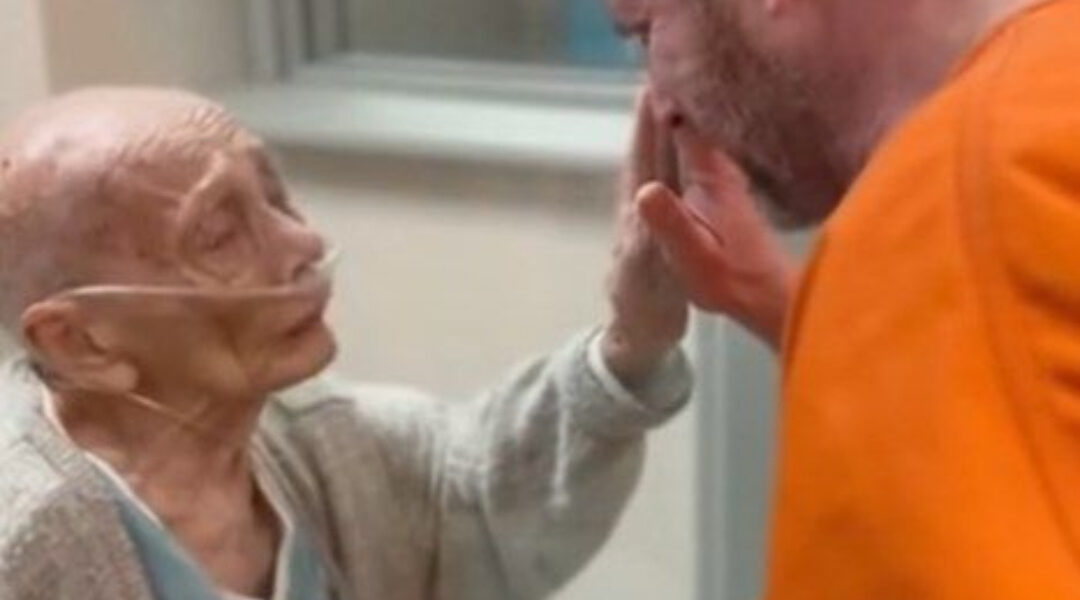
His mother — Margaret — had always been small, but now she looked impossibly fragile. Her skin was pale and thin as tissue paper, veins visible like faint blue lines beneath the surface. An oxygen tube curved under her nose. Her shoulders looked like they could crumble under their own weight.
But her eyes.
Her eyes were the same warm brown he remembered from childhood — the eyes that greeted him on the first day of school, the eyes that waited awake when he came home too late, the eyes that never stopped believing he might still become a better man.
Those eyes found him instantly.
“Mom…?” he whispered, his voice cracking.
Her lips curved into the smallest, softest smile.
“Oh, sweetheart…” she breathed. “There you are.”
Something in him broke.
He pressed both palms to the glass like a child desperate for comfort. Tears blurred everything, but he could still see her smile.
The nurse locked her wheelchair in place and stepped back, giving them space the glass refused to allow.
“Mom, I’m so sorry—”
He choked on the words. They tore out of him raw.
“I’m so sorry for everything. For not being there. For this. For all the years I—”
She shook her head slowly, painfully.
“No, baby…” she whispered. “No. I knew this day would come. I had to see my boy.”
He bowed his head, shoulders shaking.
She had used the last of her strength — her last good hours, maybe her last good day — to make this trip. To sit in this cold room. To see the son she always believed in, even when he didn’t believe in himself.
“I should’ve been better,” he sobbed. “I should’ve been the son you deserved.”
“You’re my son,” she said softly. “That’s enough.”
He lifted his hand again, pressing it to the glass.
He needed to feel her, even if only through a barrier that stole warmth and touch and time.
With effort that made the nurse take a step forward, Margaret raised her frail hand from her lap.
Her fingers shook violently.
Every movement cost her.
But she did it.
She lifted her hand
and placed it against his
with only the glass between them.
It wasn’t touch.
But it was close enough to break him open.
Mark leaned his forehead against the divider, crying like he hadn’t since he was a boy.
She watched him with love, not pity.
“Shh,” she whispered. “It’s alright now. I got to see you.”
He wanted to say more.
Apologize more.
Promise more.
Cling to her more.
But her breaths were getting slower.
The nurse stepped closer, gentle hand on her shoulder.
“We need to go soon,” she said quietly.
Margaret nodded weakly, but kept her hand against the glass.
Kept her eyes on her son.
She exhaled, a thin, soft breath.
“I love you, Mark.”
“I love you, Mom,” he sobbed. “Always.”
Her hand slipped down the glass.
The nurse caught it.
Margaret’s eyelids fluttered.
She gave him one last look — a mother’s look, full of pride, forgiveness, and a lifetime of love.
Then the nurse turned her wheelchair toward the door.
Mark reached after her, fingers clawing the empty air.
“Mom!”
But the door closed gently behind her.
It was the last time he ever saw her.
That night, alone in his cell, Mark stared at the ceiling, feeling the imprint of her hand still warm against his own.
He had spent fifteen years behind walls.
But this was the first night he felt truly caged.
And the first night he felt truly free —
because a mother’s final act of love
had given him something he hadn’t felt in years:
Hope.
Not for release.
Not for freedom.
But for forgiveness.
For a moment where her last words lived in him like a lantern in the dark.
“I love you, baby.”
And that love — even through glass —
was something no prison could ever take.