
The night Lesandro Guzman-Feliz stepped out of his home did not feel dangerous.

It did not carry the weight of destiny or the shadow of something terrible waiting just beyond the door. It felt ordinary — the kind of night that passes without leaving a mark. A hallway lit by tired bulbs. A familiar door. A promise to be back soon.
Junior was fifteen years old.
An age suspended between childhood and becoming — old enough to take responsibility seriously, young enough to believe the world still followed certain rules. That if you did nothing wrong, nothing wrong would happen to you. That home was something you could always return to.
That evening, he left to help a friend.
It wasn’t heroic. It wasn’t risky. It was a small favor, the kind teenagers do without thinking twice.

“I’ll be right back.”
His mother watched him leave with the quiet trust that parents are forced to practice every day — not blind faith, but the careful confidence built from routine, from knowing your child, from believing the streets you’ve walked for years will not suddenly turn cruel.
Nothing about the moment suggested danger.
No raised voices.
No tension.
No warning.
The door closed behind him with an ordinary sound — the soft click of life continuing as planned.
Outside, the Bronx moved in its familiar rhythm. Storefront lights glowed. Music drifted through open doors. People passed one another with the unspoken understanding that this was home.
Junior walked comfortably. He knew these streets. They had watched him grow. They had shaped his childhood, carried his laughter, held his footsteps.
Minutes passed.
Then more.

At home, his mother felt the first quiet stir of unease — not panic, not fear, just that subtle instinct parents recognize when something shifts slightly out of place. She reached for her phone and called him.
The phone rang.
No answer.
That silence — brief, ordinary — would later become unbearable.
Elsewhere, a different chain of events had already begun. Not driven by knowledge, but by rumor. Not by truth, but by assumption.

A video circulating on social media had sparked anger inside a small group of people. The person in the video was not Junior. But in the speed of outrage, facts were irrelevant. No one paused to verify. No one asked the most important question: Are we sure?
When Junior was seen, he was misidentified.
Not because of who he was — but because of who someone thought he looked like.
A human life was reduced to a guess.
When the danger became clear, Junior ran.

He ran toward safety.
Toward help.
Toward the place people go when something is wrong.
He reached the doors of a hospital.
Medical staff responded immediately. They fought for him with urgency and skill, doing everything humanly possible.
But some injuries cannot be undone.
Junior did not survive.
He was fifteen years old.

By morning, the Bronx felt different.
The news spread quickly — through phones, through whispers, through stunned conversations between neighbors. Parents held their children closer. Strangers stopped mid-step, absorbing the weight of a name they had never known but would never forget.
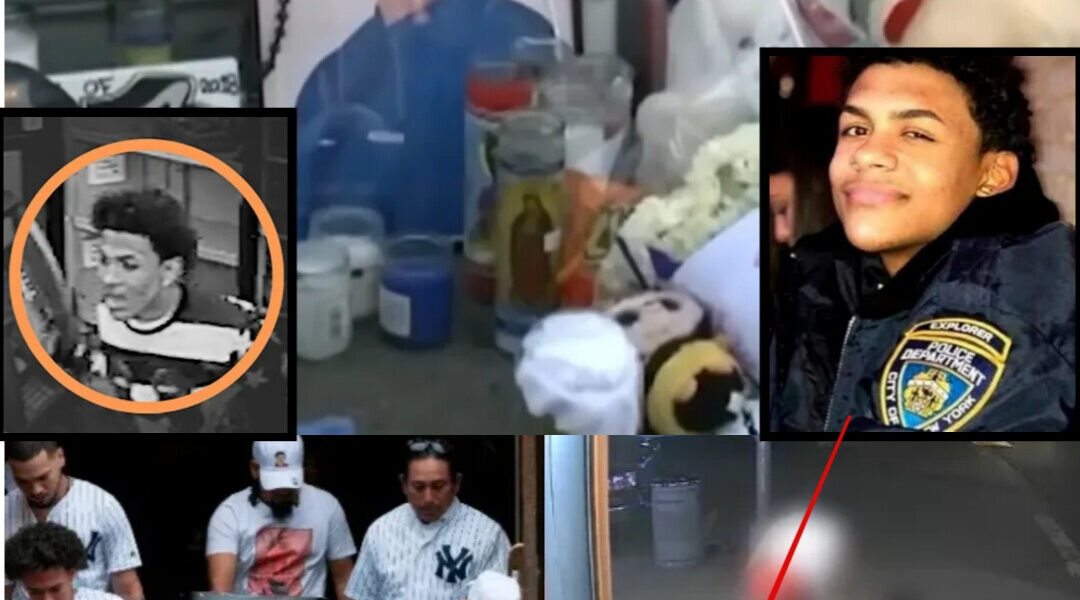
Outside the deli where it began, candles appeared. Flowers lined the sidewalk. Handwritten notes spoke of grief, rage, confusion, love.
An ordinary storefront became a place of mourning.
But Junior’s life could never be reduced to the final moments captured on cameras. He was not footage. He was not a headline.
He was a son.
A brother.
A friend.

Those who knew him spoke of his warmth, his humor, his loyalty. He laughed easily. He made plans. He dreamed out loud.
Junior was also part of the NYPD Explorers program — something he took seriously, something he was proud of. It wasn’t just an activity. It was a vision of who he wanted to become.
He wanted to be a detective.
He believed in justice.
He believed in protecting people.
He believed communities could be safer.

The contrast between his dream and the way his life ended was devastating. A boy who wanted to uphold the law lost his life to senseless violence.
Arrests were made. Names were identified. The legal process moved forward, as it must.
But no courtroom could restore what had been taken.
Later, Junior’s family received an anonymous message. It expressed regret. It admitted the truth.
“It wasn’t supposed to be him.”
The words echoed with cruelty of their own.

Not because they offered clarity — but because they revealed how fragile life becomes when decisions are made in anger. There is no comfort in knowing someone else was meant to be harmed. No relief in learning a death was a mistake.
For Junior’s family, grief settled into the quiet spaces of daily life.
The empty chair.
The hallway without footsteps.
The phone that would never ring with his voice again.
His mother returned again and again to that unanswered call — a moment frozen in time.
His sister struggled to reconcile the brother she knew with the version the world now spoke about. The boy who teased her. The boy who dreamed. The boy who should still be here.

In schools, counselors spoke to students about trauma and loss. Teachers faced classrooms where one desk sat empty.
Community leaders spoke about violence, misinformation, responsibility. They urged reflection. They urged change.
But none of those words could reach the one person who mattered most.
Junior could not hear them.
Vigils continued. Candles burned into the night. People said his name aloud, refusing to let it fade into statistics.
His story became part of a larger conversation — about how quickly anger spreads online, about how assumptions turn deadly, about how young lives are swallowed by cycles they did not create.

Yet beyond the public discussion, there was a quieter truth.
Junior was missed not as a symbol — but as a person.
For how he laughed.
For how seriously he took his future.
For how clearly he imagined a better world.
He believed the streets could be safer.
He believed he could help make them so.
Instead, the streets took him.

The phrase “it wasn’t supposed to be him” lingered long after the news cycle moved on — as if there could ever be a correct victim. As if violence ever makes sense.
Junior’s life mattered not because he was mistaken for someone else.
It mattered because it was his.
A fifteen-year-old boy who left home to help a friend.
A son whose mother called him one last time.
A future detective whose plans were cut short.

His story continues to be told not to shock, but to remember.
Not to sensationalize, but to honor.
To insist that behind every headline is a family changed forever.
To insist that lives lost to violence are more than footage and fragments.

Junior’s name deserves to be spoken with care.
His memory deserves dignity.
And his story deserves to be told gently — so it is never forgotten.