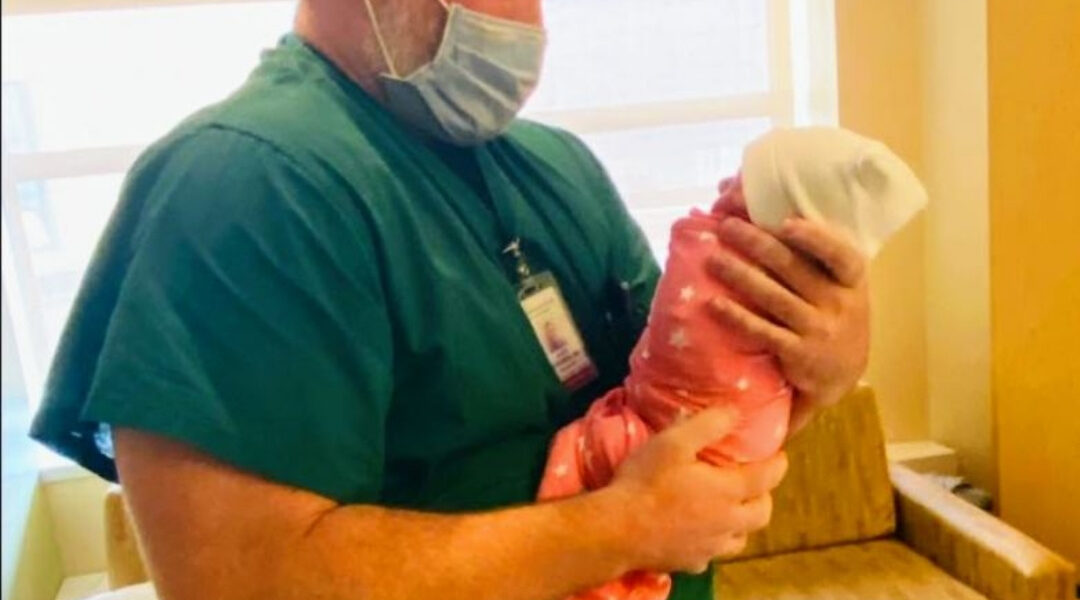

No, the man holding our newborn daughter is not my husband.
He isn’t my brother, a cousin, or a lifelong friend.

He is our son Julian’s neonatologist.
Two years ago, in this very same hospital, this same man stood in front of us with eyes heavy and voice careful, delivering words no parent is ever prepared to hear. Our baby boy was very sick. The diagnosis was fetal hydrops—a condition so severe it steals hope before you even have time to understand what’s happening.
From that moment on, he became more than just a doctor.
He worked relentlessly in the NICU, staying late, reviewing labs, consulting specialists, trying everything medicine could possibly offer. Every option was explored. Every door was knocked on. Every sliver of hope was chased. And when nearly thirty-six hours had passed, he returned to us once more—this time with tears in his eyes.
There was nothing more that could be done.
The room collapsed around us.
But he didn’t leave.
Instead, he sat with us and shared something deeply personal—his own story of loss. Not as a physician, but as a human being who understood grief. He told me, gently, that I should never stop saying Julian’s name. That loving him out loud mattered. That he mattered.
When the machines were silenced and the room grew unbearably still, he stayed. He stood there as Julian took his final breath in my arms and his father’s. And when I lifted my head through my sobs, I saw him too—crying openly as we kissed our son goodbye.
He didn’t have to be there.
But he was.
Days later, he attended our son’s funeral. He called us again and again, checking in, making sure we were breathing, surviving. He showed up to our follow-up appointments, helping us search for answers about what had caused Julian’s condition. He carried our questions with care, never rushing, never dismissing our pain.
And then life moved forward—slowly, painfully, uncertainly.
Two years passed.
We found ourselves back in the same hospital, walking the same halls, carrying a weight of fear no one else could see. This time, though, something was different.
This time, our baby lived.
Our daughter arrived healthy. Strong. Pink. Crying with life.
My husband left the room briefly that day, just once. In the hallway, by chance, he crossed paths with a familiar face. Recognition passed between them in an instant. The doctor looked surprised—then stunned—when he learned that we had just welcomed a healthy baby girl.
What happened next still feels unreal.
A knock came at our door.

When it opened, there he stood. No clipboard. No urgent words. No devastating news to deliver. He didn’t come because something was wrong.
He came because something had gone right.
This time, he stepped into the room not as the doctor who fought beside us as we lost our son—but as someone who had shared that loss with us and lived to see this moment too.
He asked if he could hold her.
As he cradled our five-week-old daughter in his arms, the room filled with a different kind of silence. One layered with memory. With absence. With love that never left.
We spoke Julian’s name.
We remembered the sacred moments. The heartbreak. The way time stopped the day we lost him. And this time, mixed in with the tears of grief were tears of joy—because grief and joy are not opposites. They coexist. They always have.
This doctor didn’t just witness our worst day.
He carried it with us.
And now, standing in the same hospital, holding our daughter, he carried our healing too.
He was no longer just Julian’s neonatologist.
He was a friend.
A witness to love that survived loss.
A reminder that compassion in medicine matters.
A testament to how deeply human care can change lives.
Sometimes healing doesn’t come from forgetting.
Sometimes it comes from being seen—then, and again, years later—when life finally dares to begin anew.