
The building was at its most honest at three in the morning.

No footsteps. No chatter. Just the low hum of fluorescent lights and the tired rhythm of pipes breathing behind the walls. Elias had learned that sound over years of night shifts—the way it rose and fell like a sleeping chest, the way it told him everything was still working, still holding together.
He pushed his mop cart slowly down the hallway, the wheels rattling just enough to remind him he was awake. These final rounds were always the longest. Not because the work was harder, but because the night stretched thin when the world forgot you were there.
Elias liked that part.
He liked the quiet.
That was why the sound made him stop.
It wasn’t loud. It wasn’t clear. Just a faint, broken rhythm that didn’t belong to pipes or air vents. A soft whimper, thin as a thread, slipping through the hum like a mistake.
Elias froze, one hand tightening around the mop handle.
There it was again.
Not mechanical. Not random.
Human.
He turned toward the sound, heart beginning to thud in his chest. It led him to the far restroom—the one barely used at night, the one that smelled faintly of disinfectant and old tile. The door was cracked open.
The cold hit his knees as he knelt and pushed the door wider.
The light flickered once, then steadied.
And there—wedged beside the toilet bowl, pressed against cold porcelain—was a newborn baby.
For a moment, Elias couldn’t breathe.
The baby was wrapped in nothing but a thin paper towel bundle, already damp, already losing heat. Tiny lips tinged blue. Skin pale, almost gray. The faint whimper he’d followed was fading into silence.
“Oh… no,” Elias whispered, his voice breaking.
His hands shook as he reached down. Arthritis stiffened his fingers, pain flashing through his joints as he scooped the baby up. The skin was cold. Too cold. Slippery with moisture. Fragile in a way that made his chest ache.
Instinct took over.
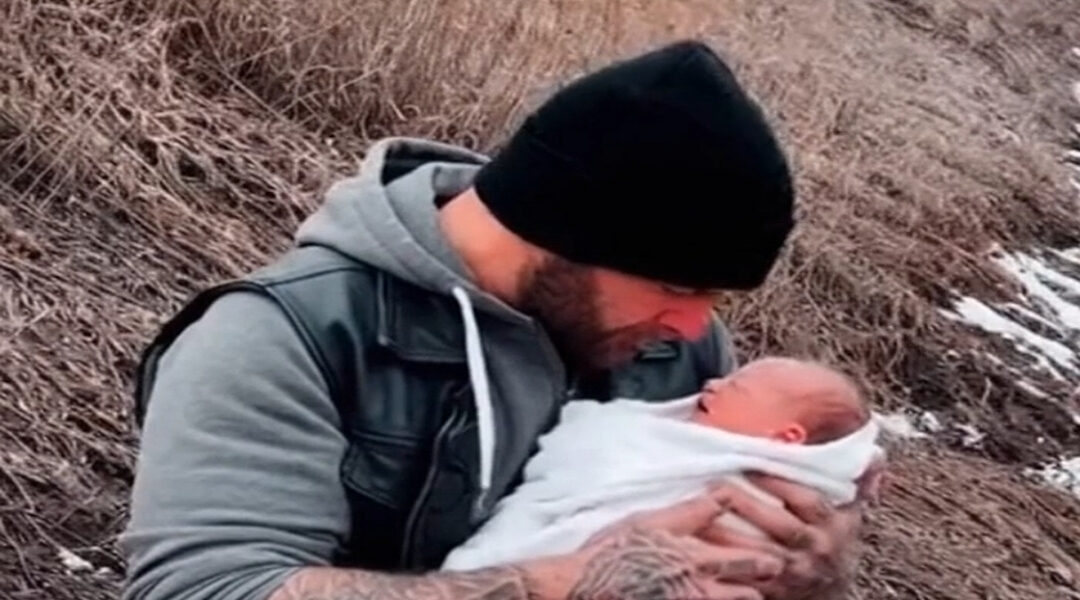
Elias dropped back against the wall, sliding down the tiles, pulling the baby tight against his chest. He tore more paper towels from the dispenser, wrapping them around the tiny body, pressing warmth into warmth.
“I’ve got you,” he whispered, rocking gently. “You’re safe now. I’m here.”
The baby didn’t respond.
Elias felt panic surge, sharp and sudden. He leaned his ear closer, listening for breath. Nothing. Then—barely—there it was. A shallow gasp. Weak. Desperate.
“Come on,” Elias murmured, tears blurring his vision. “Stay with me, little one.”
He rocked back and forth, back pressed to the cold wall, arms forming a cradle he hadn’t used in decades. He whispered nonsense words, prayers he hadn’t spoken aloud in years, promises he didn’t know if anyone would hear.
Then the baby cried.
It was small. Thin. Almost apologetic.
But it was life.
Elias collapsed forward, a sob tearing from his chest as relief hit him so hard his legs gave out. He pressed his forehead against the baby’s head, rocking, whispering again.
“That’s it. That’s it. I’m here. You’re okay.”
The blue in the baby’s lips began to fade. Slowly. Painfully slowly. Pink crept back into the skin. A tiny fist twitched, fingers curling weakly against Elias’s shirt.
The mop lay forgotten on the floor.
So did time.
When the supervisor burst in moments later—phone already out, voice tight with urgency—he found Elias exactly where he’d fallen. Sitting on the cold tile. Uniform soaked with tears. Arms wrapped around a newborn as if letting go might undo everything.
“I found them,” Elias said hoarsely. “They were cold. So cold.”
“You did the right thing,” the supervisor said, kneeling beside him, placing a hand on his shoulder. “Help’s coming.”
Elias nodded, but he didn’t loosen his grip. He kept rocking, kept whispering.
The baby cried again—stronger this time. Louder.
The sound filled the restroom, cutting through the hum of the building like a declaration.
When paramedics arrived, they moved quickly but gently. They checked vitals, wrapped the baby in warm blankets, praised Elias in voices meant to calm. One of them smiled softly.
“You saved this baby,” she said.
Elias shook his head, tears streaking down his face. “No,” he whispered. “We saved each other.”
As they lifted the baby from his arms, Elias felt the weight leave his chest—but not the warmth. His hands hovered in the air for a moment, as if still holding something sacred.
Before the baby was carried out, tiny fingers reached back and curled around his thumb.
Elias broke.
He cried openly then, shoulders shaking, the mop cart standing silent beside him like a witness that would never speak.
Later, when the building woke up and the night dissolved into morning, people would talk about the miracle. About the janitor who listened when the world was quiet. About the baby who survived against impossible odds.
But Elias didn’t think of it that way.
He thought of the sound that didn’t belong.
Of choosing to stop.
Of kneeling on cold tiles when it would have been easier to keep moving.
At three in the morning, when no one was watching, compassion had answered a whisper.
And because it did, a heartbeat kept going.
Sometimes, that is enough to change everything.