
Elena dropped to her knees the moment Atlas’s hooves touched the grass.
For months, she had imagined this exact second—sunlight instead of flickering barn bulbs, wind instead of the sour bite of ammonia, open space instead of iron bars. She had rehearsed it in her head so many times that she believed she was ready.
She wasn’t.
Atlas stepped down from the trailer slowly, nostrils flaring as he took in the scent of open pasture. Fresh grass. Damp earth. Air that moved freely. He lowered his head and sniffed, as if trying to remember what the world was supposed to feel like.
Then his legs buckled.
It happened so fast Elena barely had time to breathe. One moment he was standing—tall, red-brown coat dulled by months of neglect but still unmistakably powerful—and the next, his knees folded beneath him like paper. His weight shifted wrong, his head dipping dangerously low, momentum pulling him toward the ground.
“Elena!” someone shouted behind her.
She didn’t hear them.
She was already moving.
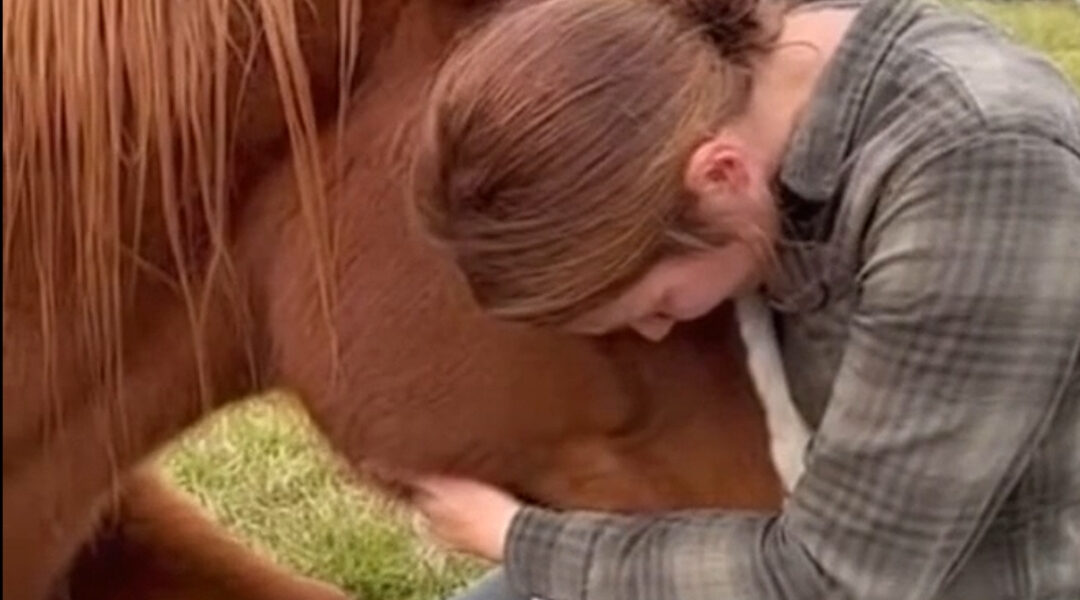
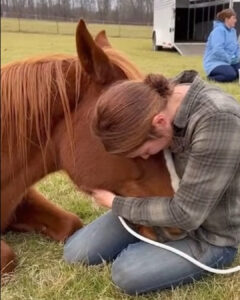
She threw herself forward, arms wrapping around Atlas’s thick neck, bracing her body beneath his head so it wouldn’t slam into the earth. His muscles trembled violently, panic flashing through his eyes as the ground rushed up too quickly.
“I’ve got you,” she sobbed, pressing her cheek into his mane. “I’ve got you. You’re safe now.”
Atlas collapsed fully, chest heaving, breath ragged and uneven. His great body shook with exhaustion, with fear, with the memory of pain that hadn’t yet learned it was over. Elena stayed on her knees, legs sinking into the lush green pasture, holding his head against her chest as if she could keep him tethered to the world by touch alone.
Tears streamed down her face, soaking into his tangled mane.
“You don’t have to fight anymore,” she whispered, voice breaking. “No more dark. No more cages. No more fear.”
Atlas’s eyes fluttered, then closed halfway. A long, shuddering sigh escaped him, as if he had been holding his breath for months and was only now daring to let it go.
For so long, Elena had only seen him through bars.
When she’d first found him, Atlas hadn’t looked like a stallion at all. He was a shadow—rib-thin, coat matted, eyes dull with a kind of exhaustion that went deeper than hunger. The barn he’d been kept in smelled of rot and neglect, ammonia burning the back of her throat. Light barely reached the stalls. Silence hung heavy, broken only by the scrape of hooves and the low, hopeless sounds of animals waiting for something to change.
No one had expected Atlas to survive.
The vets warned her gently, carefully, the way people speak when they don’t want to give false hope. His muscles were wasted. His strength was gone. His body had been pushed too far for too long.
But Elena had looked into his eyes and seen something stubborn still burning there.
Not strength.
Will.
So she fought for him.
She fought through paperwork, late-night calls, endless expenses, and the quiet doubt of people who thought it was kinder to let go. She sat with him in that dark barn for hours, brushing his coat inch by inch, whispering to him about grass and sky and wind—things he couldn’t see but might remember.
And now he was here.
Collapsed in the open.
Alive.
The rescue team moved quickly but carefully, surrounding them without crowding. Someone slid an IV into place. Another checked his pulse. A vet murmured steady reassurances, more for Elena than for Atlas.
But Elena barely noticed.
All she could feel was the slow, fragile rhythm beneath her hands—the faint pulse at Atlas’s neck, unsteady but present. She stroked his face, tracing familiar lines, grounding both of them in the moment.
“I’m here,” she whispered again and again. “I’m staying.”
Time stretched strangely around them.
Minutes blurred into an hour as the wind moved softly through the pasture, grass bending and straightening like it was breathing with them. Atlas’s breathing slowly evened out. The violent shaking eased into smaller tremors. His ears flicked once, responding to sound not with fear, but with awareness.
Elena stayed exactly where she was.
Her knees ached. Her arms burned. Her back screamed in protest. She didn’t move.
If he needed her weight, she would give it.
If he needed her warmth, she would stay.
If he needed her heartbeat to remind him how to keep going, she would offer it freely.
“I know it’s scary,” she murmured. “The light. The space. It’s a lot all at once. But you’re not alone. Not anymore.”
Atlas shifted slightly, leaning into her touch. His breath caught, then steadied again. His head pressed more fully into her shoulder, a quiet, unmistakable gesture of trust.
Someone behind her wiped their eyes.
This was not the dramatic moment people imagined when they thought of rescue. There were no triumphant rears or powerful strides into freedom. There was no instant transformation.
There was only collapse.
And holding.
And waiting.
As the IV fluids began to work, Atlas stirred. His eyes opened fully this time, dark and glossy but alert. He blinked slowly, taking in the endless green around him. The open sky. The absence of walls.
A low sound rumbled in his chest—not fear, not pain, but something close to disbelief.
Elena laughed softly through her tears.
“Yes,” she said. “It’s real. You’re really here.”
Hours later, when Atlas finally gathered the strength to shift his legs beneath him, the entire team froze, ready to intervene if he faltered. Elena loosened her grip just enough to let him move, her hands never leaving his neck.
Slowly—painfully—he pushed himself upright.
He didn’t stand tall.
He didn’t walk away.
He simply knelt in the grass, head still resting against Elena’s shoulder, as if the world beyond her arms was still too much to face alone.
And that was enough.
Because survival doesn’t always look like standing.
Sometimes, it looks like choosing not to lie down again.
As the sun dipped lower, casting warm gold across the pasture, Elena finally allowed herself to breathe fully. Atlas was still weak. Recovery would be long. Some days would be harder than others. There would be setbacks, moments of fear, nights where she wondered if she was asking too much of him.
But he was here.
Alive.
Breathing.
Feeling grass beneath his legs instead of concrete.
She pressed her forehead gently against his.
“We’ll take it slow,” she promised. “One breath at a time.”
Atlas closed his eyes and exhaled, long and deep.
The field fell quiet.
And in that hush—where pain met hope, and survival met love—life clung on, fragile but real, refusing to let go.