
The river shimmered quietly beneath the African sun, its surface broken only by ripples and reflections of towering bodies moving with ancient grace. Along the banks of the Chobe River in Botswana, elephants gathered as they had for generations—drinking, cooling their massive frames, teaching their young how to survive in a world both beautiful and unforgiving.
Among them was a mother and her calf.

He was only weeks old, still round with infancy, his legs slightly unsure beneath him, his trunk a playful mystery that often seemed to have a mind of its own. Everything about the world was new to him—the feel of wet mud between his toes, the weight of water against his skin, the echo of splashes and low rumbles surrounding him.
And like all children, curiosity pulled him forward.
The waterhole was irresistible.
With clumsy enthusiasm, the calf stepped in, then deeper, splashing joyfully as if the river itself had been created just for him. He rolled his trunk through the water, lifted it high, sprayed droplets into the air, and stomped with delight. For a moment, there was no danger—only innocence, laughter in elephant form, and the pure joy of discovery.

But joy in the wild is always watched.
Nearby, his mother stood still.
Her eyes never left him.
She was calm, but alert—the kind of stillness that holds readiness within it. Mother elephants carry generations of memory: droughts survived, migrations remembered, calves protected. She knew that water could soothe, but she also knew how quickly it could turn into a trap.
When the calf decided he had splashed enough, he turned toward the bank.

That was when trouble found him.
The slope was steeper than he expected. His legs, strong but inexperienced, slipped against the slick mud. He tried again, scrambling, pushing upward with determination that outweighed his strength. Each attempt sent him sliding back into the water, his small body splashing harder now—not with joy, but with growing confusion.
He paused.
Then he tried again.
This time, panic crept in.

His movements became faster, less coordinated. His trunk flailed, his feet churned the mud beneath him, but the river refused to release him. The bank that had seemed so easy to descend now felt impossibly high.
That was when his mother moved.
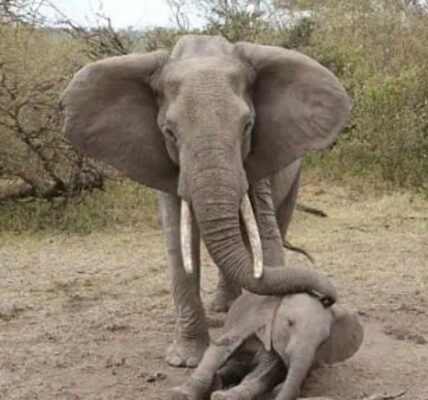
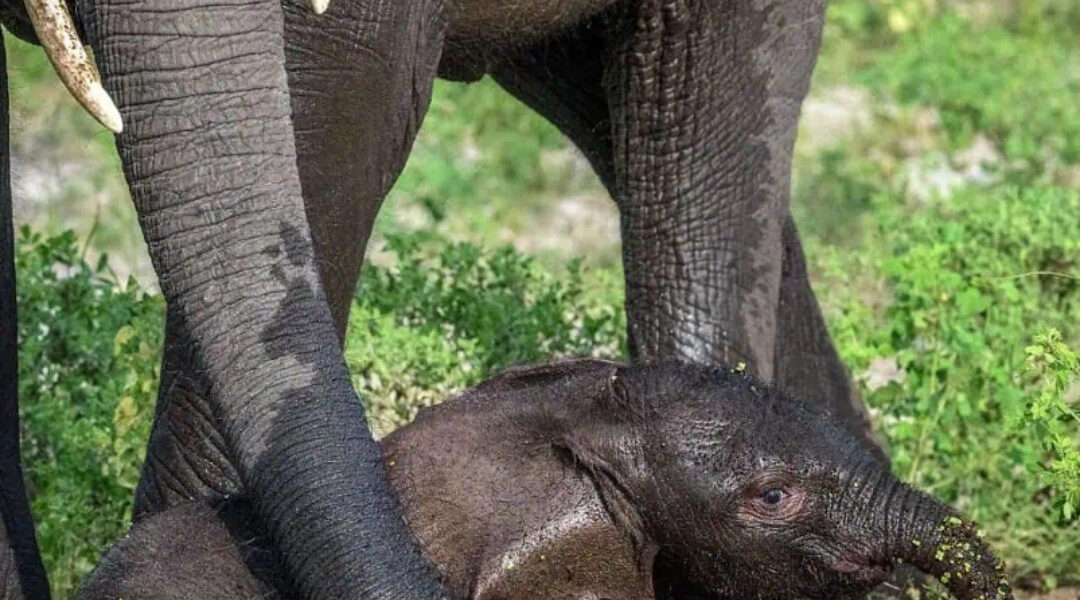
She did not charge. She did not panic. She stepped forward with deliberate calm, closing the distance between them in long, powerful strides. Her trunk reached out, wrapping securely around the calf’s body—not tight, not forceful, but certain.
It was the grip of absolute protection.

With a controlled lift that revealed her immense strength, she hoisted him partially from the water, steadying his weight as if he were no heavier than memory itself. The calf squeaked softly, startled but trusting, his legs dangling awkwardly as the world shifted beneath him.
Still holding him close, the mother adjusted her footing, then gently guided him toward the embankment. She lowered him just enough so his feet could find the mud, and then—almost patiently—she showed him how to climb.
Her foot nudged the earth ahead of him, demonstrating where to step.
Her body blocked the water behind him.

Her presence said everything words never could: You are safe. Follow me.
The calf hesitated, then pushed upward again. This time, with his mother’s trunk supporting him and her body forming a barrier against slipping back, he gained ground. Inch by inch, he climbed until his small body finally cleared the edge of the bank.
But he wasn’t quite done.

With a gentle, almost playful nudge—what could only be described as a soft kick of encouragement—the mother helped him scramble fully onto dry land. The calf stumbled forward, then stood still, breathing fast, covered in mud, wide-eyed and alive.
The lesson was over.
Nearby, South African wildlife photographer Neal Cooper stood frozen behind his lens.
He had photographed countless moments in the wild—predators and prey, storms and migrations—but this was different. This was intimacy. This was family. This was love unfolding without performance or awareness of an audience.

He later reflected that the calf’s curiosity had likely prompted the mother to stay especially close, using the moment not only to rescue him, but to teach him. How to use mud to cool his body. How to get out when the ground gives way. How to survive mistakes.
“She was leading by example,” Cooper said. “It was education wrapped in care.”
The mother did not linger long after the rescue.
Once she was satisfied, she turned and walked away, trusting that the lesson would settle into the calf’s growing memory. The little one followed, his steps still uncertain but his confidence renewed. He had learned something important—not just about water or mud, but about trust.
In the wild, survival is often portrayed as harsh and unfeeling. But moments like this reveal another truth: that beneath the weight of strength and instinct lies tenderness. That protection does not always roar. Sometimes it reaches quietly, wraps gently, and lifts with patience.

Elephant families are built on bonds that last decades. Calves remain with their mothers for years, learning not only where to walk and what to eat, but how to grieve, how to celebrate, how to belong. A mother’s trunk is not just a tool—it is a hand, a guide, a comfort, a lifeline.
And for this calf, that trunk meant everything.
As the elephants moved on along the riverbank, the waterhole returned to stillness. The mud settled. The sun climbed higher. To the rest of the world, nothing remarkable had happened.
But a life had been protected.
A lesson had been passed down.
And a photographer had captured a reminder that love—real, instinctive, fierce love—exists everywhere, even in the quiet bend of a river where a mother refused to let her child slip away.
In the wild, danger is constant. But so is care.
And sometimes, all it takes to survive is a mother who never looks away.