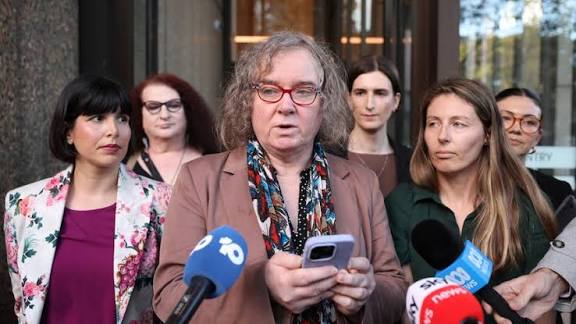

High Court Dismisses Giggle for Girls Appeal in Landmark Australian Gender Discrimination Case
Australia’s legal chapter over female-only spaces has effectively closed as the High Court refuses to hear a final appeal, leaving intact a landmark ruling that found a women-only networking app unlawfully discriminated against a transgender woman.
The legal battle that brought Australia’s fiercely contested debate over sex, gender identity, and women-only spaces to the national stage has reached its final judicial destination.
The High Court of Australia has refused Sall Grover and her company, Giggle for Girls, permission to appeal, effectively ending years of high-stakes litigation. The decision leaves standing a historic Federal Court ruling that found the platform’s exclusion of a transgender woman constituted unlawful gender discrimination.
The final disposition, recorded under Giggle for Girls Pty Ltd & Anor v Tickle, cements a legal precedent that carries profound implications for service providers, advocacy groups, and lawmakers across the country.

While the courts have now drawn a definitive legal line, the wider political and cultural friction shows no sign of abating. Prominent political figures, including conservative senator Jacinta Nampijinpa Price, have continued to rally behind Grover, ensuring that the debate over the definition of women’s spaces remains at the forefront of Australian public life.
How a Women-Only App Triggered a National Lawsuit
At the center of the controversy is Giggle for Girls, a social networking platform launched by Sall Grover to provide a dedicated online space exclusively for women.
The platform was built on the premise that women should have a secure environment to communicate, share experiences, and build community without male presence. During the registration process, users were required to upload a photograph, which was then analyzed by a third-party artificial intelligence system designed to detect facial features associated with biological sex.
Roxanne Tickle, a transgender woman, was initially accepted by the automated system but was subsequently removed from the platform.
The removal prompted a landmark legal challenge. Tickle argued that her exclusion amounted to unlawful discrimination based on gender identity under federal law.
Grover countered that the platform was explicitly established around biological sex to protect female privacy and safety. In August 2024, the Federal Court ruled in favor of Tickle, finding that the exclusion violated Australia’s Sex Discrimination Act.
The Full Federal Court subsequently upheld that finding in May 2026, ordering Grover and her company to pay A$20,000 in damages alongside mounting legal costs. With the High Court’s refusal to grant special leave to appeal, those rulings are now final.
Why the High Court’s Decision Matters for Australian Law
The finality of the High Court’s refusal to hear the case marks a critical turning point for how anti-discrimination legislation is interpreted in Australia.
The proceedings forced the judiciary to examine how provisions of the Sex Discrimination Act 1984 apply when commercial services attempt to distinguish between biological sex and gender identity.
Legal experts note that the precedent could influence how businesses, community organizations, and other service providers navigate single-sex spaces.

For transgender advocates, the outcome is viewed as a vital confirmation that existing legal frameworks robustly protect transgender Australians from exclusion in everyday life.
Conversely, supporters of sex-based rights argue the ruling erodes the ability of women to establish and maintain private environments predicated strictly on biological sex.
The tension between these two legal interpretations is precisely what elevated a dispute over a mobile application into one of the most consequential civil cases in modern Australian history.
Political Flashpoints and the Debate Over “Safe Spaces”
Beyond the courtroom, the case has acted as a powerful catalyst for Australia’s broader culture-war debates.
Senator Jacinta Nampijinpa Price thrust herself directly into the controversy by publicly backing Grover during her appearance at CPAC Australia 2025 in Brisbane. Price spoke forcefully about the necessity of protecting traditional women’s rights, positioning herself as a leading voice against what she characterizes as mounting social pressure to alter definitions of sex and gender.
For conservative commentators and supporters of Grover, the litigation symbolizes a broader fight to preserve sex-segregated environments that address intimate privacy, domestic violence support, and female solidarity.
On the other side of the political spectrum, progressive groups and legal defenders maintain that upholding discrimination protections is essential to ensuring social inclusion and equality under the law.
Because both sides view the issue through the lens of fundamental dignity and safety, the dispute has consistently resisted easy compromise.
What Happens Next: The Move From Courts to Parliaments
Now that ordinary avenues of legal appeal have been exhausted, political analysts suggest the battleground will likely shift from the judiciary to federal and state parliaments.
Grover has vowed to continue speaking publicly about the implications of the case, while her supporters push for legislative reforms to clarify or alter how anti-discrimination laws treat single-sex exemptions.

At the same time, advocacy organizations representing transgender Australians are expected to vigorously defend the current statutory framework against any attempts to wind back protections.
The central question facing Australian lawmakers is whether the legal boundaries established by the courts strike the correct balance, or if Parliament will face mounting pressure to rewrite the rules governing sex and gender in public life.
As political parties prepare for future electoral cycles, the underlying social tensions highlighted by the Giggle for Girls litigation remain entirely unresolved.
How do you think federal legislators should balance protections against gender identity discrimination with the legal provision of biological sex-based spaces?