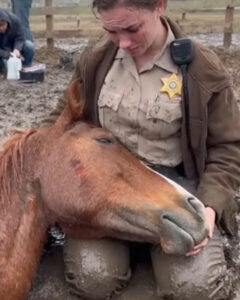
The mud swallowed Deputy Sara almost to her thighs the moment she stepped into the pen.
It was early morning. Cold enough that her breath showed in the air. The stench hit first — rot, ammonia, neglect thick enough to taste. Her uniform soaked instantly, brown water seeping through fabric, chilling her skin.
But she didn’t step back.
Because the mare couldn’t.
The horse lay half-buried in the muck, skeletal and unmoving except for the faint rasp of breath. Her ribs pressed sharply against skin stretched too tight. Open sores marred her sides. Infection had settled in raw patches along her face and neck.
She had likely been down all night.
Maybe longer.
The vet’s voice came low and tight from behind her. “Critical. Shock. Hypothermic. We fight to stabilize — right now.”
Sara didn’t answer.
She was already kneeling.
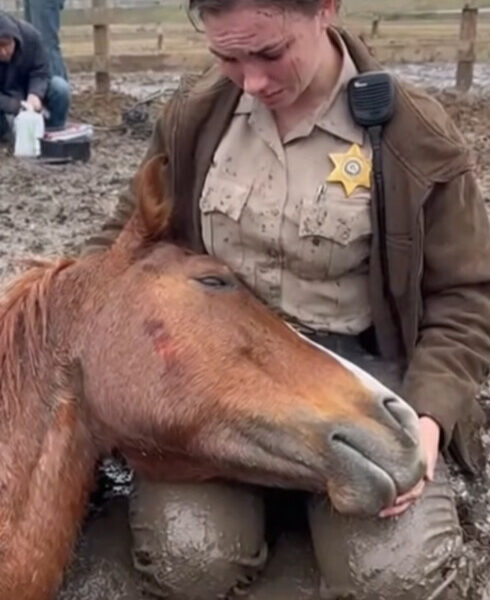
The mud sucked at her boots as she lowered herself beside the mare. Carefully — gently — she slid her hands beneath the animal’s heavy head and lifted.
The mare let out a long, shuddering sigh as her head settled into Sara’s lap.
That sigh felt like surrender.
Or maybe relief.
Sara cradled her, ignoring the cold that bit through her pants, ignoring the filth soaking her sleeves. The mare’s eyelashes brushed against her thigh as her eyes fluttered weakly.
“Hey, girl,” Sara whispered, her voice breaking. “It’s okay.”
Tears mixed with streaks of dirt on her face. She stroked the mare’s mud-caked cheek, careful around the sores.
“I know it hurts,” she murmured. “Just lean on me.”
The mare’s breath came shallow. Each inhale looked like effort. Her pulse beneath Sara’s hand was faint — barely there — but steady enough to cling to.
Behind them, the rescue team moved with urgency. IV fluids were prepared. Blankets were laid out. Someone radioed for additional support. Boots sloshed through mud, but the pen felt strangely quiet around the two of them.
Sara wrapped one arm around the mare’s neck, shielding her from the cold wind. The other hand remained pressed gently against her jaw.
“I’ve got you,” she whispered again. “We’re getting you out. You’re not alone.”
The mare’s body trembled faintly.
Shock does that.
Hypothermia steals heat slowly and without mercy. Malnutrition weakens the heart. And when an animal has been left standing in its own waste for too long, survival becomes a thread thinner than hope.
Sara had seen neglect before.
But this was different.
This mare wasn’t fighting wildly. She wasn’t panicking.
She was simply tired.
The kind of tired that lives deep in the bones.
When Sara adjusted her hold, the mare didn’t resist. Instead, she pressed her head slightly heavier into the deputy’s lap — as if she understood the contact, as if she recognized safety.
That small movement broke something in Sara.
“You don’t have to be brave anymore,” she whispered. “We’re here now.”
The vet knelt beside them, sliding a catheter into place with practiced care. Fluids began their slow drip. Warmed solutions. Electrolytes. Antibiotics.
Life measured in droplets.
“Stay with me,” Sara murmured, matching her breathing to the mare’s. Inhale. Exhale. Inhale. Exhale.
Mud clung to everything — her badge, her jacket, her radio. But none of it mattered.
Because this was not about paperwork or procedure.
This was about keeping a living thing tethered to the world long enough to give her a chance.
The mare’s eyelids drooped. Her lashes flickered.
“Don’t go,” Sara breathed, tears falling freely now. “Breathe with me.”
For a terrifying moment, the mare’s breathing faltered.
The team froze.
Then — a shallow inhale.
A weak exhale.
Still there.
Sara pressed her forehead gently against the mare’s muddy brow.
“I promised you,” she whispered. “We’re getting you out.”
Time blurred.
The sun crept higher, thin warmth touching the pen. Steam rose faintly from the mud. The IV line continued its quiet drip.
Gradually, almost imperceptibly, the mare’s pulse grew stronger beneath Sara’s palm.
Not strong.
But stronger.
“She’s responding,” the vet said softly.
Sara nodded, unable to trust her voice.
They worked carefully to free the mare’s body from the suctioning mud. Straps were slid beneath her with painstaking patience. A rescue board was positioned. Every movement was deliberate.
But through it all, Sara never removed her arm from around the mare’s neck.
Even as the lift began — slow, steady, coordinated — she stayed close.
The mare groaned faintly as her body shifted, but she did not panic.
She had her head in someone’s lap.
And that seemed to be enough.
When they finally eased her onto the transport stretcher, Sara stood — legs numb from cold and strain — but she kept one hand resting on the mare’s face.
“You’re going to make it,” she whispered.
No one could promise that.
The prognosis was still guarded. Infection was severe. Shock had taken its toll.
But in that pen, in that moment, something had shifted.
The mare was no longer alone in the mud.
She was held.
Protected.
Fought for.
As the transport trailer doors closed gently, Sara wiped her face with the back of her sleeve, leaving streaks of brown across her skin.
Her uniform was ruined. Her boots caked solid. Her badge nearly hidden beneath layers of muck.
She didn’t care.
Because when that mare’s head had settled into her lap and released that long, trembling sigh — it had been trust.
And trust, in the face of cruelty, is something sacred.
Later, people would talk about the rescue.
They would say the deputy sank into freezing mud without hesitation.
They would say she held the horse like a child.
They would say she cried.
All of that was true.
But what mattered most was simpler.
A life that had been left to fade in filth was given something different.
Warmth.
Contact.
A voice saying, “You’re not alone.”
And sometimes, when life is hanging by the thinnest thread —
That is what keeps it from breaking.