
The call came just before dawn, the kind that doesn’t bother with pleasantries.
“She’s down,” the woman on the line said, voice breaking. “She’s been in the mud all night. She keeps trying to get up… she can’t.”
Erin didn’t ask questions. She didn’t need to. Months of quiet reports had led to this moment — whispers about horses barely standing, about neglect hidden behind distance and threats. This time, there was no waiting.
By the time Erin reached the back pen, the cold had already settled deep into her bones.
The mud swallowed her boots, then her legs, each step pulling her lower as if the ground itself wanted to keep her there. The smell hit next — rot, waste, and the unmistakable sourness of long-term neglect.
And then she saw her.
The mare lay crumpled against the fence, half-sunken into freezing mud. Her body was so thin it barely looked real — ribs sharp as broken slats, hips jutting beneath skin stretched too tight. Open sores covered her face and legs, raw and weeping. Her chest rose and fell in shallow, ragged rasps, each breath sounding like it might be the last.
She wasn’t dead.
But she was close.
Erin dropped to her knees without thinking, the cold seeping through her uniform instantly. She radioed the vet, forcing her voice to stay steady.
“She’s emaciated. Hypothermic. Barely responsive,” Erin said. “She’s been down all night.”
The reply came fast — clipped, urgent.
“She’s in shock. Keep her awake. Keep her breathing. I’m coming with fluids and a sling. Do not let her give up.”
Erin ended the call and stepped fully into the mud.
The mare groaned weakly when Erin touched her, a sound so soft it barely carried. Erin slid her hands beneath the mare’s head, lifting it from the sludge and pulling it gently into her lap. The horse’s weight felt impossibly light — fragile, breakable.
“Hey, girl,” Erin whispered, her voice cracking. “I know it hurts. I know.”
The mare exhaled — a long, tired sigh — and for a moment, her body loosened as if she had been holding herself together by sheer will alone.
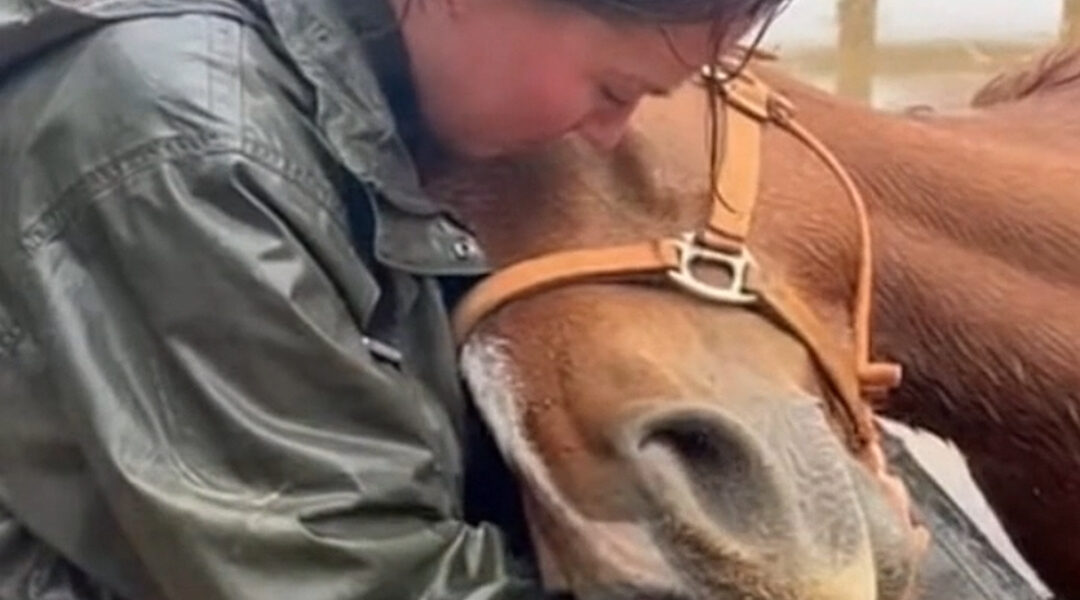
Erin wrapped her arms around the mare’s neck, pressing her forehead against the damp, mud-caked face. Tears slid freely now, mixing with dirt on her cheeks.
“You’re okay,” she murmured. “Lean on me. I’ve got you. You’re not alone.”
The mare’s eyelids fluttered. Her breathing stayed shallow, uneven. Erin counted each rise of her chest like a prayer, terrified of the space between breaths.
Minutes stretched into something heavy and slow.
Erin didn’t move.
She didn’t shift her legs even as they went numb. She didn’t wipe her face. She simply held the mare’s head in her lap, shielding her from the cold with her own body, whispering steadily — anything to keep her anchored here.
“Stay with me,” Erin said softly. “Just stay. Help is coming.”
The mare blinked again, her dark eyes cloudy but aware. For the first time, they focused — not on pain, not on fear — but on the woman holding her.
Recognition.
Trust.
A faint tremor ran through the mare’s body, then stilled. Her breathing synced with Erin’s, shallow but present.
In the distance, an engine rumbled.
Sirens.
The vet truck.
But Erin stayed exactly where she was, murmuring, stroking, grounding the mare in the only thing she had been denied for so long: warmth and presence.
When the veterinary team arrived, they froze for a heartbeat at the sight — Erin kneeling in filth, her arms wrapped around the dying horse like a lifeline.
“You kept her awake,” the vet said quietly. “That may have saved her.”
They worked quickly — blankets, IV lines, warm fluids. The mare groaned as the sling was positioned, her legs shaking violently when they lifted her.
“She might not make it,” the vet warned, meeting Erin’s eyes.
Erin nodded.
“I know.”
But she didn’t step away.
Even as they transported the mare to the clinic, even as the day turned to night, Erin stayed. She sat beside the stall, uniform stiff with dried mud, watching the slow, fragile rhythm of the mare’s breathing beneath the heat lamps.
When the mare stirred, Erin spoke.
When her breathing faltered, Erin touched her.
When the barn fell quiet, Erin stayed awake.
Sometime after midnight, the mare lifted her head — just an inch — and nudged Erin’s sleeve weakly with her nose.
Erin laughed through tears.
“There you are,” she whispered. “That’s it. Keep fighting.”
This mare had been left to die unseen.
Instead, she was held.
And in that muddy pen, on a freezing morning, one simple truth became undeniable:
Sometimes, survival doesn’t begin with medicine.
Sometimes, it begins with someone refusing to let you be alone when it would be easier to walk away.