When Jeremiah arrived at the shelter, even the most experienced hands went still.
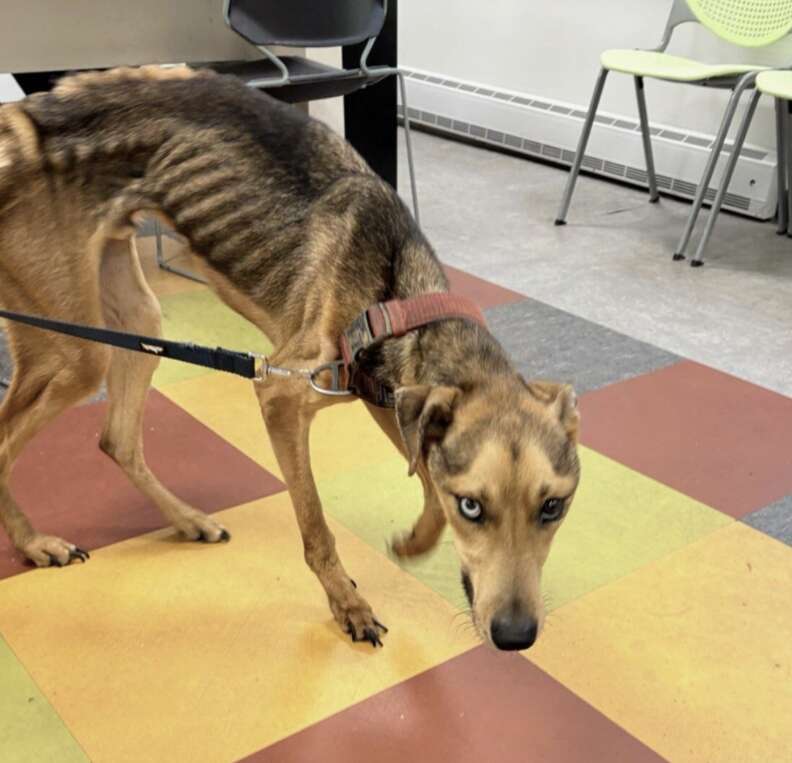
At just 27 pounds, the dog standing in front of them looked less like a living creature and more like a shadow that had somehow learned to walk. His ribs pressed sharply against thinning skin. His legs trembled under a body that had nothing left to give. Every step seemed impossible — and yet, he took them.
Staff at Pennsylvania SPCA would later say they could hardly believe he was still on his feet.
“Skin and bones,” they described him.
A walking skeleton.
No one knew much about where Jeremiah had come from. Only that he’d been found on the street, alone, carrying the kind of hunger that doesn’t come from missing one meal — but from being forgotten for a very long time.
And still, when someone knelt down in front of him…
Jeremiah wagged his tail.
It was small. Weak. Almost apologetic.
But it was there.
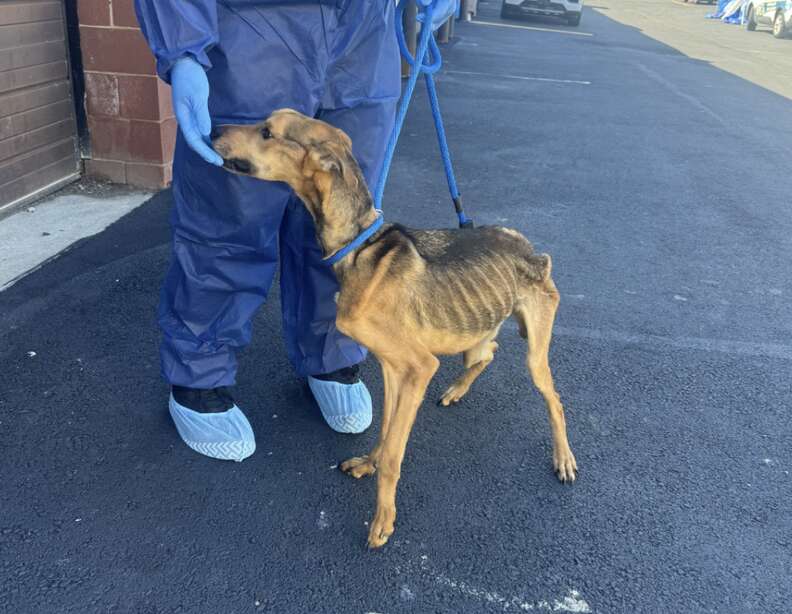
Even at his worst, Jeremiah was gentle. Even when his body was failing him, his heart hadn’t learned how to stop trusting.
That was the part that broke people the most.
The veterinary team moved quickly, but carefully. Dogs this malnourished can’t simply be fed their way back to health. Too much food, too fast, can be deadly. So Jeremiah was placed on a strict refeeding plan — tiny meals, measured portions, constant monitoring.
Every bite mattered. Every hour mattered.

For weeks, Jeremiah’s world became a quiet routine: rest, careful meals, soft voices, slow progress. Staff watched him closely, worried about setbacks, praying for small victories.
And Jeremiah?
He tried.
He tried in the only way he knew how — by showing up with hope.
Despite his condition, he greeted everyone like an old friend. Volunteers would walk in, and Jeremiah would lift his head, eyes bright, tail tapping gently against the floor.
“He was still so happy and eager to greet his friends,” one staff member said later. “Even when he was critical.”
It didn’t make sense. But then again, love rarely does.
As the days passed, something began to change.
Jeremiah started gaining weight — slowly, safely. His body began to remember what strength felt like. His legs steadied. His steps grew more confident. The dog who once struggled just to stand now leaned into walks, curious about the world he’d nearly lost.
And there was one thing Jeremiah loved almost as much as people.
Food.
That simple truth became part of his healing. Food motivated him. Encouraged him. Helped him learn. With treats carefully woven into his recovery plan, Jeremiah began mastering little tricks — sit, wait, focus — not just because he wanted the reward, but because he wanted to connect.
Each command was another way of saying: I’m still here. I’m learning how to live again.
Week by week, the “walking skeleton” filled out. His weight nearly doubled. Muscle returned. Energy followed. For the first time in what was likely years, Jeremiah ran — not far, not fast, but freely.

He played.
He smiled.
And when he was finally strong enough, the shelter staff knew what that meant.
Jeremiah was ready for something he had likely never known.
A home.
Not long after he was cleared for adoption, a couple walked through the shelter doors carrying a quiet grief of their own. They had recently lost their dog — a companion who had filled their home with routine, warmth, and love. The silence left behind had been heavy. They weren’t sure they were ready.
But they were hopeful.
When they met Jeremiah, something shifted.
They didn’t see the emaciated body from weeks before. They saw the dog he had become — gentle, resilient, affectionate. A dog who had survived something terrible and still believed in people.
“They fell in love with him during the meet,” a PSPCA representative said. “They were fully prepared to help him transition to home life.”
Jeremiah leaned into them like he already knew.
Not long after, paperwork was signed. Leashes were clipped. And Jeremiah walked out of the shelter — not as a rescue anymore, but as family.
He also walked out with a new name.
Tucker.
The name suited him.
At home, Tucker did something that quietly moved everyone who saw it.
He settled in.
Not with fear. Not with hesitation.
But with the calm certainty of a dog who finally felt safe.
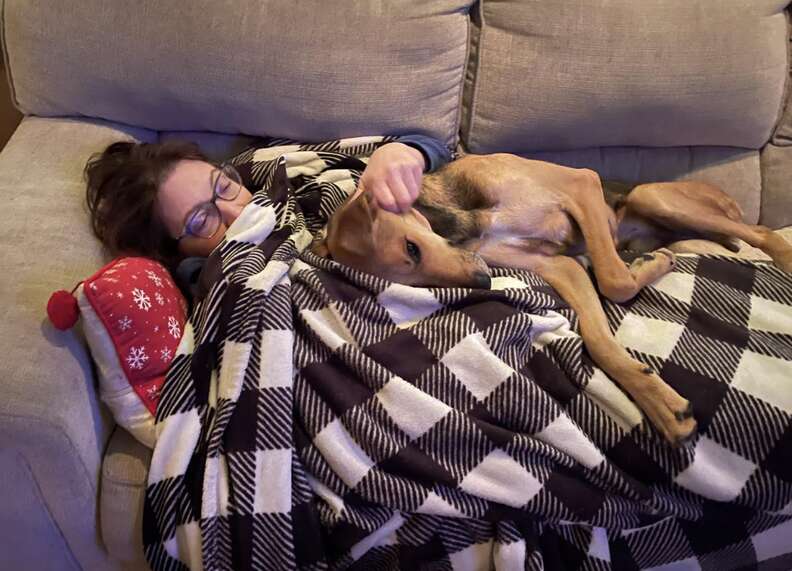
“He fits in like he’s been here for years,” his new parent later said. “He brings a lot of joy to my life that I’ve been missing.”
Tucker learned couches. Learned soft beds. Learned the rhythm of mornings and evenings and knowing when someone would come back through the door. He learned what it felt like to sleep without hunger pressing against his ribs.
And slowly, his past loosened its grip.
Today, Tucker is happy. Healthy. Loved.
It’s easy to look at his photos now — bright-eyed, relaxed, curled up beside people who adore him — and forget how close he once came to disappearing entirely.
But the shelter staff remember.
They remember the dog who weighed just 27 pounds.
The dog who shouldn’t have been able to walk.
The dog who wagged his tail anyway.
Jeremiah — Tucker — is proof of something simple and powerful:
That neglect can nearly destroy a body,
but it doesn’t always break a heart.
Sometimes, all it takes is patience.
Care.
And a little love — given at exactly the right time.
And sometimes, that love doesn’t just save a life.
It transforms it.