
The morning began like so many others in northern New York—quiet, pale, and cold enough to sting the lungs with every breath.
A woman took her Labrador mix for a walk, bundled against the January chill, the world around them frozen into stillness. The canal beside the path looked solid, sealed over by a smooth sheet of ice that reflected the dull winter sky. It looked safe. It looked finished.
It wasn’t.
The dog stepped closer, curious, tail lifting slightly as his paws tested the edge. The ice cracked without warning—sharp, sudden, violent. In an instant, the surface gave way and the dog disappeared beneath it, plunging into dark, freezing water.
The sound that followed was not a splash.
It was panic.
The woman screamed his name and ran forward without thinking. She dropped to her knees, reaching, slipping—and then she was gone too, swallowed by the canal as the ice shattered around her.
The cold was instant and brutal. It stole breath, strength, thought. She fought her way back toward the edge, hands numb, muscles locking as she struggled not to sink. Nearby residents heard the screams and ran for help. Someone called 911. Someone else ran to the fire department.
By the time officers from the Little Falls Police and Fire Departments arrived, they managed to pull the woman from the canal—soaked, shaking, but alive.
Her dog was still in the water.
He paddled frantically, claws scraping uselessly at broken ice, his head barely above the surface. Each breath came harder than the last. The cold was already winning.
State police troopers arrived moments later, sirens cutting through the winter silence. Among them was Trooper Michael Szarek.
He didn’t need the details explained twice.
The dog was drowning.
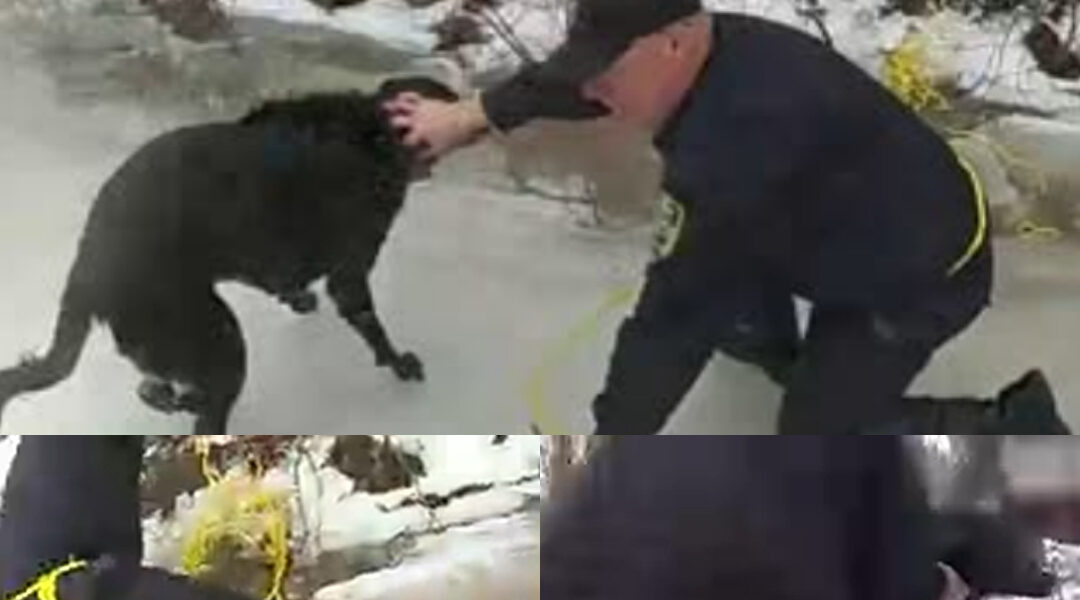
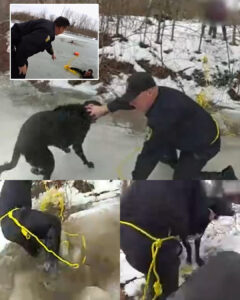
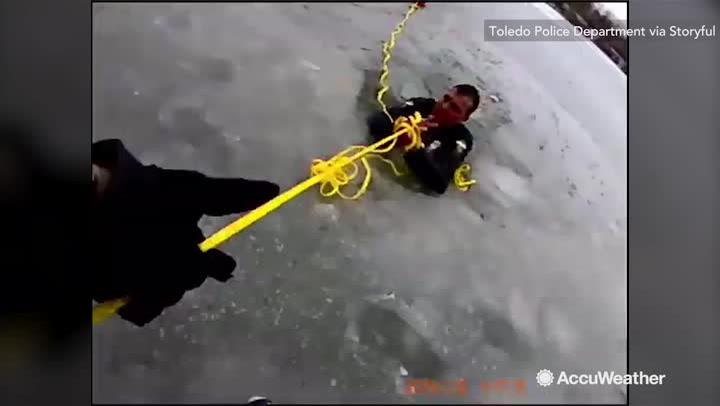
On his body camera, the scene unfolds in raw urgency—cracked ice, dark water, responders shouting instructions that barely register over adrenaline. Szarek grabbed a water rescue rope and dropped to the edge of the canal, lying flat to distribute his weight.
“Easy, buddy,” he called out, voice steady despite the chaos. “I’ve got you.”
He threw the rope again and again, trying to loop it around the dog’s chest, his neck—anything. But the current tugged. The ice shifted. The dog panicked, eyes wide, legs thrashing as exhaustion set in.
The rope missed.
Again.
The dog slipped lower.
Szarek didn’t hesitate.
He handed the rope back, stripped off his heavier gear, and looked at the trooper beside him. There was no discussion. No debate. Just a shared understanding that time was gone.
They went into the water.
The shock of the cold was violent, like a blow to the chest. It stole breath, burned skin, locked joints. The canal was deeper than it looked, the edges unstable, ice cracking and breaking as they moved.
They fought their way forward, arms numb, boots heavy with water. The dog barely had strength left to paddle when Szarek reached him. He grabbed fur and skin, fingers digging in as the dog whimpered weakly, collapsing into the first solid hold he’d felt since the ice gave way.
“I’ve got him!” Szarek shouted.
Together, the troopers turned back, pushing through water and ice, muscles screaming, lungs burning. Hands reached from the bank—firefighters, officers, strangers—grabbing collars, shoulders, arms, anything they could hold onto.
The dog was lifted first.
Then the troopers.
The Labrador mix hit the ground coughing, water pouring from his mouth as his chest heaved. Someone wrapped him in a blanket. Another responder rubbed his sides, urging warmth back into his shaking body.
The woman who owned him watched from a nearby ambulance, tears streaming down her face as she reached out.
“He’s alive,” someone told her.
She broke.
The dog lifted his head weakly, eyes searching until they found her. His tail moved—just once—but it was enough.
Trooper Szarek staggered back, soaked to the bone, hands red and trembling from cold and adrenaline. He didn’t smile. He didn’t pose. He simply watched the dog breathe, watched life return where seconds earlier there had been nothing but water and ice.
Later, officials would say no one was seriously injured. The rescue would be described as “successful.” The footage would spread online, people calling the troopers heroes.
But standing there in the cold, none of that mattered.
What mattered was this:
A dog had fallen through the ice.
A woman had nearly lost everything.
And when the rope failed, when the cold threatened to take one more life, someone chose to step forward instead of back.
Winter in northern New York is unforgiving. Ice does not care who you are or what you love. It breaks without warning and gives nothing back willingly.
That morning, though, something broke the other way.
Training met instinct.
Fear met resolve.
And compassion outweighed the cold.
The dog survived because people refused to let him disappear beneath the surface.
Because when the ice gave way, they went in after him.