
The video doesn’t begin with drama.

There is no roar. No spectacle. No reminder of how dangerous a Kodiak bear can be.
Instead, it opens on stillness.
A massive bear lowers his head slowly, deliberately, as if the weight of the world has finally become too much to hold up on his own. His fur is thick, dark, powerful—everything you would expect from an animal that weighs nearly 1,400 pounds and can stand more than 10 feet tall.
But his posture tells a different story.
Jimbo, a 24-year-old Kodiak bear, is tired.
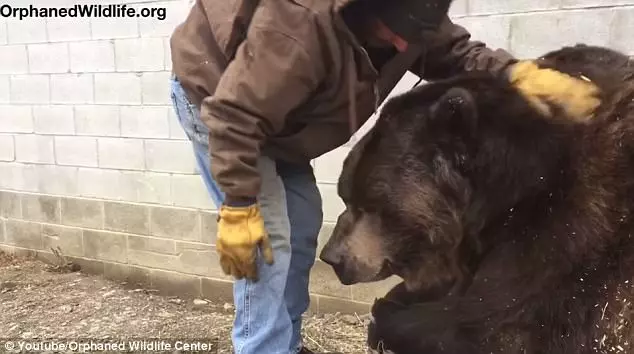
Not the kind of tired that comes from play or movement, but the quiet exhaustion that follows discomfort, illness, and long days when the body just doesn’t feel right. Earlier that week, Jimbo had been under the weather—restless, uneasy, not himself.
And on this day, he needed comfort.
So he went to the one place he knew he could find it.
Jim Kowalczik was already there.
Jim is not just a caretaker. He is Jimbo’s constant. The familiar presence who has been part of his life since he was a cub too injured to ever return to the wild. The human who learned Jimbo’s moods, his habits, the subtle shifts in his breathing that signaled something wasn’t right.
At the Orphaned Wildlife Center, love doesn’t arrive loudly. It arrives quietly, in routines, in patience, in hands that know when to be firm and when to be gentle.
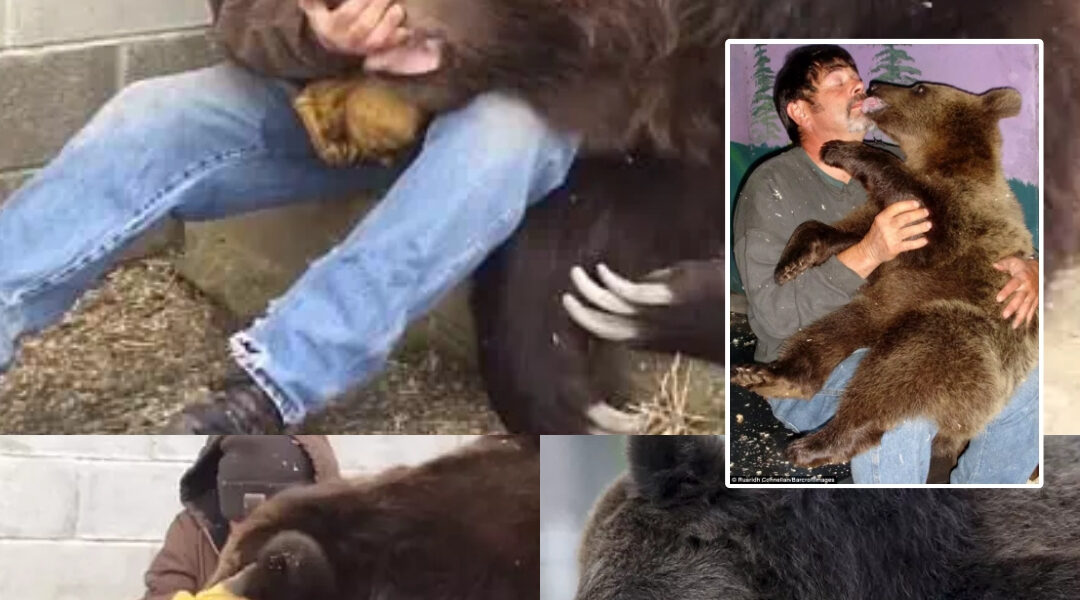
Jimbo approached Jim slowly, lowering himself until his enormous head rested against Jim’s lap.
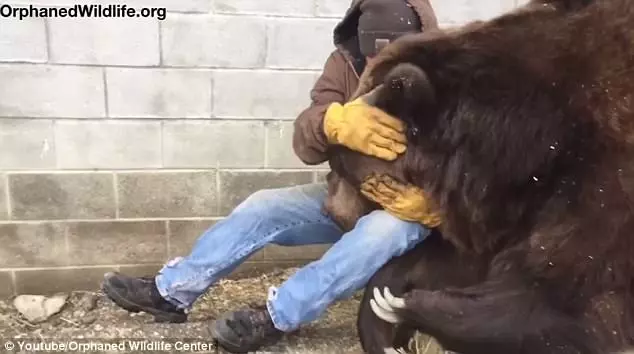
And Jim did not hesitate.
He wrapped his arms around the bear’s neck, pressing his cheek into thick fur, stroking along Jimbo’s jaw, his shoulder, the place behind his ear where Jimbo likes to be scratched. He whispered softly—words no one else needed to hear.
The kind of words you offer when you’re not trying to fix anything.
Only to be there.
For a moment that felt almost unreal, Jim placed his gloved hand gently into Jimbo’s mouth—a gesture that, out of context, would terrify most people. But this wasn’t recklessness. It was trust built over decades. A language understood by two beings who had spent a lifetime learning each other’s boundaries.
Jimbo didn’t clamp down.
He relaxed.
His eyes softened. His breathing slowed. His massive body leaned further into Jim’s presence, surrendering to the care without fear or tension.
In the background, the world faded.
There was no audience in Jimbo’s mind. No viral video. No millions of viewers waiting to react.
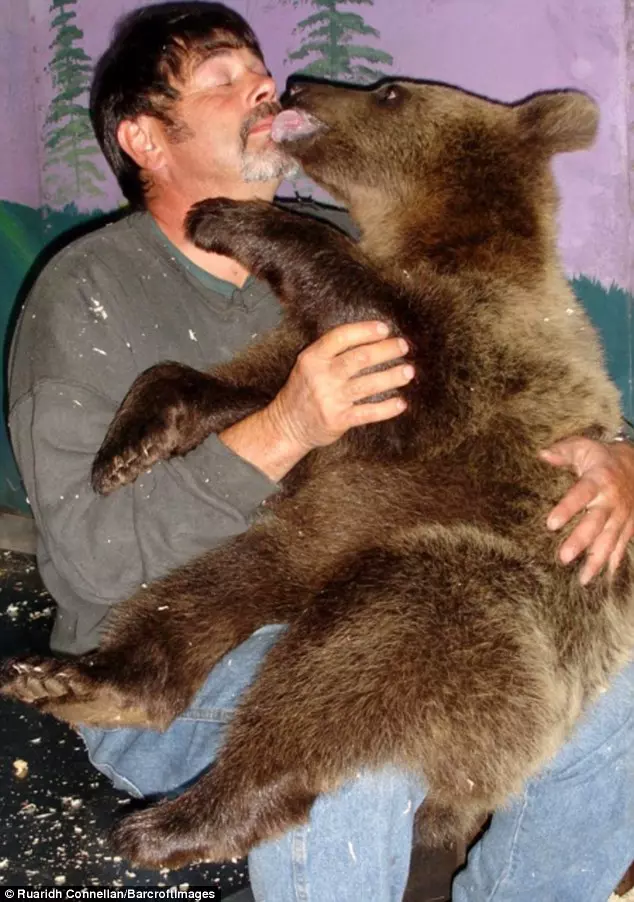
There was only a bear who didn’t feel well, and a human who knew exactly how to help.
The video was later titled simply:
“When Your Bear Had a Hard Day and Needs Some Extra Love.”
Within days, it spread across the internet, gathering more than a million views. People watched in disbelief, awe, and emotion. Many replayed it over and over, unable to reconcile the size and power of Jimbo with the tenderness of the moment unfolding on screen.
But for Jim and the Orphaned Wildlife Center, there was nothing unusual about it.
This is what care looks like when it is real.
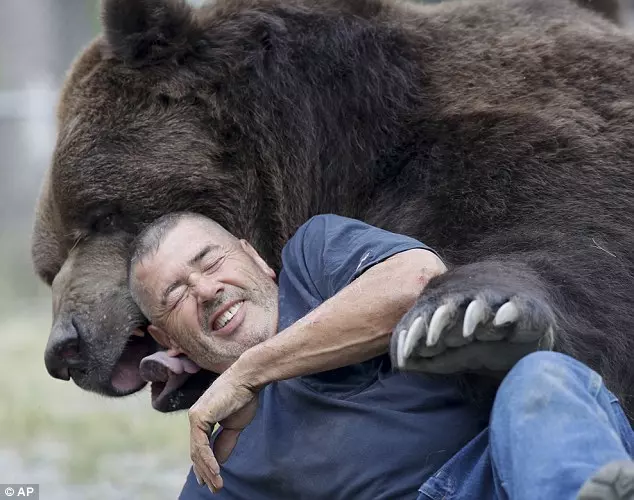
Jimbo has lived at the sanctuary since he was young. Early injuries made survival in the wild impossible, and from that moment on, his life followed a different path. Not one of captivity for entertainment, but one of protection—where his needs came before spectacle.
Jim and his wife, Susan, have built their lives around animals like Jimbo. Animals that can’t be released. Animals that require long-term commitment, specialized care, and an understanding that love doesn’t always look like distance.
Sometimes, love looks like sitting still while a 1,400-pound bear rests his head on your lap.
Sometimes, it looks like whispering to an animal who cannot understand the words but understands the intention.
On this particular day, Jimbo had just been checked by a veterinarian. The exam didn’t bring immediate answers—only the confirmation that something had made him uncomfortable, unsettled, off-balance.
So Jim did what he’s always done.
He stayed close.
He rubbed Jimbo’s neck, scratched gently under his chin, ran his hands through thick fur in slow, rhythmic motions. He let Jimbo lean, knowing that weight was not a burden—it was trust.
And Jimbo responded the only way he could.
He rested.
His massive head sank heavier into Jim’s lap. His body stilled. The restless energy faded, replaced by calm. By safety. By the quiet certainty that whatever he was feeling, he didn’t have to endure it alone.
The video ends without resolution.
No dramatic recovery. No triumphant moment.
Just a bear settling back down, receiving one last pat, one last gentle stroke, as if to say: That’s enough. I’m okay now.
For many who watched, the moment cracked something open.
It challenged assumptions about wild animals and human connection. It blurred lines people insist must remain rigid. It reminded viewers that care, when done responsibly, doesn’t erase an animal’s nature—it respects it.
Jimbo is still a Kodiak bear.
He is still powerful. Still dangerous in the wrong circumstances. Still deserving of boundaries and respect.
But he is also an individual.
One with preferences. With moods. With bad days.
And on his bad days, he is allowed comfort.
That truth—simple, profound—was what moved people the most.
Not because Jimbo was cuddled.
But because he was seen.
In a world that often treats animals as symbols, content, or cautionary tales, Jimbo was allowed to just be a living being having a hard moment.
And Jim was allowed to meet that moment with compassion instead of distance.
That is not recklessness.
That is responsibility carried for a lifetime.
As comments poured in, many people said the same thing in different words:
This is what real care looks like.
This is what trust looks like.
This is what devotion looks like.
And they were right.
Because heartwarming moments are not made by cameras.
They are made by years of showing up.
By learning when to step back and when to step closer.
By choosing patience over fear.
By understanding that love, when given wisely, does not weaken the wild—it protects it.
Jimbo didn’t need a performance.
He needed extra love.
And on that day, he received exactly what he needed.