
The water was calm that morning, the kind of calm that feels borrowed rather than promised. Small ripples moved gently across the surface, reflecting a pale sky that hadn’t yet decided what the day would become. Floating among the kelp and quiet swells was a mother sea otter—alert, steady, carrying the weight of a new life.

Her pup was impossibly small.
Newborn sea otters arrive into a world that offers little forgiveness. The ocean is cold. Currents shift without warning. And a pup, born without the ability to dive or hunt, depends entirely on one thing to survive: its mother.
This mother knew that.
The pup drifted beside her at first, buoyed by its thick natal fur, which traps air and keeps it afloat like a tiny life raft. Its eyes were barely open, its movements uncertain, limbs paddling more from instinct than coordination. Every sound it made was soft—small squeaks carried briefly before disappearing into the open water.
Then, with deliberate care, the mother moved.

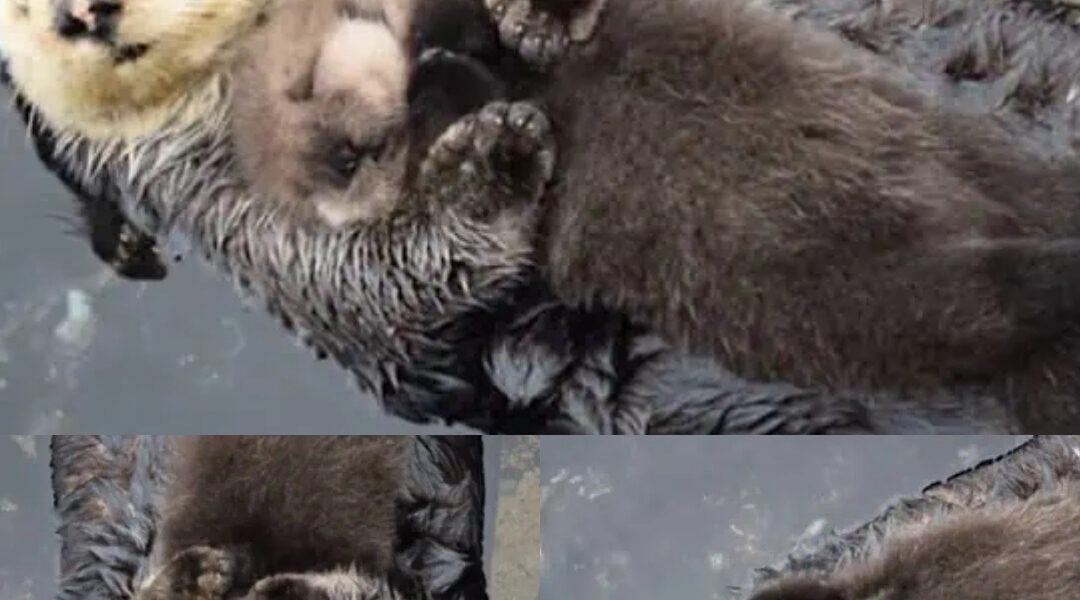
She rolled gently onto her back and guided the pup upward, lifting it out of the water and onto her belly. The movement was slow and practiced, as if she’d already learned that this was where her baby belonged. The pup settled against her chest, its damp fur pressed into warmth, its tiny body finally still.
On her belly, the pup was safe.
This was not coincidence. Sea otter mothers have few options when it comes to keeping their babies warm. They cannot leave the water for long. They cannot build nests. What they have instead is ingenuity—and devotion.
Cradling her pup against her body, the mother floated effortlessly, adjusting her position with subtle movements of her hind flippers. She glanced down often, checking, recalibrating, making sure the pup hadn’t slipped, hadn’t grown cold, hadn’t become overwhelmed by the vastness around them.

At one point, she bent her head and gently blew air into the pup’s fur.
It looked almost playful, but it wasn’t. By blowing air into the pup’s coat, she was helping restore the insulating layer that keeps it warm and buoyant. It was grooming, protection, and instruction all at once—a quiet lesson passed down through instinct rather than words.
Nearby, photographer Suzi Eszterhas watched through a long lens, careful not to intrude. She had spent more than two decades photographing sea otters, learning their rhythms, their boundaries, the ways they communicate care through movement rather than sound. Even so, moments like this never became ordinary.
“This mother was different,” Eszterhas would later explain. “She was very relaxed. Very confident. She seemed completely focused on her baby.”
The mother otter didn’t rush. She didn’t panic. She simply floated, holding her pup where it could stay dry, warm, and close to her heartbeat. The harbor around them was busy—boats passed in the distance, human sounds drifted faintly across the water—but she did not move away.
Instead, she adapted.

When hunger eventually pulled at her, the mother made another careful decision. She eased the pup back into the water, watching closely as it floated on its own, supported by its natural buoyancy. She lingered for a moment, eyes fixed on the small body bobbing beside her.
Then she dove.
The dive was quick and efficient. Sea otters must eat constantly to fuel their high metabolism, especially mothers who are nursing. She disappeared beneath the surface, paws working, whiskers sensitive to movement below. All the while, the pup remained where she’d left it—floating, waiting, trusting.
To an outside observer, it might have looked risky.
To the mother, it was necessary.
She resurfaced moments later with food, chewing quickly before returning to her pup. Without hesitation, she rolled onto her back again, lifting the pup back onto her belly as if nothing else in the world required her attention.
At times, she left the pup floating near a dock while she hunted, returning again and again, never straying far. Eszterhas later joked that she felt like an accidental babysitter, watching over the pup from a respectful distance while its mother worked.
But the truth was simpler.
The mother otter trusted herself.
Sea otters are not born knowing how to be mothers. They learn through instinct sharpened by necessity. Every choice matters. Every mistake costs energy, time, sometimes life. And yet, this mother moved with quiet confidence, adapting to a world that offers little margin for error.
The pup, for its part, seemed content.
Curled against its mother’s belly, it slept often, rising and falling with her breathing. When it stirred, she adjusted. When it squeaked, she responded. When it slipped, she corrected. No movement was wasted. No care was withheld.
It was a bond forged not in sentiment, but in survival.
Along the California coast, nearly 3,000 sea otters now live—descendants of a small group of just 50 individuals discovered in 1938. Once hunted nearly to extinction for their fur, sea otters are now protected, their numbers slowly recovering thanks to decades of conservation efforts.
Still, they remain classified as endangered.
Their survival depends not just on laws and protections, but on countless moments like this one—mothers teaching pups how to float, how to stay warm, how to exist in a world that rarely slows down for the vulnerable.
The pup would spend months learning to dive, to groom itself properly, to crack shells, to forage independently. Before that, it would learn something even more important.
It would learn what safety feels like.
Pressed against its mother’s chest, carried across water it could not yet understand, the pup was being given more than warmth. It was being shown, again and again, that the world—however large—could still hold space for care.
Eszterhas lowered her camera at times, simply watching. There are moments that resist documentation, that feel too intimate to frame. A mother adjusting her position so her baby doesn’t slip. A tiny paw curling unconsciously into fur. A breath blown gently into a coat not yet thick enough to protect itself.
No drama. No spectacle.
Just love, expressed through action.
As the light shifted and the water changed color, the mother continued her careful routine. Lift. Float. Groom. Dive. Return. Over and over, until the pup was no longer shivering, no longer restless, no longer overwhelmed.
The ocean carried them together.
For anyone watching, the scene lingered long after it ended—not because it was rare, but because it was universal. A reminder that care does not always look loud or heroic. Sometimes it looks like a mother floating on her back, holding her child above cold water, doing whatever it takes to keep them safe.
And sometimes, that is more than enough.