For generations, towering trees had offered shelter, fruit, and safety. Vines stretched like familiar pathways through the canopy. The air carried the steady rhythm of insects, birds, and unseen life moving in balance. For the orangutan, this was not just a place to live—it was home, memory, and survival woven into one.
Then the ground began to shake.
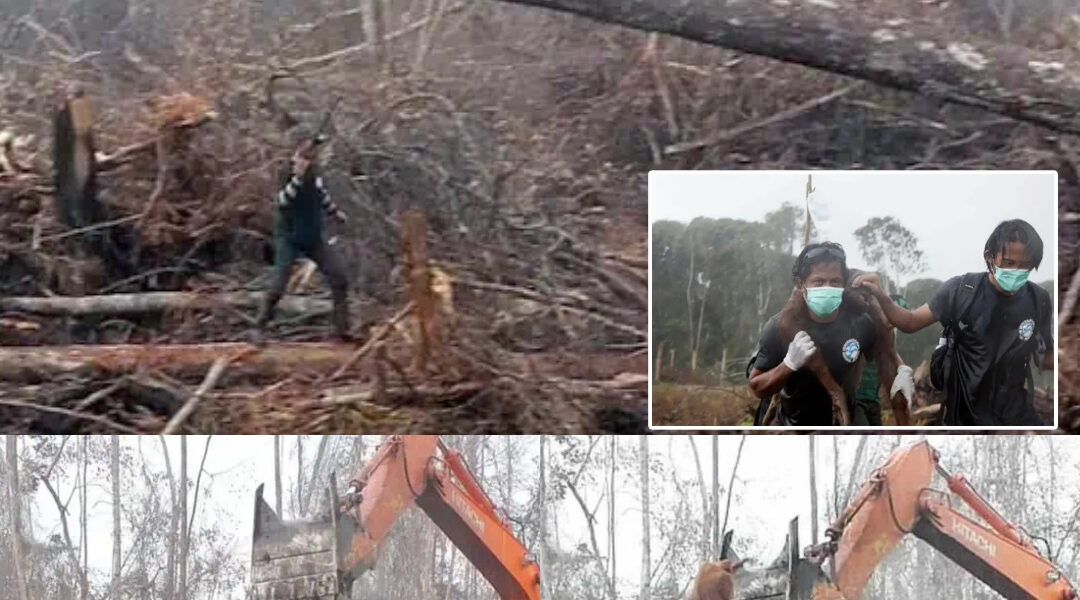
At first, it was distant. A low vibration that didn’t belong to the forest. The orangutan paused, gripping a branch, listening. The sound grew louder, heavier, foreign. Leaves trembled. Birds scattered. And then, through the trees, the machine appeared.
An excavator.
Its metal arm rose and fell with mechanical indifference, tearing into the earth, crushing roots, snapping trunks that had taken decades to grow. Each movement erased another piece of the world the orangutan knew.
The orangutan climbed down.
That decision—captured on video and later shared across the world—was not calculated. It wasn’t symbolic. It was instinct. When the ground beneath your life is being destroyed, you don’t analyze the odds. You act.
The orangutan approached the excavator, standing upright, arms raised. Its movements were urgent, almost pleading. It reached for the machine, gripping the metal arm, pushing against it with all the strength its long limbs could muster.
As if asking it to stop.
As if this enormous, roaring thing could understand what it was taking.
The excavator did not pause.
It kept moving, its engine drowning out the forest’s protests. Against steel and horsepower, the orangutan’s strength meant nothing. Still, it did not retreat. It clung. It pulled. It stood its ground as trees fell behind it, the sound sharp and final.
This was not aggression.
It was desperation.
Orangutans are not fighters by nature. They are careful, deliberate, deeply intelligent beings who avoid conflict whenever possible. They rely on memory—knowing which trees fruit when, which paths are safe, where water can be found. When their forest disappears, that knowledge becomes useless overnight.
And starvation follows.
The footage is difficult to watch because it strips away abstraction. Deforestation is often discussed in numbers—hectares lost, percentages declined, populations reduced. But here was a single animal, alone, trying to physically stop the destruction of everything it depended on.
One body against a machine.
Viewers around the world reacted with shock, anger, and grief. Many said the same thing: It looks like it’s begging.
In a way, it was.
As the excavator continued its work, rescue teams from International Animal Rescue were alerted. They had seen scenes like this before—too many times. Orangutans displaced by logging and palm oil expansion often wander into cleared land, confused and vulnerable, sometimes injured, sometimes starving.
By the time rescuers arrived, the forest was already changed.
The orangutan was still there.
Exhausted. Covered in dirt. No longer fighting, but not fleeing either. There was nowhere left to go.
Rescuers approached slowly, speaking softly, careful not to add more fear to an animal already overwhelmed. They sedated the orangutan gently and carried it away from the destruction it had tried so hard to stop.
The machine kept working after they left.
That detail is what stays with many people.
The orangutan was saved—but the forest was not.
This rescue took place in the Sungai Putri forest of West Kalimantan, a region that has become a frontline in the fight to protect the critically endangered Bornean orangutan. Once vast and continuous, these forests are now broken into fragments, surrounded by plantations and roads.
For orangutans, fragmentation is a death sentence.
They cannot simply “move on” the way some animals can. Their slow reproduction rate—one baby every several years—means population recovery is painfully fragile. Every lost adult, every destroyed habitat, pushes them closer to extinction.
The orangutan in the video survived because humans intervened.
But thousands more are not filmed.
They disappear quietly—through hunger, injury, or conflict—without viral videos or global outrage. Their stories end unseen.
At the rescue center, the orangutan was given medical care, food, and space to recover. Its physical wounds healed faster than the deeper damage. Trauma in great apes is real. They remember. They grieve. They search for what is gone.
Rehabilitation is slow and careful. Caregivers avoid unnecessary contact, encouraging natural behaviors, preparing the animal—if possible—for eventual release into protected forest. But release depends on one crucial factor.
There must be somewhere safe to return to.
That is the question hanging over every rescue like this one.
The video spread quickly because it showed something people struggle to ignore: a living being resisting erasure. Not with violence. Not with rage. But with presence.
Standing there. Holding on. Refusing to vanish quietly.
The orangutan did not understand deforestation. It did not know about palm oil markets or land permits or profit margins. It knew only that the place it relied on was being destroyed—and that destruction felt wrong.
That clarity is what unsettles viewers most.
Because the orangutan’s reaction mirrors something deeply familiar. The instinct to protect home. To stand in front of danger. To fight even when you know you might lose.
In the end, this was not a story about heroism.
It was a story about loss.
A forest lost. A home lost. A way of life slipping away under metal tracks and falling trees.
The orangutan’s brave stand did not stop the excavator. But it did something else. It forced millions of people to look directly at the cost of deforestation—not as a concept, but as a lived experience.
One animal. One moment. One irreversible change.
And perhaps that is why the footage continues to circulate.
Because in that brief, heartbreaking stand, the orangutan showed us what the planet itself cannot say out loud:
That survival should not require begging. That homes should not vanish overnight. And that once a forest is gone, no rescue—no matter how compassionate—can fully restore what was taken.
The orangutan was carried to safety.
The forest was not.
And that truth is what lingers long after the video ends.