Each spring, she returned to the same spot, driven by an instinct older than memory. She built her nest carefully, laid her eggs with patience, and stayed close — guarding them against cold nights and curious shadows. And each year, something went wrong.
Floodwaters rose without warning.
Predators came in the dark.
The eggs disappeared.
Again.
And again.
And again.
To most people passing by, she was just another swan along the water’s edge — graceful, quiet, easily overlooked. But to one man who lived nearby, her story was impossible to ignore.
Rob Adamson had been watching her for years.
Living on a narrowboat, Rob spent his days close to the water. He noticed patterns others missed — the way seasons changed, the way wildlife struggled silently alongside humans. And he noticed the swan’s heartbreak long before anyone else did.
Every year, the same outcome.
Every year, the same loss.
She never abandoned the place.
Never stopped trying.
There is something profoundly moving about persistence in the face of repeated failure. Especially when it comes from a creature that cannot explain its grief, only endure it.
At first, Rob did what most people would do — nothing.
He knew the rule: don’t interfere with wildlife. Nature must take its course. Intervention often causes more harm than good. He told himself that this was simply how things were meant to be.
But over time, watching the same tragedy repeat itself became unbearable.
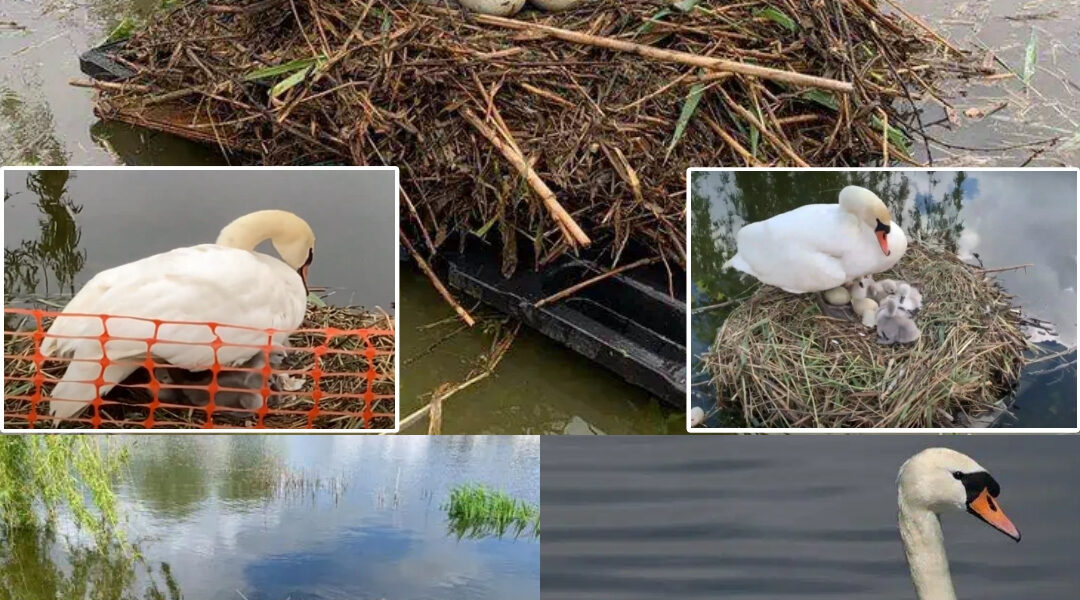
One year, he tried a small step. He built a simple fence around the nesting area to keep foxes away. It helped — briefly. But then the water rose again, swallowing the nest from below. Eggs that had survived predators were lost to flooding.
Rob realized the truth no one wanted to say out loud.
If nothing changed, the eggs would never survive.
And the swan would never become a mother.
“I knew you shouldn’t interfere,” he later admitted. “But it had gotten to the point where they were all going to die. I couldn’t go to sleep knowing that. I knew I would regret it if I didn’t do something.”
That regret — the kind that settles in quietly and never leaves — pushed him to act.
Rob didn’t rush in recklessly. He thought. He watched the water. He studied the problem the way the swan herself might have — patiently, carefully.
The danger came from two directions:
Predators from the land.
Floods from the water.
So the solution had to rise above both.
He built a raft.
Not a grand structure. Not something flashy. Just a sturdy, floating platform designed to move with the water rather than fight it. A place where the nest could stay dry even when the river swelled. A place foxes couldn’t easily reach.
When Rob placed the raft in the water and guided the swan’s nest onto it, there was a moment of uncertainty. Wild animals don’t trust easily. The swan watched him closely, alert, wary, ready to flee if needed.
But she stayed.
Something about the raft felt right.
Something felt safer.
Days passed.
Then weeks.
The water rose — and the nest stayed afloat.
Predators came — and left empty-handed.
For the first time in years, the eggs remained.
Rob tried not to get his hopes up. After watching so many failures, optimism felt dangerous. But every morning, he checked from a distance, heart quietly pounding.
And then, one day, he saw movement.
A crack.
A tiny shift.
A sound so soft it could have been imagined.
The eggs were hatching.
One by one, small gray shapes emerged — wet, fragile, alive. Eight cygnets broke free from their shells, wobbling into the world beneath their mother’s watchful gaze.
Eight lives that, without intervention, would never have existed.
Rob stood back, overwhelmed.
“When I saw them start to hatch,” he said later, “I was so happy. It’s like winning the lottery.”
But this wasn’t luck.
It was compassion.
It was attention.
It was someone choosing not to look away.
The swan did what she had always known how to do. She gathered her cygnets close, shielding them beneath her wings. She led them gently across the water, teaching them to swim, to follow, to survive.
Rob didn’t linger.
He didn’t claim credit.
He simply watched — quietly — as a decade of loss transformed into a moment of triumph.
This story isn’t about breaking rules.
It’s about recognizing when the rules no longer protect life.
It’s about understanding that sometimes, the most humane choice isn’t strict non-interference — but thoughtful, respectful help.
The swan never knew Rob’s name.
She never thanked him.
She didn’t need to.
Her cygnets were alive.
And that was enough.
In a world filled with loud rescues and dramatic heroics, this one unfolded gently — the way nature itself prefers. A man saw suffering. He weighed the consequences. And he chose kindness.
Sometimes, changing a life doesn’t require saving the world.
Sometimes, it just means building a raft — and giving hope somewhere safe to rest.