
She should have been learning how to hunt.

She should have been following the heavy footsteps of her mother across the ice, memorizing the rhythms of survival written into every movement. She should have known how to wait, how to stalk, how to endure hunger and cold — the lessons every polar bear cub must master early in life.
Instead, she was alone.
Somewhere on a remote Arctic island, her mother died. No one knows exactly how — starvation, illness, injury — only that one day the great white presence that had defined the cub’s world was suddenly gone. What remained was silence, endless cold, and a cub far too young to survive it.
Polar bear cubs do not get second chances in the wild.
Without a mother, they do not learn to hunt. They cannot defend themselves. They do not last long.

Driven by hunger and instinct, the cub wandered. Her small body moved across an unforgiving landscape until something unfamiliar appeared on the horizon — structures, noise, movement. Humans.
A gold mine.
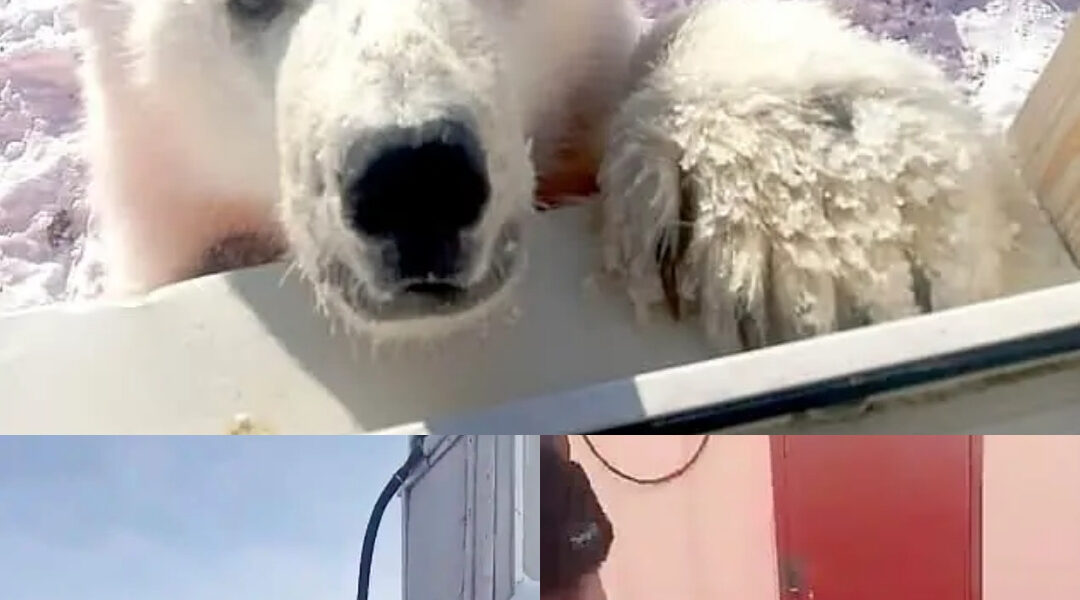
The cub approached not as a predator, but as a desperate child. She lingered near the workers’ camp, watching, waiting, her ribs visible beneath her thick white fur. And then she did something no wild polar bear should ever do.
She begged.

The miners knew the rules. Feeding polar bears was strictly forbidden — not only for human safety, but because contact with people can doom a bear’s future in the wild. Everyone understood that line should not be crossed.
But understanding rules is easier than ignoring a starving cub.
The men looked at her and saw not danger, but helplessness. A creature that had lost everything. A life slipping away right in front of them.
So they broke the rules.

At first, it was small — scraps of food left behind, tossed from a distance. The cub returned again and again, learning quickly that these strange two-legged beings were not a threat. Over time, caution faded into familiarity.
Days turned into weeks.
Weeks into months.
The miners named her. Talked to her. Watched her grow. Against all reason and regulation, they cared for her — because doing nothing would have meant certain death.
And the cub survived.
But survival came with a cost.

She grew used to humans. Too used. She no longer feared them. She no longer hunted. Why would she, when food appeared without effort? When hands reached out not with weapons, but with care?
In one video that later spread across the world, the cub can be seen climbing a ladder with awkward determination before leaping down and wrapping herself around one of the miners in a clumsy, affectionate hug.
She behaves not like a wild predator —
but like a dog greeting its owner.
It is adorable.
And heartbreaking.

Because this is the moment her fate quietly changed.
A polar bear that trusts humans cannot return to the wild.
Eventually, the miners’ contract ended. The work was finished. They packed their belongings and prepared to leave the island — but not before reporting the cub’s situation. With no communication during their shift, they could only call for help once they reached the mainland.
When wildlife officials were finally alerted, time was critical.
The cub had been left behind.
Alone again.

Searching the mining site for the people who had become her family.
“Our only hope,” said Andrey Gorban, director of the Royev Ruchei Zoo, “was that the miners had left enough waste behind for her to feed on for a few weeks.”
It was a fragile hope — but the only one available.
With support from the Moscow Zoo, a rescue mission was launched. When the team arrived, they found the cub near the site, lingering, waiting, as if expecting familiar faces to return.
She was still alive.
Still gentle.
Still trusting.
That trust sealed the final decision.

This bear could not go back to the wild.
Releasing her would have been a death sentence — not only for her, but potentially for humans she might approach without fear. She had crossed a line that cannot be uncrossed.
So she was taken to the Moscow Zoo.
Not as a prisoner.
But as a survivor.
Some criticized the miners for feeding her, for domesticating an endangered animal. But Andrey Gorban did not.
“Rightly or wrongly,” he said, “they fed the endangered animal and through that domesticated it. The shift workers saved its life. The cub had no chance to survive.”
And that is the truth that sits uncomfortably at the center of this story.
There was no perfect choice.
Only the least cruel one.
The miners did not set out to change the cub’s fate forever. They did not plan to make her dependent on humans. They saw a dying animal — and chose compassion over rules.
They chose to save a life.
Now, the cub lives in care. She is fed properly. Monitored. Protected. She will never roam the Arctic ice as her ancestors did. She will never hunt seals beneath frozen waters.
But she is alive.
Her story is not one of triumph or failure — it is a reflection of a world where wildlife increasingly collides with human activity. Where animals are forced into impossible situations. Where survival sometimes means losing the very wildness that defines them.
A polar bear was given a second chance — not the one nature intended, but the only one available.
And it began not with heroics, not with planning, but with a group of miners who looked at a starving cub and decided that saving her life mattered more than following the rules.
Sometimes, mercy is messy.
Sometimes, it comes with consequences.
But sometimes, it is the only reason a heartbeat continues.
And for this polar bear, mercy meant everything.