There are moments in the wild that feel almost too intimate to witness — moments so gentle they seem to pause time itself. This was one of them.

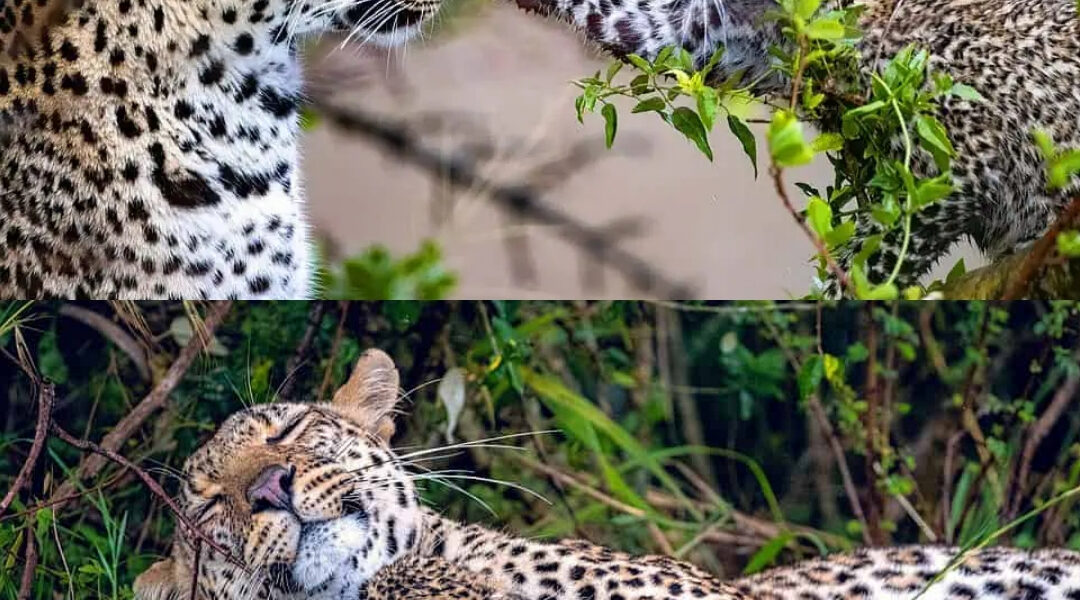
Beneath the soft hush of the savanna, a mother leopard lay resting with her cubs nestled close, their spotted bodies blending into the earth and shadows. To an untrained eye, it might have looked like nothing more than another pause in a predator’s day. But what unfolded next revealed something far deeper.
Because love, even in the wild, has a language all its own.
When rain began to fall, it came suddenly. The quiet was broken by the soft patter of droplets against leaves, then by the restless stirring of the cubs. Still young, still ruled by curiosity, they woke with energy that refused to be contained. One cub, especially bold, scrambled to his feet and began climbing nearby branches, testing his balance, his courage, his growing independence.
Every movement was clumsy.
Every sound too loud.
And inevitably, it woke his mother.

In the wild, such disruption could easily be met with impatience. A leopard’s life is defined by vigilance, efficiency, survival. Rest is precious. Energy is carefully guarded.
But this mother did not snap.
She did not swat.
She did not retreat.
Instead, she rose slowly and stepped toward her cub — not with discipline, but with warmth.
She lowered her head, pressed her face against his small body, and wrapped him into her chest in a brief, tender hug. Her posture softened. Her eyes, usually sharp and calculating, seemed to melt into something unmistakably maternal.
For a fleeting moment, predator and prey vanished from the narrative.

This was simply a mother and her child.
Wild animals are often described as instinct-driven, emotionless, ruled solely by survival. But anyone who has watched a mother with her young knows that this idea falls apart quickly. In the animal kingdom, motherhood is fierce, consuming, and deeply emotional — because the stakes are unforgiving.
A cub’s survival depends on more than strength.
It depends on care.
On patience.
On love.
The photographer watching from a respectful distance could hardly believe what he was witnessing. Scenes like this are rare not because they don’t happen — but because they are usually hidden. Wild mothers do not perform affection for an audience. These moments exist quietly, away from danger, away from eyes that do not belong.
Yet here it was.

After the brief embrace, the cub stayed close, emboldened rather than restrained. Soon, the others joined, tumbling around their mother, climbing over her back, tugging at her tail, play-fighting with the careless joy of youth.
And she let them.
She followed them as they wandered, never far, never distracted. When they strayed too close to unfamiliar shapes, she shifted position, guiding them back with her presence rather than force. When they grew too noisy, she simply leaned in, her body a shield and a reminder.
At one point, the cubs settled just a short distance away, collapsing into a pile of spots and limbs. The mother lay beside them, her body curved protectively around theirs, eyes half-closed but never fully asleep.
This is how wild mothers rest.
Always alert.
Always listening.

To witness such tenderness from an animal so often portrayed as solitary and ruthless challenges the way people think about wildlife. Leopards are hunters. They are symbols of power and precision. But before they are predators, they are parents.
And parenthood changes everything.
The photographer later described the moment as unbelievable — not because it was dramatic, but because it was real. Unfiltered. Unstaged. A reminder that affection does not belong exclusively to humans.
Love does not require words.
It requires presence.
In the wild, a mother’s love must be efficient. There is no luxury for prolonged comfort or indulgence. Every hug is brief. Every moment of closeness balanced against the need to remain hidden, vigilant, ready.
Yet even within those constraints, love finds a way.
The cub who had interrupted his mother’s rest seemed unaware of any wrongdoing. He leaned into her, pressed his head against her chest, and eventually grew still. Safe. Content.
That safety would not last forever.
One day, she would push him away.
One day, she would teach him to hunt alone.
One day, she would disappear from his life entirely.
But not yet.
For now, he was still hers.
And she was still willing to pause the world for him.
Photographs captured that day now circulate widely, drawing awe and tenderness from viewers around the globe. People see themselves reflected in the image — in the way a mother leans toward her child, in the quiet forgiveness, in the instinct to protect even when exhausted.
Because across species, across continents, across environments, motherhood carries the same truth:
Love is instinct.
Love is sacrifice.
Love is watching over another life even when no one is watching you.
In that brief hug between a leopard and her cub, the wild revealed something deeply familiar. Something comforting. Something human.
Not because animals are like us —
but because we are not as different from them as we often believe.
And for a moment, in the hush after the rain, love stood still long enough for us to see it.