The cold arrived quietly, settling over the world in a blanket of white. Snow softened every edge, muted every sound, and turned the ordinary into something almost unreal. For many, winter brings caution, discomfort, retreat. But for one elephant, it brought something else entirely.
It brought wonder.

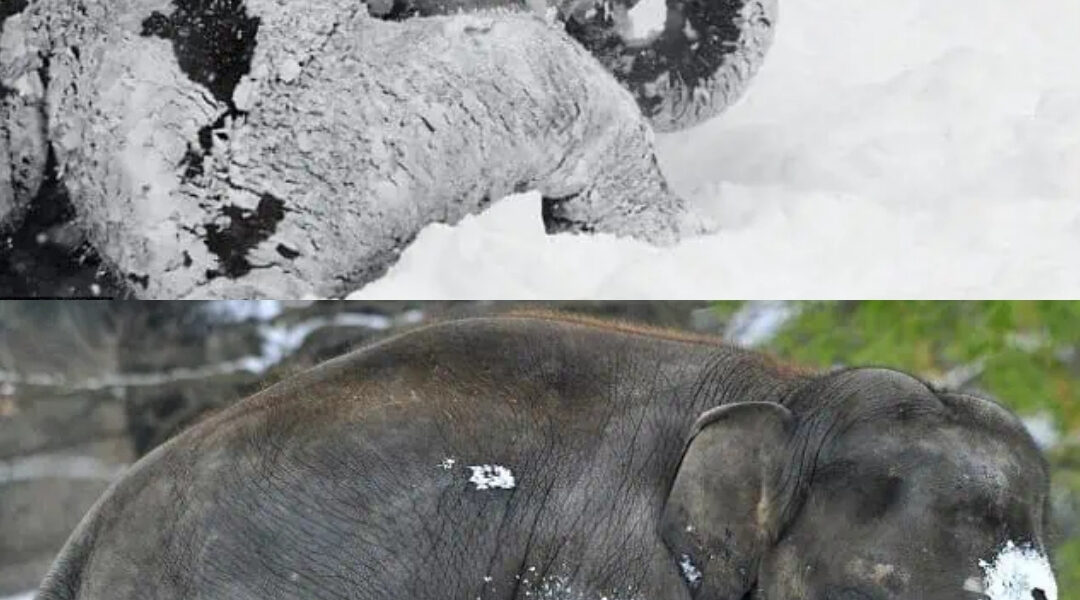
Ko Raya stood at the edge of her enclosure, her massive feet sinking slightly into fresh snow. She paused, ears gently fanning the icy air, as if listening to a language she had never heard before. The ground beneath her was no longer familiar earth or packed dirt, but something soft, cold, and endlessly intriguing.
Then she lowered her trunk.
The first touch was careful. Curious. Snow clung to the rough, sensitive skin, melting almost instantly. Ko Raya pulled back, tilted her head, and tried again. This time, she scooped a small mound, lifting it up as if inspecting a strange gift from the sky.
And just like that, the hesitation vanished.

With a sudden burst of energy, Ko Raya leaned her enormous body to one side and rolled, fully committing herself to the moment. Snow coated her back, her sides, her legs. She wriggled and rocked, a creature weighing several tons moving with the delight of a child discovering play for the first time.
It was impossible to watch without smiling.
Ko Raya shook herself upright, sending snow flying in every direction. She trumpeted softly, not a call of alarm or command, but something lighter — a sound of excitement. Then she went back down, rolling again, pressing her body into the snow as if trying to absorb the cold magic beneath her.
For those who understand elephants, the scene was extraordinary.

In the wild, Asian elephants grow up under blazing suns, in dense forests and humid plains. Snow does not belong to their ancestral memory. It is not part of the stories carried through generations of migration and survival. And yet, Ko Raya met it not with fear, but with joy.
She had been born into a different world.
Ko Raya entered life surrounded by human care rather than jungle canopy. She grew up learning safety, routine, and trust. And while her body carried the heritage of distant tropical lands, her experiences shaped her into something uniquely her own.
That morning, snowballs began to appear.
With surprising delicacy, Ko Raya gathered snow with her trunk, compressing it clumsily but enthusiastically. She lifted the misshapen sphere, studied it, then tossed it forward with a flick of her trunk. It landed a short distance away, breaking apart in a soft explosion of white.
She froze, clearly delighted by the result.

Again and again, she repeated the process — scoop, lift, throw. Sometimes she aimed nowhere in particular. Sometimes she sent the snowball toward her companions, who responded with slow movements and playful sways of their own. Soon, the enclosure was alive with motion, white dust drifting through the air as massive bodies participated in an unlikely winter game.
At one point, curiosity got the better of her. Ko Raya lifted a snowball to her mouth and tasted it. The reaction was immediate. She jerked her head back, clearly unimpressed by the icy sensation, then seemed to reconsider. A second taste followed — shorter this time — before she decisively dropped the snow and returned to throwing it instead.
Not everything new needs to be liked to be enjoyed.

What made the moment so powerful was its authenticity. This was not training. Not performance. Not a response to command. No one directed her movements or encouraged the play. The caretakers stood back, watching quietly, understanding that interruption would only diminish what was unfolding naturally.
Ko Raya was choosing joy.
Elephants are often spoken of in terms of intelligence, memory, strength. Less often do people talk about their capacity for play. Yet play is a sign of safety, of emotional well-being, of a mind free enough to explore rather than merely survive.
That morning, Ko Raya was not surviving.
She was living.
As snow continued to fall, she slowed, her movements growing heavier but calmer. She stood still for a long moment, steam rising from her body into the cold air. Her breathing was steady. Her posture relaxed. The excitement settled into contentment.
Then she walked.
Each step left behind a deep footprint in the untouched snow — a trail of evidence that something remarkable had passed through. Those prints would not last. Snow would fill them in. New snow would erase them completely.
But the memory would remain.

For the people watching, it was more than a charming sight. It was a reminder that joy does not belong to one climate, one species, or one way of life. It emerges where there is space, safety, and the freedom to feel.
In a world that often feels heavy, divided, and unrelenting, the image of an elephant rolling in snow carried a quiet lesson. Happiness does not always arrive loudly. Sometimes it looks like curiosity. Sometimes it feels like surrendering to the unfamiliar. Sometimes it weighs several tons and moves with surprising grace.
Ko Raya did not know she was teaching anything that day.
She only knew the snow was new.
The moment was hers.
And it was worth embracing fully.
As the day faded and the cold deepened, she eventually turned back toward shelter, her body dusted white, her path marked briefly behind her. The snow continued to fall, gentle and endless, covering the world once more.
But somewhere, long after the footprints disappeared, the warmth of that moment lingered — proof that even in the coldest places, joy can bloom.