
The road cut quietly through the reserve, a thin ribbon of asphalt laid across an ancient landscape that had existed long before humans ever arrived. On most days, it was only a passing inconvenience for the animals who lived there—a brief pause in their wandering, a momentary negotiation between steel and skin, engines and breath.
On this day, traffic stopped.
Not because of an accident.
Not because of a signal.
But because an elephant herd was crossing.
They emerged slowly from the trees, one by one, their massive forms moving with a patience that felt almost ceremonial. Dust rose gently beneath their feet. Sunlight filtered across their backs. Drivers sat frozen, engines idling, watching something far older and far wiser than the road itself reclaim the space.
At the front walked the matriarch.
She was easy to recognize—not because she was the largest, but because of how the others moved around her. Her steps were steady, unhurried. Her ears lifted and fell with intention. Every decision passed through her first, shaped by decades of memory: droughts survived, predators faced, calves born and lost, paths remembered across years.
Behind her came the family—females of different ages, calves tucked close to their sides, trunks occasionally brushing against one another in quiet reassurance.
And then, in the middle of the crossing, it happened.
The smallest calf faltered.
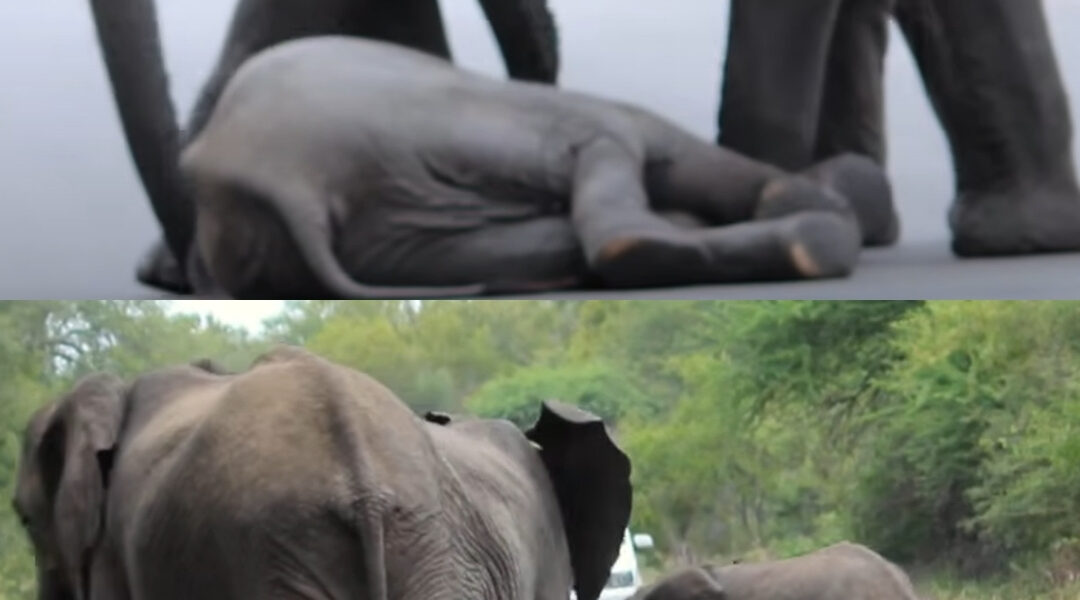
At first, it was barely noticeable—a stumble, a hesitation, the kind that happens to young bodies still learning how to carry their own weight. But then the calf’s legs buckled completely, and the tiny elephant collapsed onto the warm asphalt.
The sound was soft.
The impact gentle.
But the meaning was immediate.
The herd froze.
In the animal kingdom, moments like this can mean life or death. A fallen young one is vulnerable—to predators, to exhaustion, to the merciless logic of nature that does not pause for weakness.
But elephants are not creatures of abandonment.
They are creatures of memory.
Of relationship.
Of protection.
The reaction was instant.
Without panic, without chaos, the herd shifted as one. Large bodies turned inward. Adults stepped closer, forming a wide, living circle around the fallen calf. Tusks angled outward. Massive legs planted firmly between the baby and the open road.
The matriarch moved closer, lowering her head. Another female reached out with her trunk, touching the calf’s side, then its face. The touch was not rough. It was deliberate. Gentle. The way a mother might wake a sleeping child.
The calf did not rise.
For a moment, the world seemed to hold its breath.
Cars remained still. No horns sounded. No engines revved. Humans, suddenly aware of their smallness, watched in silence as something profoundly intimate unfolded in front of them.
Inside the circle, the elephants worked quietly.
One nudged the calf’s back legs.
Another brushed dust from its face.
A third stood so close her shadow completely covered the small body, shielding it from the sun.
This was not confusion.
This was care.
Elephants are known for their intelligence, but intelligence alone does not explain what was happening here. What surrounded that calf was not instinct alone—it was relationship. Elephants live in tight-knit family units, often led by a matriarch who carries the accumulated knowledge of generations. They recognize one another by scent, by sound, by memory that can stretch across decades.
They mourn their dead.
They celebrate their young.
They remember.
The calf lay still, sides barely moving.
Perhaps the long journey had drained it.
Perhaps thirst had taken more than expected.
Perhaps its small body simply needed rest.
Whatever the cause, the herd did not rush.
They waited.
Minutes passed.
The matriarch shifted her weight, releasing a low rumble from deep within her chest—a sound below the range of human hearing, but one that carries through the ground itself. Other elephants responded in kind, a quiet conversation conducted through vibrations rather than words.
The calf stirred.
One leg twitched.
Then another.
Encouragement came immediately. Trunks reached in again, brushing, lifting slightly, guiding without forcing. No one pulled. No one pushed too hard. They understood something humans often forget: strength cannot be rushed back into a body.
The calf tried to rise.
It failed.
And instead of leaving, instead of moving on, the herd closed in even tighter.
A wall of bodies.
A barrier of loyalty.
Predators could not reach it.
Danger could not approach.
The world would wait.
Another attempt.
This time, the calf managed to lift its front legs, wobbling, swaying dangerously. A female stepped closer, pressing her side gently against the calf’s body, offering support without overwhelming it.
The matriarch watched closely, her gaze fixed, her posture alert. She had seen this before. She knew when to wait. She knew when to act.
With one final effort, fueled by rest, encouragement, and the undeniable presence of family, the calf stood.
The moment it found its balance, the energy shifted.
Low rumbles spread through the herd.
Ears flapped.
Trunks lifted.
Not celebration as humans know it—but relief.
The calf stood for a few seconds, legs shaking, then leaned instinctively into the nearest adult. The adult did not move away. She absorbed the weight, adjusted her stance, and stayed.
Only when the calf took a step on its own did the circle begin to loosen.
Slowly, deliberately, the herd reformed its line. The matriarch moved forward again, pausing only once to glance back—an unspoken check to ensure the youngest was truly ready.
Traffic remained stopped until the very last elephant disappeared into the trees.
Only then did engines restart.
Only then did the road return to what humans expected it to be.
But something had changed.
Those who witnessed it would later struggle to explain what they felt. It wasn’t just awe. It wasn’t just admiration. It was recognition.
Because what they had seen was not so different from what humans call love.
Elephants are often described by their size, their strength, their power. But moments like this reveal something far more profound. These animals do not survive simply because they are large. They survive because they belong—to families, to histories, to one another.
In a world that often rewards speed, elephants choose patience.
In a world that often abandons the weak, elephants protect them.
In a world that moves on quickly, elephants stay.
That calf will not remember the road.
It will not remember the cars.
It may not remember the moment its legs failed.
But it will remember the feeling of trunks against its skin.
Of bodies standing close.
Of safety created by others.
Because elephants remember not just events—but bonds.
And for those who watched from behind windshields and glass, the scene lingered long after the herd was gone. It raised quiet questions humans don’t always like to ask:
If animals can stop everything to protect their young…
If they can wait without impatience…
If they can build circles instead of walking away…
Then what does that say about the world we choose to create?
On that road, for a few unforgettable minutes, humans were not in charge.
Family was.