
The storm came without warning, the kind that swallows a city whole.
Thunder rolled low and heavy over Phoenix, shaking windows and rattling nerves. Rain came down hard, pounding rooftops and streets until gutters overflowed. And then, one by one, the lights went out—first in homes, then on streets, until the entire block fell into darkness.
At the small animal shelter on the edge of town, the power loss felt immediate and personal.
Emergency lights flickered on, casting long, uneven shadows across the hallways. The building hummed softly with generators struggling to keep essential systems alive. Volunteers moved quietly, their flashlights cutting narrow paths through the dimness as they checked kennels, whispered reassurances, and tried to keep routine intact for animals who depended on it.
For most of the dogs, the storm meant fear expressed loudly—barking, whining, scratching at kennel doors.
But not for the dog in isolation.
She had arrived two days earlier.
No name.
No history anyone could trace.
Just a small note clipped to her chart:
“Unknown, female, approx. 3 years old.”
She had been found tied to a stop sign, her leash a rough rope that had rubbed her neck raw. No food bowl. No shelter. No explanation. Just a silent dog standing perfectly still in the middle of traffic, as if she had learned that moving—or asking—only made things worse.
Since coming into the shelter, she hadn’t made a sound.
No barking when other dogs passed.
No whining when food arrived.
No reaction to voices or footsteps.
Silence like armor.
Jamie noticed it immediately.
Jamie had been volunteering at the shelter for three years, long enough to recognize the different ways animals broke. Loud ones. Aggressive ones. Shaking ones. But the quiet ones—those were the ones that stayed with her.
Because silence usually meant the dog had already learned that nothing came when you cried.
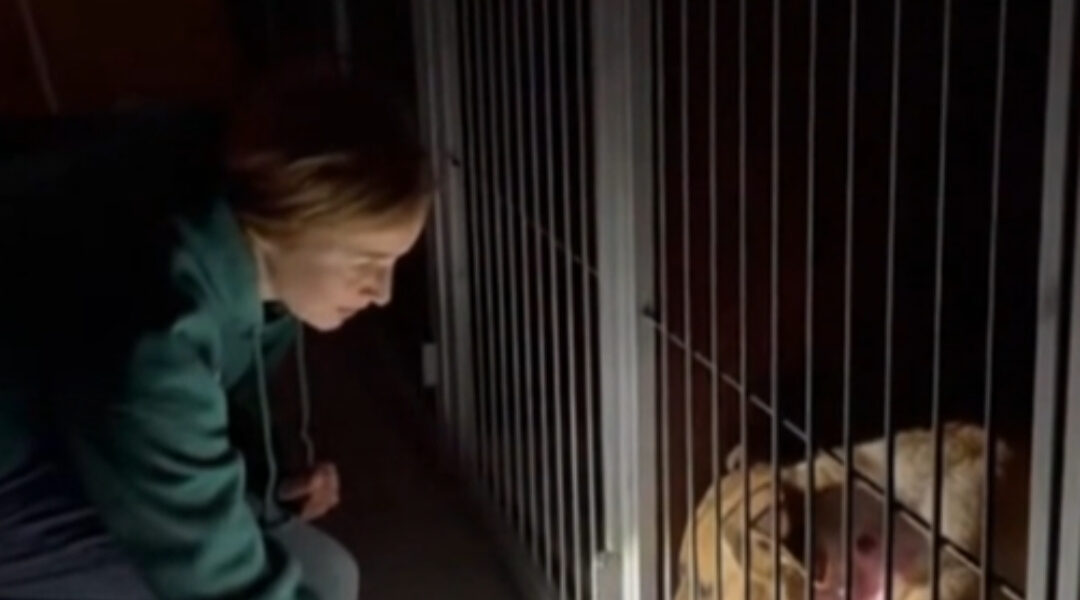
As thunder cracked overhead, Jamie made her way down the isolation hallway, flashlight in hand. The corridor felt narrower in the low light, the air heavier with tension and wet fur. She paused at each kennel, checking latches, murmuring soft words.
Then she stopped in front of the last door.
The dog sat in the back of her kennel, pressed against the wall like she was trying to disappear into it. Two amber eyes reflected the flashlight beam—alert, but empty of expectation.
“Hey,” Jamie whispered, crouching down. “It’s just me again.”
The dog didn’t move.
Jamie rested the flashlight on the floor so the beam spilled gently across the kennel instead of pointing straight at her. She knew better than to rush. She always did.
“I know,” Jamie said softly, fingers sliding through the metal bars, palm open. “I know you don’t owe anyone trust.”
Another low growl of thunder vibrated through the building. Somewhere down the hall, a dog began to howl, the sound raw and desperate. Volunteers’ voices echoed faintly as they tried to calm him.
The dog in front of Jamie didn’t flinch.
That scared her more than the noise.
“You’re too quiet,” Jamie murmured. “That’s what worries me.”
Minutes passed.
The flashlight warmed against the concrete. Jamie stayed crouched, legs aching, breathing slow and steady so she wouldn’t startle her. She talked—not because she expected a response, but because silence didn’t feel right.
“You’re safe here,” she said, though she knew the words were fragile. “No one’s tying you up tonight. No one’s leaving you behind.”
Still nothing.
Jamie blinked back tears, frustrated with herself. She had learned not to force moments like this. Animals came forward when they were ready—or not at all. And sometimes, the bravest thing you could do was simply stay.
Then, finally, the dog shifted.
It was subtle—just the lift of her head. Her ears tilted forward slightly. She crawled toward the front of the kennel, belly pressed low to the floor, stopping inches from Jamie’s hand.
Jamie’s breath caught.
“There you are,” she whispered, afraid that speaking too loudly might break whatever fragile thread had pulled the dog forward. “Hi.”
The dog hesitated. Her body trembled—not violently, but in small, controlled shivers, like she was holding herself together with sheer will. Slowly, cautiously, she lowered her chin.
And rested it on Jamie’s fingers.
Jamie didn’t move.
Didn’t breathe.
Didn’t dare hope too quickly.
The weight was light, barely there, but it was real. Warm. Alive.
“Oh,” Jamie breathed, tears finally spilling over. “That’s okay. You can stay right there.”
The dog didn’t pull away.
Thunder cracked again, louder this time, and rain hammered the roof. But inside that small circle of flashlight glow, the world narrowed to two beings who had both learned, in different ways, what it meant to endure.
“In this place,” Jamie whispered, voice breaking, “you don’t have to be afraid of being noticed.”
The dog’s eyes closed halfway—not in sleep, but in something like relief. Her breathing slowed. The trembling eased just a little.
For the first time since she had been found tied to that sign, she leaned into someone instead of bracing for what might come next.
Jamie stayed like that for a long time.
She thought about how many nights the dog must have spent alone. How many times she’d learned that silence kept her safe. How many times she’d been overlooked because she didn’t ask.
Outside, the storm raged on. Power crews would come tomorrow. Phones would ring. Paperwork would stack up. Adoptions would happen. Some animals would leave. Others would arrive.
But right now, none of that mattered.
Right now, there was a promise being made without words.
That silence didn’t mean invisibility anymore.
That stillness didn’t mean abandonment.
That this story—whatever pain had shaped it—was not finished yet.
Eventually, Jamie stood, careful not to startle her. The dog lifted her head reluctantly, watching as Jamie reached for the kennel latch.
“I’ll be back,” Jamie said softly. “I always come back.”
As she walked away, the flashlight beam swept the kennel one last time.
The dog didn’t retreat to the back.
She stayed near the door.
Waiting.
And in the darkness of a powerless building, during a storm that shook the city, that small, quiet choice felt like the beginning of something stronger than fear.
It felt like hope—learning, slowly, how to speak again.