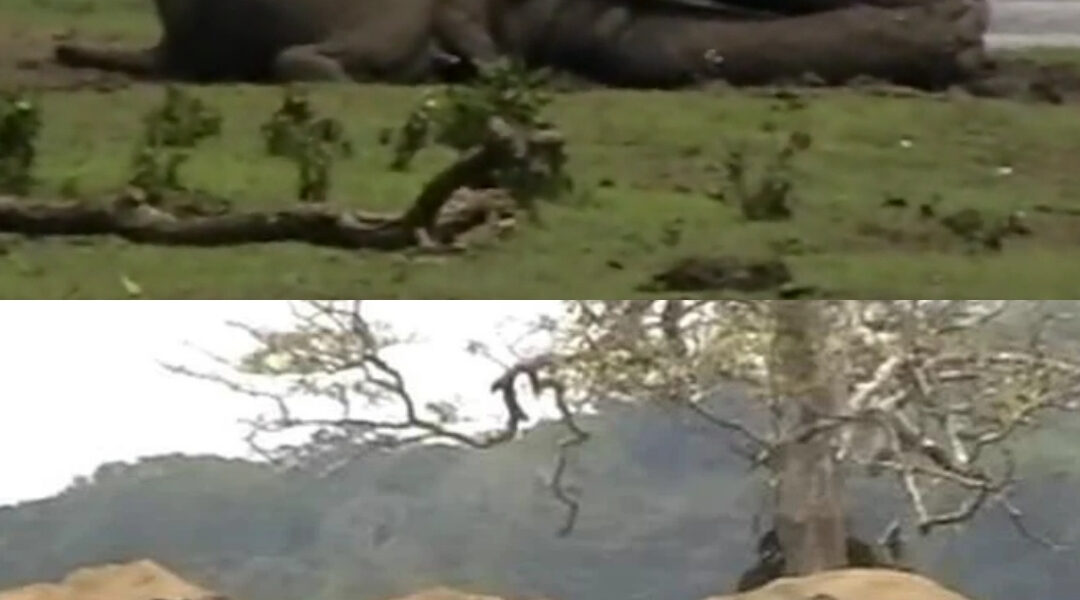
The morning air near the lake was heavy, as if the land itself sensed that something sacred was unfolding.
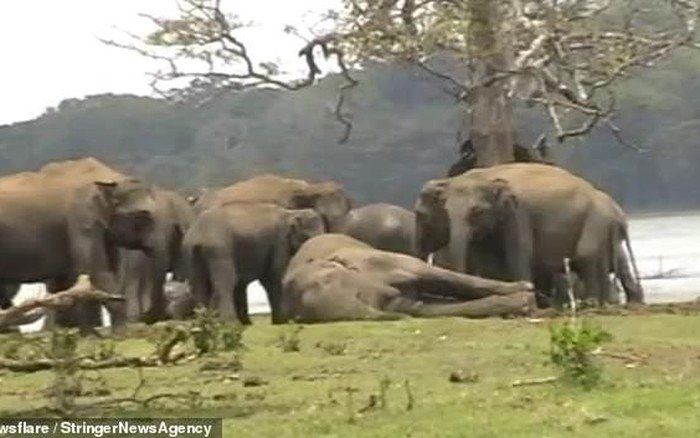
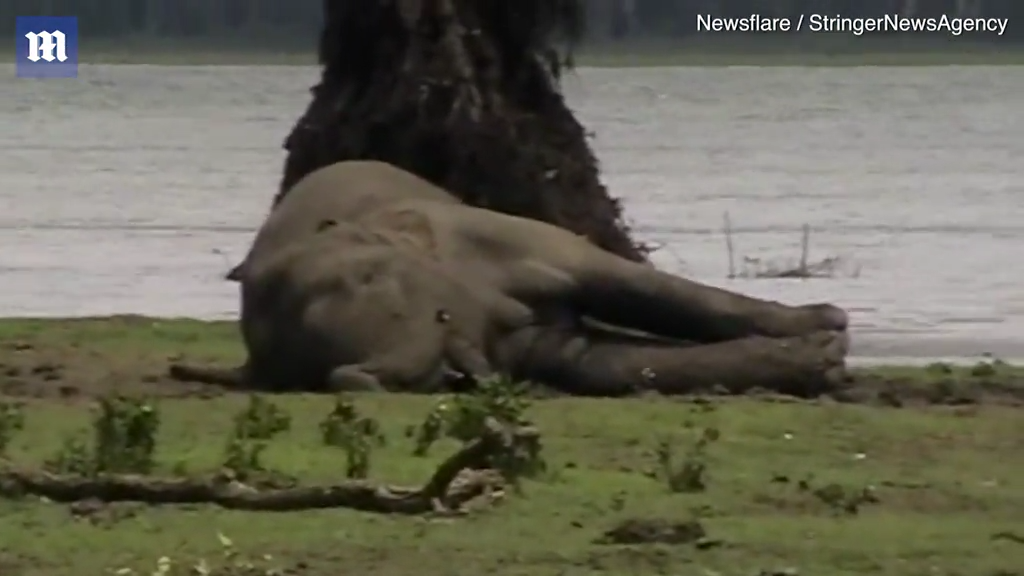
At the water’s edge lay the body of an elephant—massive, still, unmistakably absent of the life that once guided so many others. He had been a leader, a presence defined not by dominance alone, but by memory, experience, and the quiet authority that comes from years of survival. Now, after a violent clash with a rival, his journey had ended.
But his story was not finished.
From the surrounding forests and plains, elephants began to arrive.
At first, there were only a few—large silhouettes moving slowly, deliberately, as if drawn by something deeper than sound or scent. They approached without urgency, without fear. When they reached the fallen leader, they stopped.
And then they stayed.
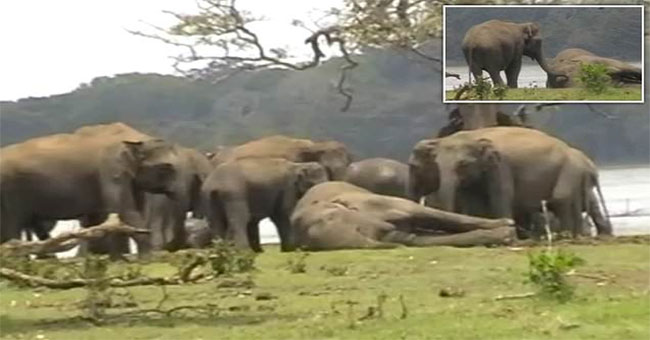
One elephant stepped forward and reached out with its trunk, touching the lifeless body with astonishing gentleness. Not probing. Not testing. Just touching—like a hand placed softly on the shoulder of someone you love. Another followed. Then another. Soon, a quiet circle formed around the body.
There was no chaos.
No trumpeting cries.
Only stillness.
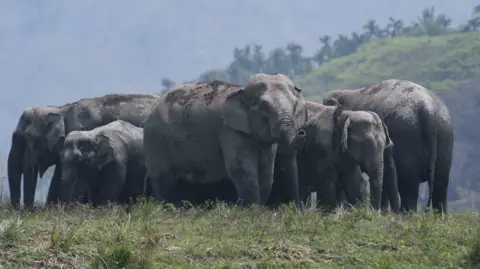
As time passed, more elephants arrived. What began as a small gathering grew larger and larger. Some reports would later say dozens came. Others said hundreds—perhaps as many as three hundred elephants standing together near the lake, drawn from miles away by an invisible call.
They did not push. They did not rush. They made space for one another.
Some elephants swayed gently from side to side, a behavior scientists have long associated with stress and emotional processing. Others stood motionless, ears slowly flapping in the heat. Calves remained close to adults, pressing their small bodies against massive legs, sensing the gravity of the moment without fully understanding it.
Every so often, a trunk reached out again—brushing the fallen leader’s face, his tusks, his side. It was not curiosity. It was recognition.
This was one of theirs.
Locals who witnessed the scene stood in stunned silence. Many had never seen anything like it. Cameras came out, but even those recording the moment lowered their voices instinctively, as if afraid to disturb something holy.
Because what they were watching was not just wildlife behavior.
It was mourning.
For years, scientists have studied elephants’ emotional intelligence, but moments like this make research feel almost unnecessary. Elephants remember. They recognize one another across decades. They form lifelong bonds. They grieve.
A 2006 study by Oxford University documented what many wildlife experts already believed: elephants respond to death in ways strikingly similar to humans. They visit the bodies of the dead. They touch bones. They linger. They return to the same places again and again, sometimes years later.
But perhaps most remarkable is this: elephants do not reserve grief only for immediate family.
They mourn distant relatives. Old companions. Even individuals from other herds—leaders they once followed, paths they once shared.
This leader mattered.
During his life, he would have guided migrations, remembered water sources during drought, sensed danger before others could. In elephant society, leaders carry history. When one falls, it is not just a loss of strength—it is a loss of memory.
And the herd felt it.
They stood beside him for hours.
Predators did not approach. The land seemed to pause. Even the water at the lake’s edge remained calm, reflecting the still forms of hundreds of elephants standing shoulder to shoulder in shared silence.
Some elephants placed their foreheads against his body. Others touched him once and stepped back, making room for the next. There was no single way to grieve. Each elephant honored him in its own way.
What struck observers most was what the elephants did not do.
They did not abandon him.
In the wild, survival demands movement. Water must be found. Food must be eaten. Calves must be protected. Staying too long in one place can be dangerous.
But on this day, the elephants chose to stay.
As if leaving too soon would mean forgetting.
As if presence itself was the final gift they could offer.
Eventually, as the sun climbed higher and the heat intensified, the herd began to shift. Not all at once. Slowly. Reluctantly. One group moved away, then another. Some turned back briefly, extending their trunks one last time before following the others.
Even in departure, there was care.
The leader was not erased. He was acknowledged.
When the final elephants left the lake, the space felt different—emptier, quieter, marked by what had just passed. Those who witnessed the farewell would carry it with them forever.
Because scenes like this challenge everything humans assume about animals.
They force us to confront an uncomfortable truth: grief is not uniquely human. Love is not limited by language. And loyalty does not end with death.
Elephants teach us that mourning is not weakness. It is evidence of connection. It is the price paid for belonging to something larger than oneself.
That fallen leader did not die alone.
He was surrounded by those who remembered him. Touched by those who followed him. Honored by those who loved him.
In a world that often rushes past loss, the elephants paused.
They stood together. They remembered. They said goodbye.
And in doing so, they reminded everyone watching of something deeply human, deeply humbling, and deeply true:
That love leaves a mark. That leaders live on in those they guided. And that some bonds are so strong, even the wild gathers to honor them.