
For most of his life, Suraj never saw the sun.

It’s a cruel irony, considering his name means “sun” in Hindi. But for more than four decades, Suraj’s world was defined not by light, warmth, or freedom—only darkness, chains, and silence.
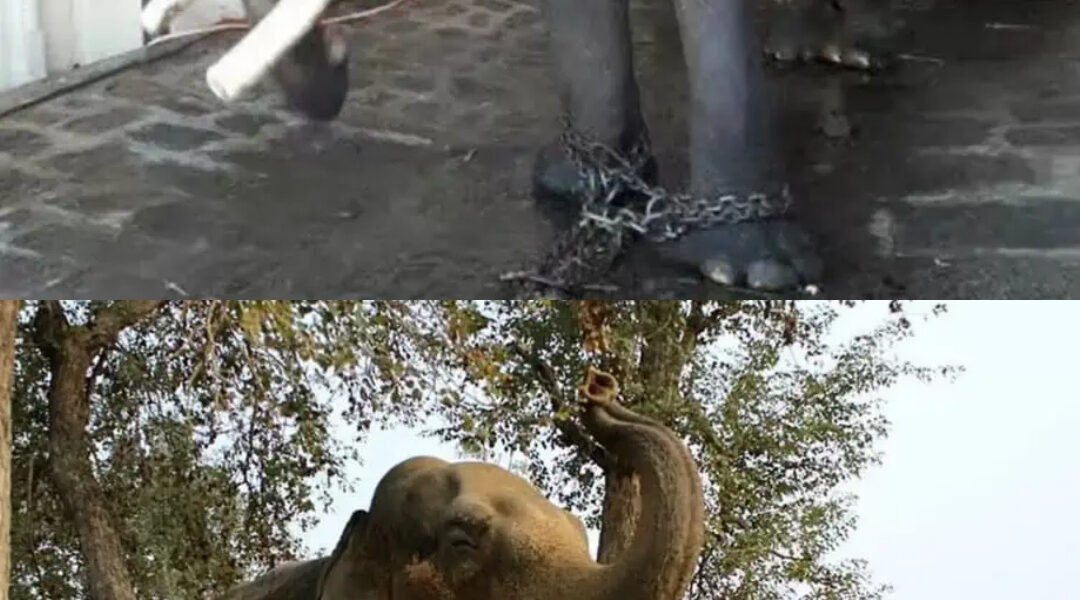
Suraj was born into captivity. As a young elephant, he was taken from the wild and forced into a life of service at a temple in Maharashtra, India. What should have been a life of roaming, family bonds, and social connection became instead a narrow, confined space where he spent day after day chained in the dark.
He stood alone.
Elephants are deeply social animals. They thrive on touch, communication, memory, and companionship. Deprived of these essentials, Suraj endured years of isolation that slowly broke both his body and spirit. His movements were restricted. His needs were ignored. His pain went unseen.

By the time Wildlife SOS learned of Suraj’s existence, he was 45 years old—and suffering.
The organization’s co-founder, Geeta Seshamani, immediately understood the urgency. What she discovered was not just neglect, but a lifetime of abuse hidden behind tradition and ignorance. Suraj was living in conditions that no animal—especially one as intelligent and emotionally complex as an elephant—should ever endure.
But rescuing him would not be easy.
The rescue mission stretched on for more than ten hours. Negotiations were tense. A hostile mob formed, determined to keep Suraj where he was. Some believed he belonged there. Others feared change. Many simply refused to acknowledge the suffering in front of them.
Still, the team did not give up.
They stood firm, hour after hour, advocating for an elephant who could not speak for himself. Local police and state forest officials eventually stepped in, escorting the Wildlife SOS team as they prepared for Suraj’s removal.

On December 20, 2015, the moment finally came.
For the first time in decades, Suraj was unchained.
He was carefully guided into an elephant ambulance—confused, cautious, but calm. As the vehicle pulled away under police escort, something extraordinary happened.
Suraj did not resist.
It was as if, deep down, he understood that this journey was different. That this time, he was not being taken to something—but away from pain.

When veterinarians examined Suraj after the rescue, the full extent of his suffering became heartbreakingly clear. His body bore the marks of long-term abuse: deep wounds from bullhooks, chronic lice infestations, severely infected eyes, and a missing left ear—likely torn away when he was poached as a baby.
These were not just injuries.
They were evidence of a lifetime spent without mercy.
Kartick Satyanarayan, co-founder of Wildlife SOS, later spoke openly about the tragedy of Suraj’s story. Although elephants are revered and worshipped in many temples, he explained, they are often kept in conditions that completely ignore their physical, psychological, and emotional needs.
Suraj was not an exception.
He was a symbol.

After his rescue, Suraj began a four-day journey to the Wildlife SOS Elephant Conservation and Care Center. Each mile carried him farther from the darkness and closer to something he had never truly known—freedom.
When he arrived, caregivers welcomed him with sugarcane and bananas. Gentle hands replaced chains. Kind voices replaced commands. For the first time in his memory, Suraj was treated not as an object—but as a living being worthy of dignity.
And something remarkable happened.
Suraj smiled.

Caretakers noticed it almost immediately. As he stepped into open fields, felt the sun on his skin, and rolled in cool mud baths, his expression softened. His eyes, once clouded with pain, began to brighten. His posture relaxed. His movements slowed, no longer stiff with fear.
He lingered in the sunlight.
He leaned into affection.
He explored.
Affectionately nicknamed the “handsome tusker,” Suraj quickly became a beloved presence at the sanctuary. He enjoyed long, unhurried walks through fields, regular baths, nutritious meals, and—perhaps most importantly—consistent love.
For an elephant who had spent decades in isolation, learning to trust again took time. But Suraj proved resilient. He responded to gentle care with quiet joy, forming bonds with his caretakers and embracing the simple pleasures he had been denied for so long.

Mud baths became his favorite ritual. He would sink into the cool earth, covering his scarred skin, letting the heat of past suffering wash away in moments of peace. Visitors and caregivers alike could not help but notice his constant, gentle smile—a reflection of an elephant finally at ease.
Suraj’s story is not just about rescue.
It is about awakening.
It is about what happens when cruelty ends and compassion begins. About the transformation that occurs when dignity is restored, even after decades of harm.
His rescue also shines a light on a much larger issue—the plight of temple elephants across India. Many remain confined, chained, and deprived, their suffering masked by tradition. Suraj’s freedom is a reminder that reverence without understanding can still cause harm.

Today, Suraj lives out his days in safety, comfort, and care. He may never regain the years he lost. But he has something infinitely valuable now.
Peace.
Freedom.
And the warmth of the sun—finally living up to his name.
Suraj’s smile is more than a charming detail. It is a testament to resilience. A quiet declaration that healing is possible, even after a lifetime of darkness.

And for everyone who hears his story, it carries a simple but powerful message:
It is never too late to choose compassion.