They say that among all creatures on Earth, elephants may have the strongest sense of family. Not because they live together, or travel in herds, or protect their young—but because when one of them is in danger, every instinct they have moves in one direction only: toward love, toward loyalty, toward rescue.

On a quiet day by a muddy riverbank, that instinct became the difference between life and death.
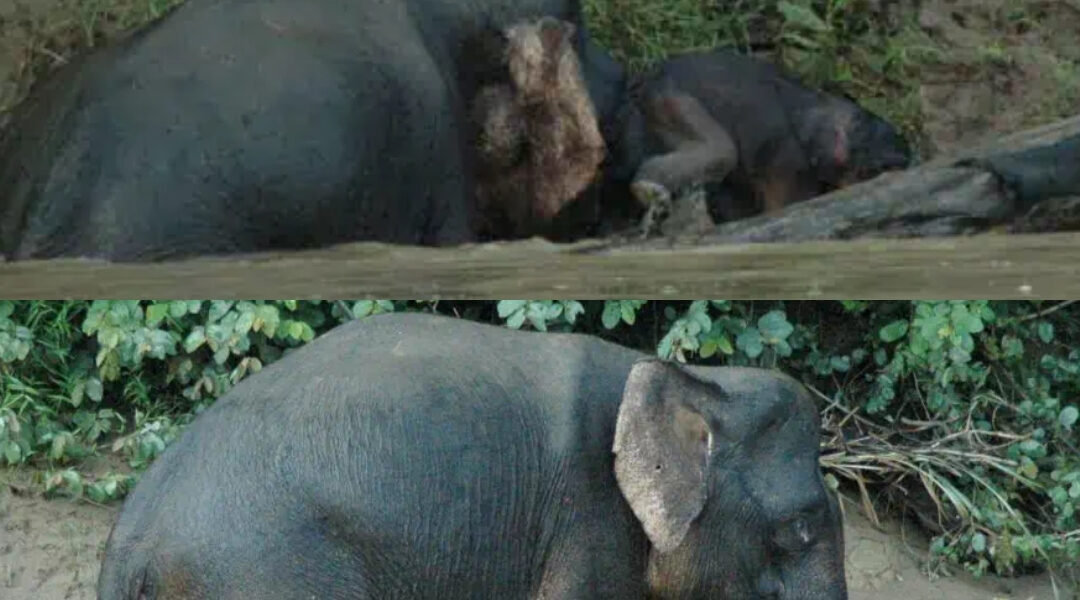
The river had already been crossed. For the adult elephant, the journey was uneventful—water up to her legs, current familiar, footing steady. But for the calf beside her, everything felt bigger, heavier, more dangerous. His legs were short. His balance untested. Every step took effort.
Still, he followed his mother, trusting her completely.
When they reached the opposite bank, the mother climbed easily onto solid ground. The slope was steep, but her weight and experience carried her forward without hesitation. She turned back, expecting her baby to follow.

He tried.
The moment his feet touched the muddy incline, they slipped. The ground beneath him was not soil, but slick, shifting sludge. He pushed forward, fell back, tried again—only to slide lower. Mud splashed across his legs, his chest, his face. Panic flickered in his eyes.
Then he cried out.
It wasn’t loud. It wasn’t dramatic. It was the soft, frightened sound of a child realizing the world beneath him was no longer safe.
His mother reacted instantly.
She rushed back down the slope, placing her massive body between him and the river below. With her trunk, she gently pushed at his side, trying to lift him upward. Once. Twice. Again. Each time, the calf gained inches—only to lose them as the mud betrayed him again.
The bank was too steep. The mud too slick. And the calf was growing tired.

As he slipped lower, the water crept closer. Just one more fall, one wrong movement, and the current could pull him back into the river. In his fear, he pressed himself against his mother’s legs, clinging as tightly as his small body could manage.
She did not leave him.
Again and again, she tried—pushing, lifting, bracing her feet into the ground. But even her strength had limits. This was not something she could solve alone.
And then, from the trees behind them, help arrived.
Two adult elephants emerged quietly from the forest. They were family—relatives bound not by chance, but by blood and memory. They had heard the distress. They understood immediately.
Without urgency, without chaos, they moved into position.
One stood beside the mother, lending weight and stability. The other began working the ground—pressing, flattening, shaping the mud with powerful feet and a careful trunk. They did not rush the calf. They did not pull him harshly. They changed the environment around him, turning danger into possibility.
Minute by minute, the ground became firmer.
The calf tried again.

This time, his foot held.
He took one step. Then another. He slipped—but not as far. Each attempt brought him higher. His breathing was heavy. His body was coated in thick brown mud. But still, he climbed.
His mother stayed so close that her shadow never left him. Every time he faltered, she touched him gently with her trunk, steadying him, encouraging him. I’m here. Don’t stop.
For nearly half an hour, the three adults worked together. Covered in mud. Muscles straining. Calm, focused, unwavering.
And finally—it happened.
The calf reached the top.
His small body trembled as he stepped onto solid ground. The moment he stood upright, his mother pressed against him, guiding him away from the edge. The other two elephants closed in, forming a quiet circle around him.

No celebration followed. No triumphant display.
Just stillness.
The calf leaned into his mother’s legs, exhausted, safe at last. Mud clung to every inch of him, but his life was intact. The danger was over.
A photographer who witnessed the scene described it as one of the most emotional moments he had ever observed in years of studying elephants. Not because it was dramatic—but because it was intimate. Raw. Honest.

Elephants live in tightly bonded matriarchal families. Adult females help raise calves, protect the injured, and care for the vulnerable. Calves remain with their mothers for years, sometimes for life. These bonds are not taught. They are inherited.
The calf that nearly slipped into the river would one day grow enormous—nearly ten feet tall, weighing several tons, consuming hundreds of pounds of food each day. But on that muddy riverbank, he was nothing more than a frightened child, saved by the unwavering devotion of his family.
And for those who watched, it was a quiet reminder.
That love does not always roar.
That rescue does not always look heroic.
That sometimes, the greatest acts of compassion happen without words, without witnesses—guided only by instinct and an unbreakable bond.

In that moment, beside a river of mud and danger, a family chose not to move on.
They chose to stay.
They chose to help.
They chose each other.
And because of that, a small life continued on—muddy, shaken, but alive.