
There are moments in war that never make the headlines.

No speeches.
No flags.
No victory music.
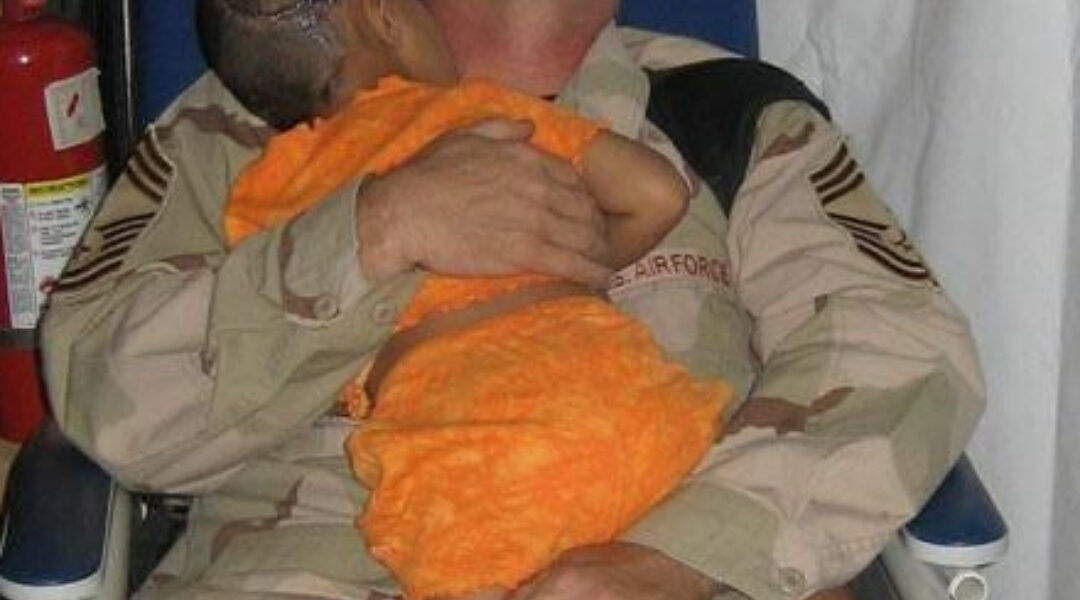
Just a chair, a tired man in uniform, and a child who should not be alive.
Chief Master Sgt. John Gebhardt was already exhausted. The kind of exhaustion that settles into the bones after too many nights without sleep, too many scenes the mind refuses to forget. Iraq was loud by day and louder by night — helicopters, alarms, distant explosions — but inside the medical tent, the noise faded into something else entirely: breathing, crying, and the quiet urgency of survival.
That was where she came to him.
She was tiny. Much too small to understand what had happened to her world. Insurgents had stormed her family’s home. Her parents were executed. Her siblings were killed. And then, as if mercy had briefly hesitated, a bullet struck her head — meant to end her life too.
It didn’t.
She arrived at the hospital wrapped in blood-soaked cloth, her body trembling, her cries sharp and relentless. Surgeons worked quickly. Nurses moved with practiced urgency. Against all odds, the infant survived.
But surviving was not the same as being at peace.
Night after night, she cried. She moaned. She startled awake as if still hearing the gunfire. No amount of medicine or gentle rocking seemed to help. The nurses tried everything — and then they noticed something strange.

When John held her, she calmed.
Not instantly. Not magically. But enough. Enough to breathe slower. Enough to rest her head against his chest. Enough to sleep.
So John stayed.
He didn’t have to. No one ordered him to. There was no protocol for this. But every night, when the lights dimmed and the hospital settled into that fragile quiet only war hospitals know, John sat down in a simple chair, cradled the injured child in his arms, and slept there with her.
Four nights in a row.
No bed. No relief. Just a chair and a promise his heart made before his mind could stop it: You will not be alone.
The nurses watched it happen again and again. They whispered about it. They said he was the only one who could calm her. That the moment she felt his arms around her, the crying eased. As if her body recognized safety before her mind ever could.
John didn’t speak about it. He didn’t see himself as a hero. He was a father back home. He knew what it meant to hold a child who trusted you completely — and he knew what it meant to imagine losing one.
So he held her.

The uniform he wore that night was not a symbol of power. It was stained with dust, sweat, and the weight of too many losses. But to that child, it was something else entirely.
It was warmth.
It was steadiness.
It was life.
His wife, Mindy, later explained what few people knew at the time: this little girl had lost everyone. She had entered the world of memory without a single familiar face left. And yet, in the middle of war, she found arms that refused to let go.
Each night, John slept lightly, instinctively adjusting when she shifted, tightening his hold when she whimpered. He woke when she cried. He stayed when others rotated out. There were no cameras then. No speeches. Just a man doing what felt necessary.
She is healing now.
Slowly. Painfully. But she is alive.
And that matters.
Some will argue endlessly about war — about politics, strategy, mistakes, and motives. Those arguments have their place. But they cannot erase this moment.
A moment where compassion crossed borders.
Where humanity stood taller than violence.
Where a child, meant to be erased, was instead protected.
John Gebhardt will likely never call himself a hero. People like him rarely do. But heroism is not always loud. Sometimes it looks like a man asleep in a chair, holding a child who has no one else left in the world.
If you ever wonder whether kindness still survives in the darkest places — remember this.
Remember that even in war, there are moments that save more than lives.
They save hope.
And sometimes, that hope fits perfectly into the arms of someone who refuses to let it fall.